
In 2004, Patrick Le Lay, then chief executive of TF1, summed up the television business model with a now infamous remark: selling “available human brain time” to Coca-Cola.
At the time, the comment caused outrage; twenty years later, it describes the economic model underpinning much of today’s media industry. Google, Meta, TikTok, YouTube, Netflix, television broadcasters, streaming platforms and independent creators are all pursuing the same goal: capturing, retaining and monetising attention.
Attention is a scarce economic resource. It is constrained by both the amount of time available and by our cognitive capacity. It is also subject to rivalry: spending time on one piece of content necessarily means not consuming another at the same moment. The number of platforms, formats and content offerings can grow indefinitely, but the time available to consume them cannot.
Yet even as content supply continues to expand, attention itself cannot increase. The ability to monetise that attention – and therefore to finance content creation – is coming under pressure.
Consumers are becoming more selective about their subscriptions and increasingly question the value offered by content libraries, even as the investments required to stand out (production, rights acquisition, marketing and distribution) have never been higher.
This creates a new tension: how can the industry continue to fund content creation and maintain acceptable profitability when demand remains essentially unchanged and supply has exploded?
That tension now shapes the entire media landscape.
The two-sided platform model
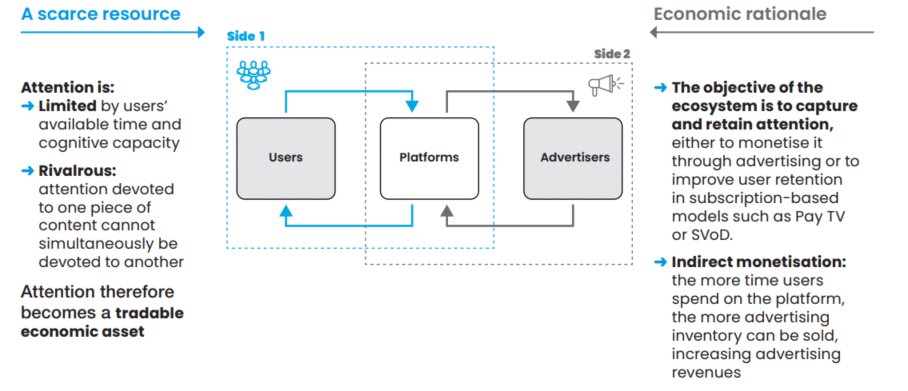
➜ In the digital age, the key strategic question becomes whether to compete on a playing field that is media-driven, creative, or both.
A market no longer growing through additional screen time
The central fact is simple: attention is not infinitely expandable.
In the United States, average screen time reached around six hours per day in 2025 and appears to have plateaued. In France, daily media consumption stands at roughly 4 hours and 14 minutes. Usage patterns continue to evolve, but the total volume of available attention is growing only marginally.
Competition between Netflix, YouTube, TF1, TikTok, Prime Video and Instagram increasingly revolves around reallocating attention rather than creating more of it. Every minute gained by one player is a minute lost by another.
This redistribution is particularly visible across generations.
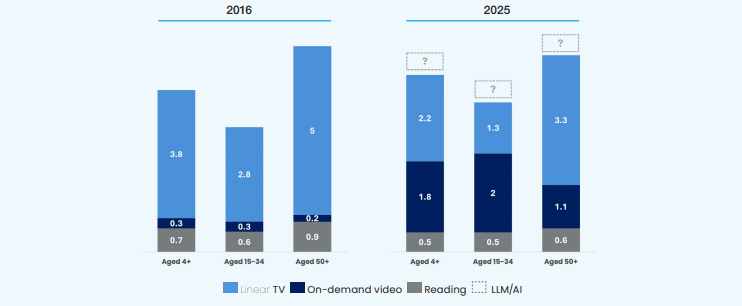
Among French 15–24-year-olds, a substantial share of media consumption is now concentrated on social platforms, with smartphones serving as the primary screen and short-form content as the dominant format. In the United States, Generation Z spends significantly less time than the average consumer watching traditional television and subscription video- on-demand services, while devoting far more time to social media.
Older generations, by contrast, remain closely attached to linear television. Among Boomers and older viewers, TV still accounts for a substantial share of video consumption, with subscription habits and loyalty patterns markedly different from those of younger audiences.
The result is the coexistence of two media worlds: one still structured around television schedules and established brands; the other shaped by platforms, algorithms, content creators and on-demand consumption.
And these figures do not yet account for time spent interacting with large language models, which is likely to grow and further reshape the balance of attention.
Average daily time spent by activity and by age group (hours/day)
Four business models competing for the same resource
Faced with a fixed resource – attention – four broad categories of media companies have developed distinct economic models.
- Linear television
The first is linear television. Historically, its model has been advertising-led (for free-to-air broadcasters): content is offered free of charge, audiences are aggregated and then sold to advertisers. Despite an ageing audience, television retains powerful advantages: mass reach, older audiences that appeal to sectors such as automotive, insurance and financial services, live events, shared cultural moments, advertiser trust and the ability to sustain premium CPMs. - Subscription video-on-demand
The second is subscription video-on-demand (and, to a lesser extent, Pay TV). Players such as Netflix, Disney+ and Apple TV+ built their businesses around subscription revenues. Yet the model is evolving rapidly. Advertising is becoming increasingly important through lower-priced, ad-supported tiers. Streaming is gradually moving towards a hybrid structure: premium subscriptions without advertising on one side, lower- cost ad-supported offers on the other. - Hybrid players
The third category comprises hybrid players, such as Canal+, Prime Video and, potentially, Netflix. Their strategy is based on aggregation, bundling and the distribution of complementary services. They combine subscriptions, proprietary content, third-party offerings and advertising with the aim of becoming the preferred gateway to multiple content ecosystems. - User-generated content
The fourth category consists of UGC (user- generated content) platforms such as YouTube, TikTok and Instagram. Their business model relies primarily on targeted advertising, powered by data, while generating additional revenue through premium subscriptions, in-app purchases and creator services.
These four models differ economically, yet all compete directly for the same resource: users’ available time.
YouTube is no longer a secondary digital medium
Within this new landscape, YouTube occupies a unique position.
Once simply a home for tutorials, amateur videos and short-form mobile content, the platform has become a mass-market media powerhouse whose advertising scale rivals and, in some cases, exceeds that of many traditional broadcasters.
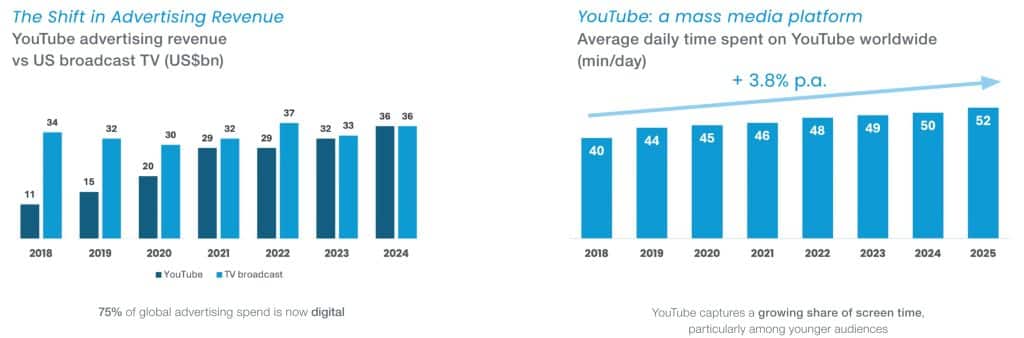
Its advertising revenues now surpass those of major American television groups. More importantly, viewing habits have shifted. In the United States, connected TV has become the primary screen for YouTube viewing. In Europe, the platform has forged numerous partnerships with traditional broadcasters, including France Télévisions and the BBC.
Instead of competing with television in digital spaces, YouTube has entered the living room, secured a place on the household’s main screen and combined some of television’s strengths with the advantages of a digital platform: personalisation, algorithmic recommendations, vast content depth, global reach and data-driven monetisation.
The boundary between television and platforms is becoming increasingly blurred, favouring players capable of attracting and retaining audiences over the long term.
Nevertheless, YouTube is still not able to pre-finance content in the way traditional broadcasters and SVoD platforms do. But for how much longer?
The rise of the creator economy
The shift in advertising spend towards digital channels has given rise to a new category of player: content creators.
Only a few years ago, major media groups competed largely among themselves within a relatively limited market. Today, content supply is virtually limitless, and media companies face competition from millions of independent creators capable of producing, distributing and monetising content without relying on traditional gatekeepers.
The creator economy is expected to reach several hundred billion dollars in value over the coming years, with its growth resting on three pillars: the democratisation of production tools, lower barriers to entry through digital platforms, and the rise of short- form content.
Growth of the global creator economy market (USD bn)
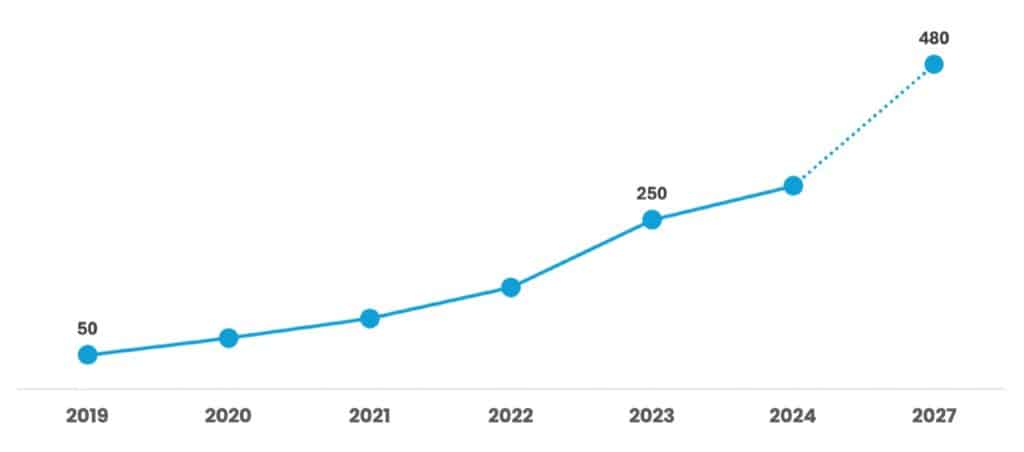
➜ 67 million creators in 2025 (+10% per year), driven by the rapid growth of digital advertising revenues.
➜ Short-form formats and digital platforms are lowering barriers to entry, enabling a growing number of amateur creators to enter the market.
For the first time, an individual with little more than a smartphone, an engaged community and a deep understanding of platform dynamics can compete with organisations that historically enjoyed vastly superior budgets, teams and distribution capabilities.
Content creator monetisation is generally based on three revenue streams: platform payments through advertising revenue sharing or creator funds; audience support through donations, subscriptions and paid communities; and brand partnerships through influencer marketing, affiliate programmes, licensing and co-creation.
Yet this economy remains highly concentrated. A small minority captures most revenues, while the majority generate only modest income, particularly given the lack of pre-financing from social networks or YouTube.
The creator economy therefore expands the competitive field dramatically without eliminating concentration. It simply relocates it.
Content creators are capturing an ever larger share of audience attention and now compete directly with traditional media groups, not only for viewers, but also for advertising budgets and talent.
However, far from creating a permanent divide between creators and established media, this shift is ushering in a new phase of convergence, in which audience relationships, production and distribution are being reconfigured.
Content creators are moving back towards traditional media
One of the most intriguing developments is the growing desire among leading content creators to engage with traditional media.
For years, they built audiences by bypassing broadcasters, producers, distributors and other established intermediaries. Today, many of the most successful are reconnecting with those very institutions.
Inoxtag’s Kaizen demonstrated how a content creator can produce a major cultural event, beginning on YouTube before being picked up and amplified by traditional media. In the United States, MrBeast’s Beast Games on Amazon Prime Video illustrates the same phenomenon: an audience built on a platform becomes the foundation for a premium format distributed by a global streaming service.
The trend extends beyond video entertainment too. Léna Situations, for example, embodies the ability of certain content creators to move from digital influence into mainstream culture. Her reach now spans events, fashion, branded collaborations, magazines, television and the luxury sector.
There is no contradiction here. Rather, it reflects a maturing market.
Content creators bring audience reach, editorial agility and community engagement, while media groups still possess critical assets: funding capacity, production expertise, established distribution networks, credibility, access to talent and robust commercial and legal structures.
Convergence between the two worlds is therefore increasingly logical. Creators seek scale; media companies seek to reclaim attention that has migrated elsewhere.
Consumption habits change but fundamentals endure
Beneath the rapid transformation of consumption patterns, one constant remains: enduring value is built around strong brands.
Programmes such as Star Academy and Koh-Lanta illustrate this clearly. They regularly outperform the average TF1 primetime slot because they have become established brands. They create anticipation, shared cultural memory and opportunities for long- term commercial development. Like franchises, they can be adapted, extended and monetised across international markets.
A strong brand turns a programme into an asset. It enables repeat broadcasts, extensions, adaptations and long-term monetisation. It reduces creative and commissioning risk and increases catalogue value.
The strongest content creators are increasingly applying the same logic. Rather than simply publishing content, they are building personal franchises: recurring formats, recognisable identities, editorial universes, merchandise, events, brand partnerships and owned communities. Their most valuable asset is not their YouTube channel, Instagram account or TikTok profile: it is their brand. Platforms distribute. Brands create durable value.
This is perhaps the most important lesson of the media industry’s ongoing reconfiguration. Technologies evolve and behaviours change, but the fundamental economics remain strikingly consistent. What endures is the ability to create loyalty, differentiation and repeat engagement.
Yet building strong brands and lasting franchises is becoming increasingly expensive. In an overcrowded market, the challenge is financial: how much must be invested to break through the noise, endure and remain profitable?
The investment battle
The race for premium content is intensifying this dynamic.
Estimated annual content spending by leading global players (US$bn)
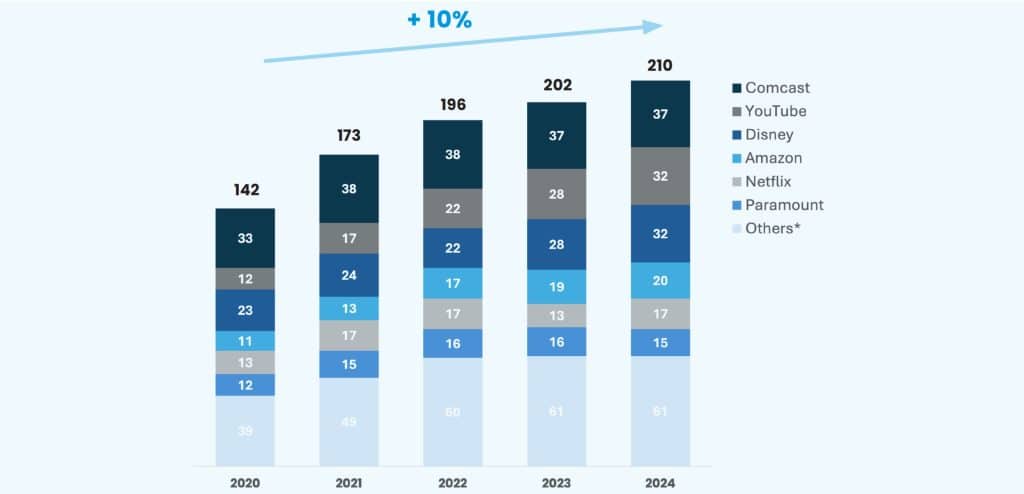
The race for premium content is increasing capital requirements: only players able to invest heavily in quality and visibility can establish meaningful presence
* Others include Meta, Warner Bros. Discovery, Spotify, Fox, Apple, and Sony
Source: KPMG, The future of content spend and business models in Media
In 2024, the industry’s leading global players invested more than $200 billion in content. The rationale is straightforward: in a saturated environment, only content capable of standing out meaningfully can capture significant attention.
But this logic creates mounting economic pressure.
Platforms and media groups continue to spend more on production, talent, rights, formats and visibility. At the same time, many subscribers increasingly question whether content libraries justify the prices being charged.
The industry is therefore caught between two imperatives: investing more in order to remain relevant while preserving acceptable profitability in a market where consumers are becoming more selective.
The resulting pressure on costs explains the growing appeal of shorter formats, more flexible production models, partnerships with creators, the use of artificial intelligence in selected production and optimisation processes, and increasingly industrialised approaches to content creation.
Visibility becomes a barrier to entry
The explosion in content supply has created another critical challenge: visibility. Producing content has never been easier; making it visible has never been harder.
Netflix hosts thousands of titles. Hundreds of hours of video are uploaded to YouTube every minute. TikTok, Instagram and streaming platforms confront users with an abundance that vastly exceeds their capacity to choose and consume.
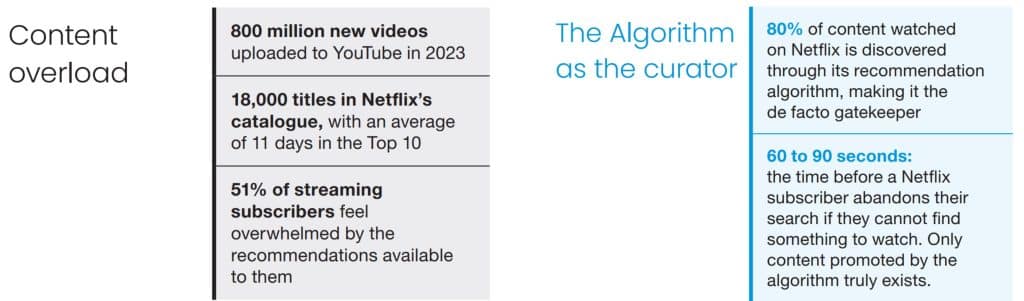
The challenge is therefore twofold: ensuring discoverability and capturing attention quickly.
This is hardly a new problem: outdoor advertising groups such as JCDecaux have long faced a similar challenge, relying on increasingly sophisticated technology and creativity to capture the attention of passers-by.
In this environment, the algorithm has become the new commissioning editor. A substantial proportion of content consumed on major platforms is driven by recommendations rather than active user searches.
This changes the rules fundamentally. Exposure no longer depends solely on broadcast schedules, advertising campaigns or transmission slots. It depends on being recommended, promoted, clicked on, watched for long enough and then fed back into algorithmic recommendation loops.
In other words, visibility itself has become a cost of market entry.
Achieving it requires investment in marketing, data, editorial optimisation, talent, production, distribution and, at times, paid media. In a saturated market, creating content is no longer sufficient. Discoverability must also be financed.
This dynamic naturally strengthens those players with the resources to invest at scale.
Consolidation will be difficult to avoid
Against this backdrop, consolidation among producers, distributors and even media operators appears increasingly inevitable.
If visibility requires ever-greater investment, if premium content becomes a prerequisite for relevance and if distribution remains concentrated in the hands of a few dominant platforms, fragmented players will find it increasingly difficult to compete independently.
The most successful creators will seek partners capable of providing funding, structure and distribution. Producers will need greater scale to negotiate effectively, invest confidently and absorb risk. Distributors will have to redefine their role beyond simple intermediation. Platforms, meanwhile, will continue to strengthen their position at the centre of content discovery.
The creator economy is not replacing traditional media, but it is forcing them to evolve.
Similarly, traditional media are not eliminating content creators. Instead, they will seek to incorporate creators’ ability to capture attention, engage communities and build powerful personal brands.
The result is a progressive restructuring of the value chain, in which the boundaries between producer, broadcaster, platform, creator, brand and distributor become increasingly blurred.
Conclusion: Everything has changed, and nothing has
The surface-level rules have changed.
Consumption has fragmented. Platforms have reshaped access to audiences. Content creators have become competitors and, increasingly, partners of traditional media. Algorithms have moved to the centre of distribution. Visibility has become a capital-intensive challenge.
Yet the underlying forces remain remarkably stable.
Attention remains the scarce resource. The brand remains the primary asset. Investment capacity remains decisive. Distribution remains a source of power. And durable value continues to concentrate around franchises capable of transcending platforms, formats and generations.
The battleground has expanded beyond television to encompass global platforms, media groups, producers, content creators, brands and algorithms. But the objective remains unchanged: capture attention, build an audience and convert that audience into value.