

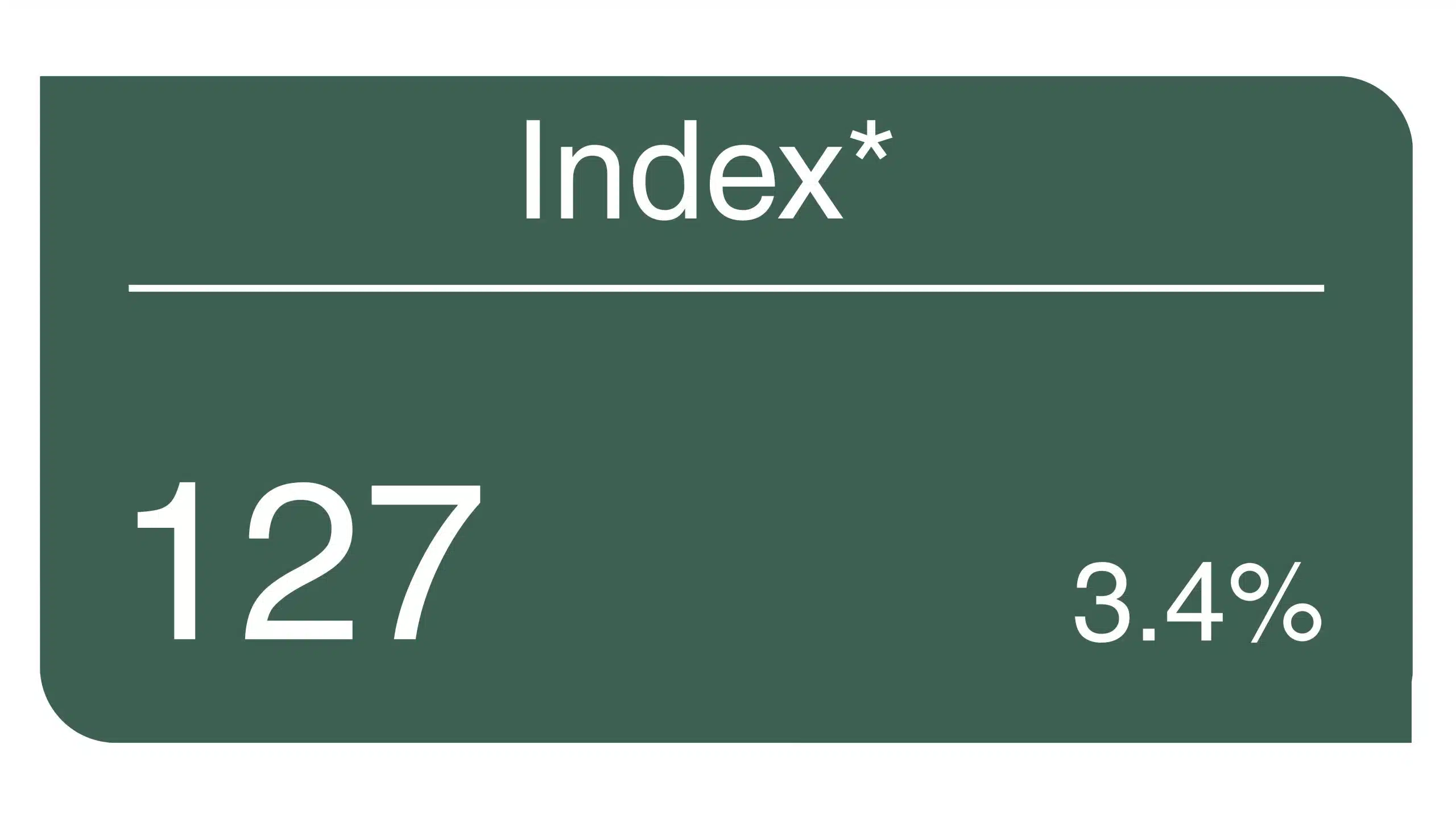
The Accuracy View
European hospitality has moved from broad-based recovery to selective outperformance. Southern Europe and Luxury & Upper Upscale continue to lead, supported by resilient leisure demand, events and pricing power, while Germany remains more constrained. With occupancy already normalising at high levels, future value creation will increasingly depend on rate, mix, operational efficiency and asset quality rather than volume growth alone.
1. Growth broadened beyond the Q1 event-driven boost, with Q2 performance increasingly
supported by underlying demand. Southern Europe remained the clear outperformer, led by
Spain and Italy, while France improved and Germany continued to lag. The shift from rateled to more balanced occupancy and pricing growth suggests a healthier, albeit uneven, market backdrop.
2. Luxury & Upper Upscale remained the strongest-performing segment for a fifth consecutive
quarter. Its sustained premium over midscale categories increasingly points to structural
advantages – international demand, lower price sensitivity and stronger pricing power –
rather than a temporary cyclical effect.
3. Hotel demand continued to outpace aviation growth, highlighting the resilience of domestic and intra-European travel. Southern leisure markets remain best positioned, while slower long-haul traffic is limiting incremental demand in more internationally exposed destinations.
4. Cost and regulatory pressures continue to constrain margin conversion, particularly in the UK and mid-market segments. At the same time, investment liquidity is returning selectively, with capital concentrating on prime and value-add assets. The widening gap between asset-level performance increasingly suggests that location, product quality and operational execution will determine both earnings and valuation outcomes.
Accuracy Index – Q2 2026
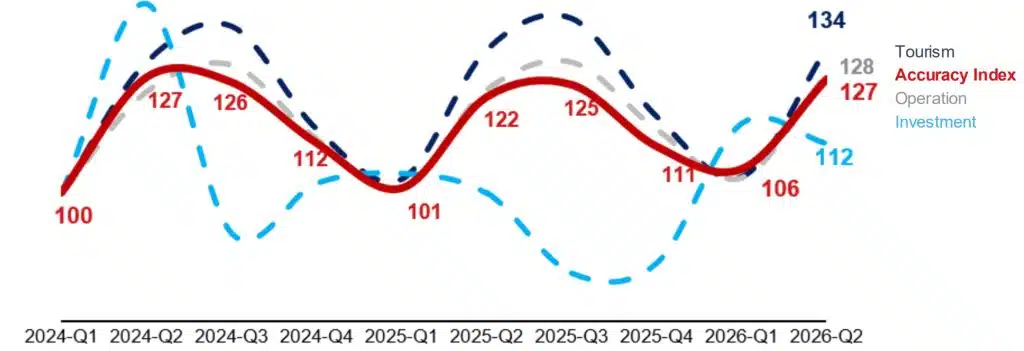
Sources: Mergermarket, CoStar, EuroStat and Accuracy analysis
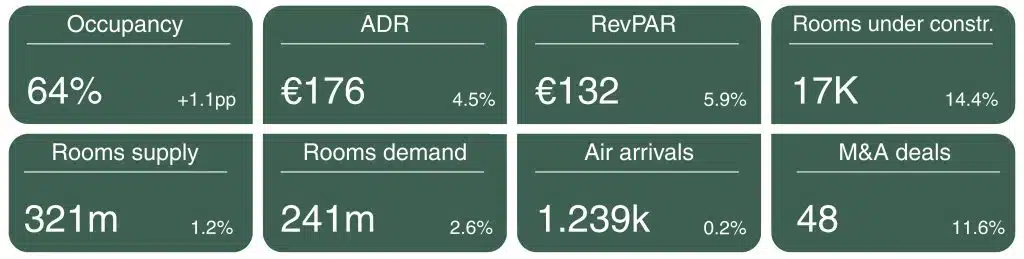
OPERATIONAL PERFORMANCE
France: pricing power increasingly differentiates hotel performance
Evolution of occupancy (in %)
Evolution of RevPAR (in €)
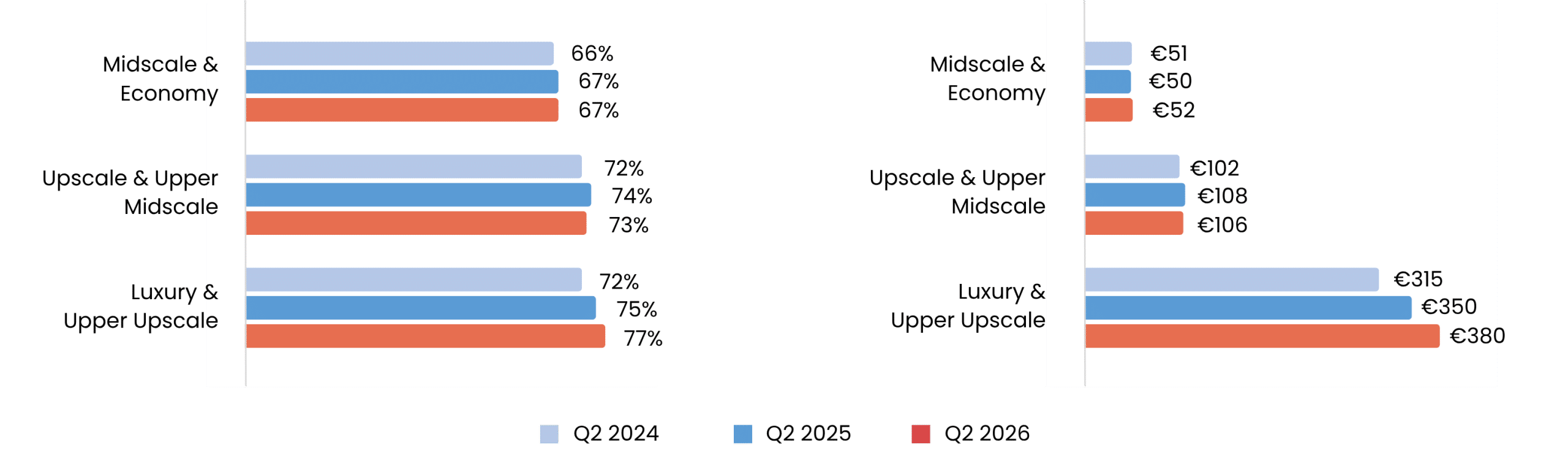
Sources: CoStar and Accuracy data analysis
The French hotel market remained resilient in Q2 2026, but performance is becoming increasingly
polarised. In Paris, Luxury & Upper Upscale hotels continue to benefit from strong pricing power,
resilient international demand and a supportive events calendar (notably Roland Garros), driving
RevPAR to €380 (+8.6% YoY). By contrast, mid-market performance remains softer, reflecting
greater price sensitivity and continued pressure on corporate travel budgets. Beyond Paris, improving leisure demand and the gradual recovery of business travel are both supporting growth, suggesting that value creation is increasingly driven by segment positioning, pricing power and demand mix rather than broad-based market expansion.
Germany : flat RevPAR puts the focus on margin preservation
Evolution of occupancy (in %)
Evolution of RevPAR (in €)
Sources: CoStar and Accuracy data analysis
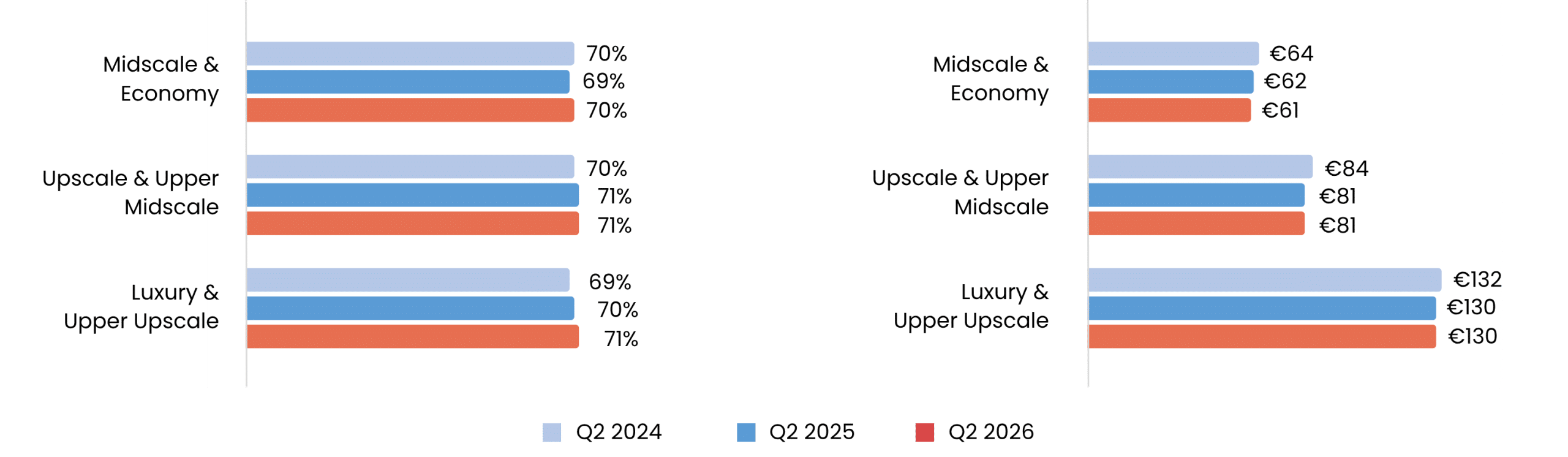
Germany remained stable but lacked momentum in Q2 2026. Occupancy was resilient across all segments at around 70–71%, highlighting a broadly healthy demand base. However, limited pricing power and a less supportive events calendar kept RevPAR broadly flat. With limited top-line growth, rising labour and operating costs are increasingly shifting the focus from revenue generation to margin preservation, particularly in the more cost-sensitive mid-market segments.
Italy : resilient demand sustains one of Europe’s strongest hotel markets
Evolution of occupancy (in %)
Evolution of RevPAR (in €)
Sources: CoStar and Accuracy data analysis
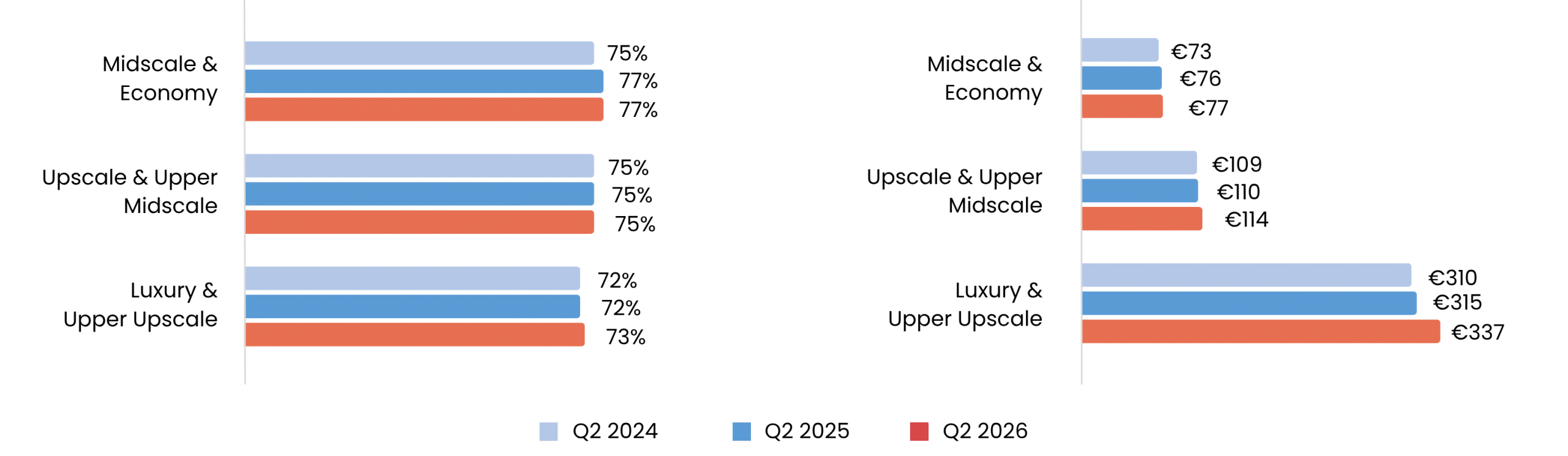
Italy remained one of the strongest-performing markets in Q2 2026 despite normalisation following the Milano-Cortina boost. RevPAR growth remained positive across all segments, led by Luxury & Upper Upscale at €337 (+7.0% YoY), highlighting continued pricing power at the top end of the market. More moderate growth in Upscale and Midscale & Economy suggests a gradual return to underlying trading conditions rather than a sharp post-event correction. With occupancy remaining healthy across segments, Italy continues to benefit from a structurally supportive leisure and international demand mix, providing a stronger platform for rate growth than most other European markets.
Spain: strong demand shifts the growth story from volume to value
Evolution of occupancy (in %)
Evolution of RevPAR (in €)
Sources: CoStar and Accuracy data analysis
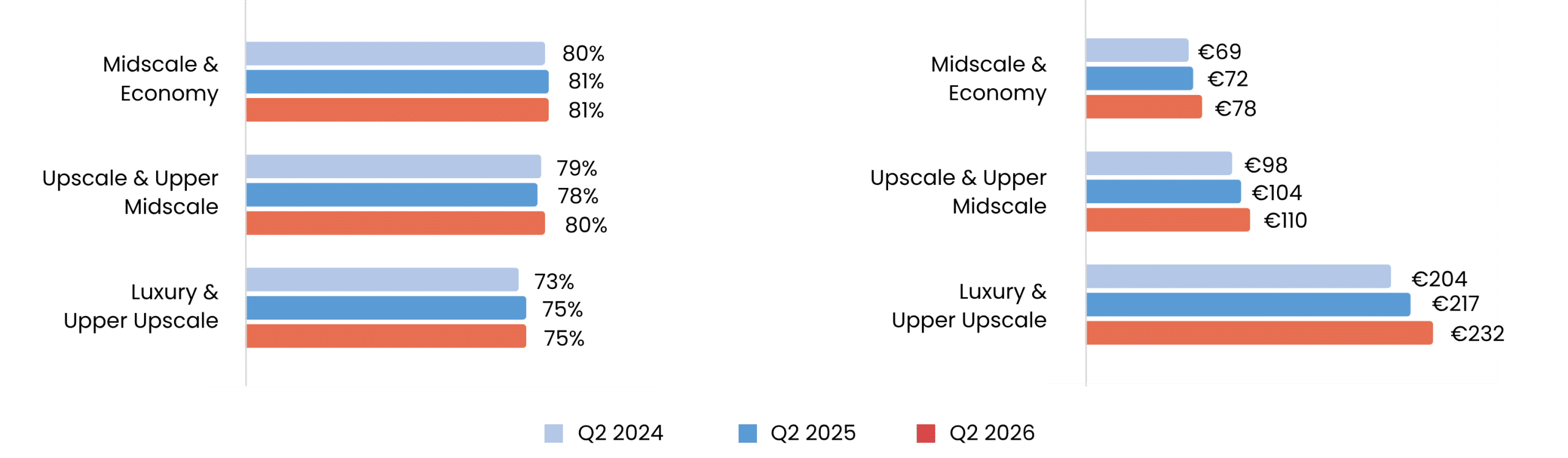
Spain maintained strong momentum in Q2 2026, supported by resilient domestic and international demand and continued pricing power across the hotel spectrum. RevPAR increased across all segments, led by Luxury & Upper Upscale at €232 (+6.9% YoY), while Midscale & Economy also recorded solid growth to €78 (+8.3%), supported by occupancy above 80%. The key shift is increasingly from volume to value: tourism spending continues to outpace visitor growth, while Mediterranean destinations and major urban markets remain the main growth engines. With occupancy already at high levels, further upside is likely to depend increasingly on rate, mix and revenue management rather than additional volume growth.
UK: revenue momentum returns, but margins remain under pressure
Evolution of occupancy (in %)
Evolution of RevPAR (in €)
Sources: CoStar and Accuracy data analysis
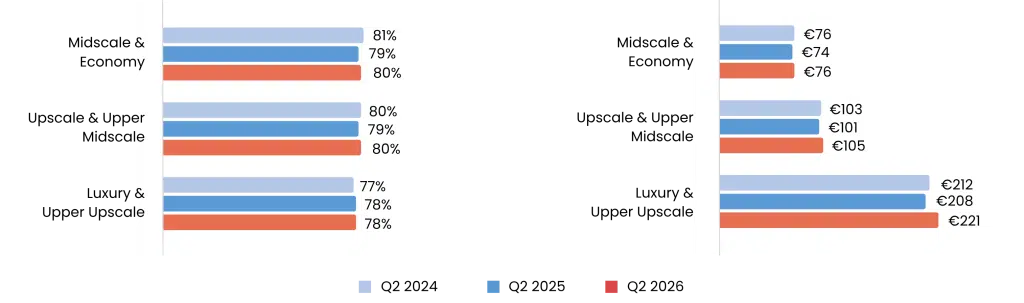
UK hotel performance rebounded in Q2 2026, with RevPAR growth across all segments and occupancy returning to around 80%, highlighting resilient underlying demand. Luxury & Upper Upscale led the recovery at €221 (+6.3% YoY), while Upscale and Midscale & Economy also posted solid gains. However, the key challenge is increasingly shifting from revenue generation to profit conversion: April’s wage increase and business rates revaluation have reset the sector’s cost base higher, while energy and other operating expenses remain elevated. As a result, positive top-line momentum is likely to translate only partially into EBITDA growth, with operators increasingly focused on pricing discipline, productivity and cost control.
INVESTMENT PERFORMANCE
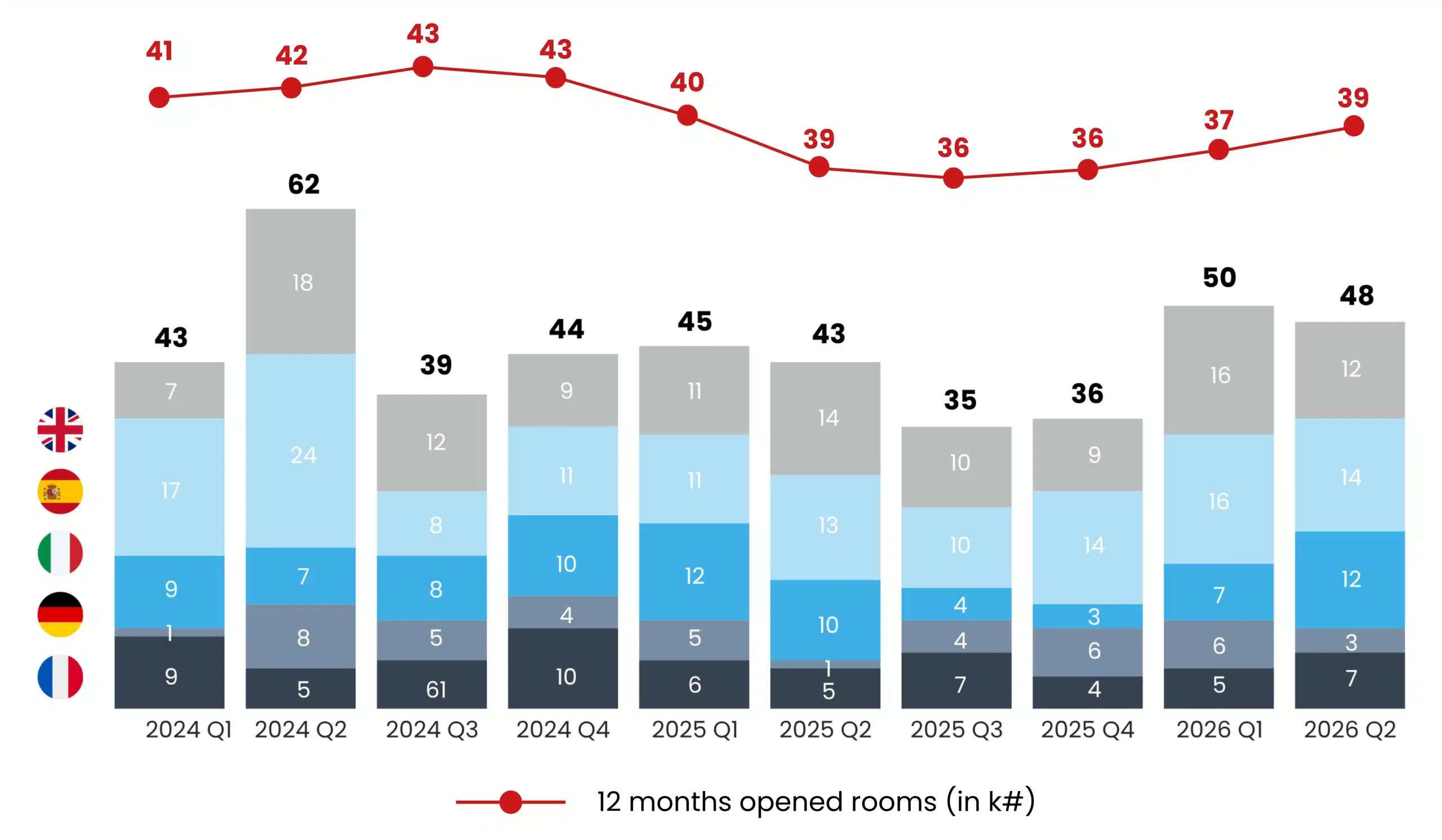
Number of hotel transactions vs. 12-month room openings
Sources: Mergermarket and CoStar
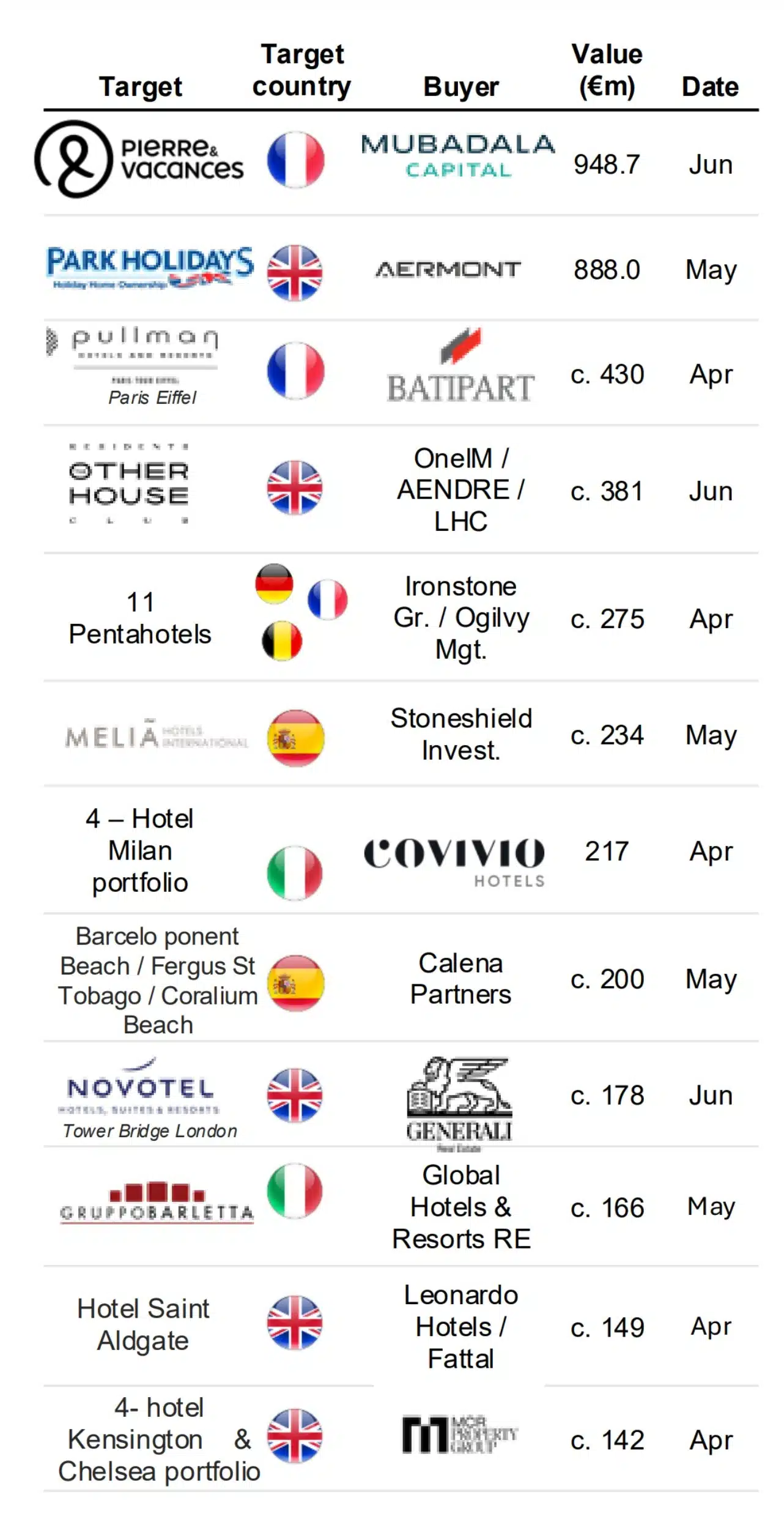
The European hotel investment market remained liquid in Q2 2026, although recovery is increasingly selective. Within our five-market sample, deal count reached 48, the second highest quarterly level since 2024, supported by the return of large-ticket transactions (including large operators Pierre & Vacances and Park Holidays).
Across Europe, however, H1 investment volumes remained c.10% below last year, despite staying well above long-term averages. Capital is increasingly concentrating on prime single assets, premium hotels and markets with strong operating fundamentals, with the UK, Spain and France accounting for almost twothirds of European transaction volumes. Spain stands out for its record investment activity and strong leisure exposure, while Germany remains significantly quieter. With yields broadly stable and financing costs limiting further repricing, liquidity is available, but investors continue to favour quality, scale and clear value-creation potential over broad market exposure.
Main European hospitality transactions – Q2 2026
Sources: Mergermarket and news
TOURISM PERFORMANCE
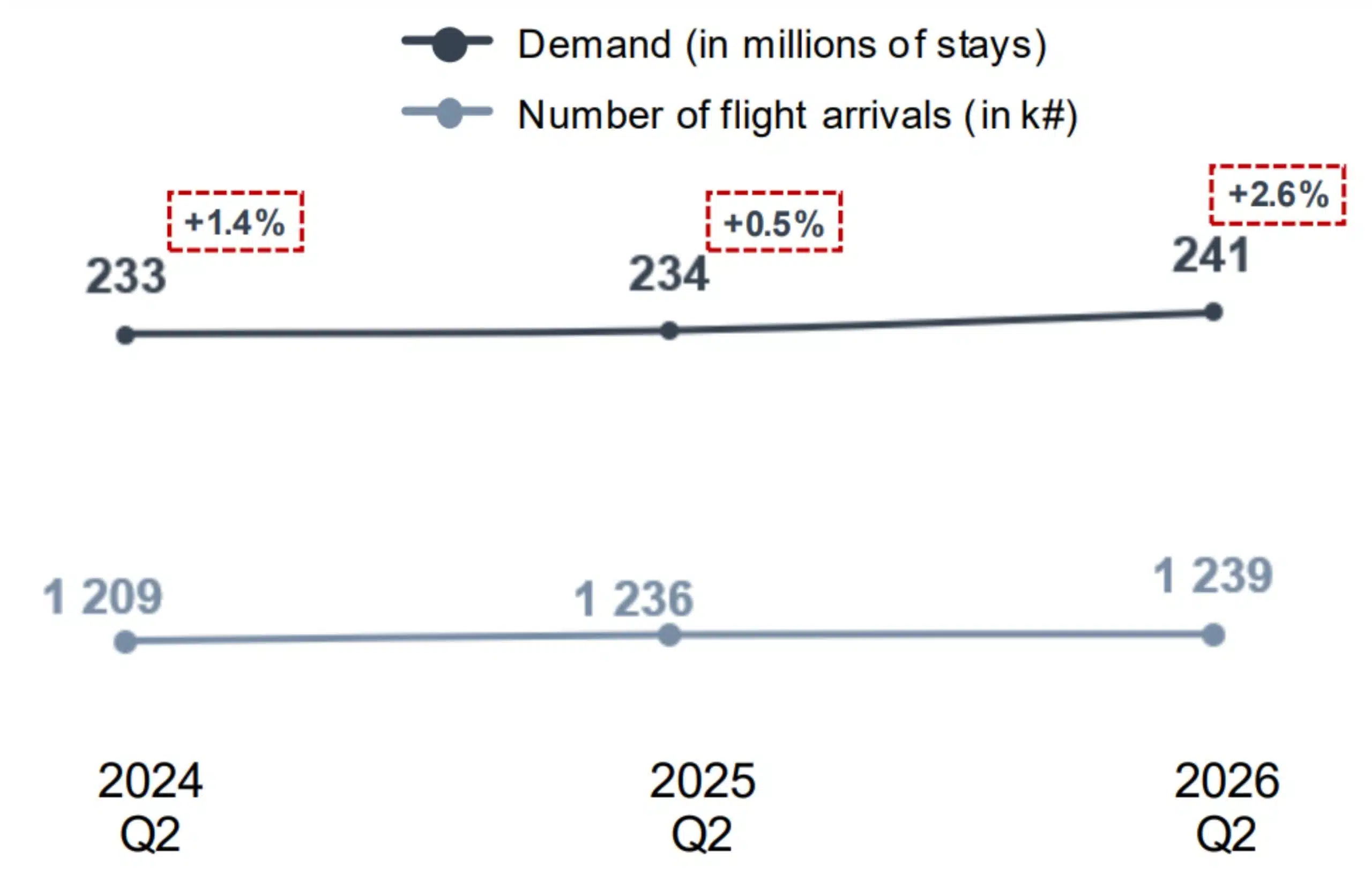
Air arrivals and hotel demand
Sources: Eurostat and Accuracy data analysis
Tourism demand remained resilient in Q2 2026 despite a clear slowdown in European aviation. In our five-market sample, hotel demand reached 241 million stays (+2.6% YoY), materially outpacing growth in flight arrivals (+0.2%).
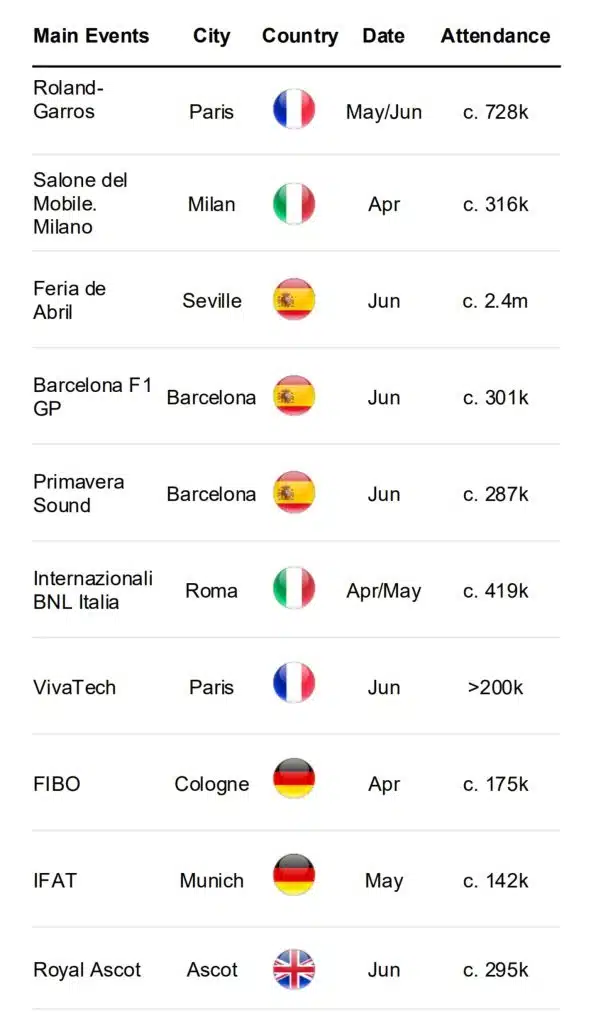
This divergence highlights the strength of domestic and intra-European demand at a time when air traffic growth has been constrained by geopolitical disruption and capacity pressures. Performance remained uneven across markets, with Italy and Spain continuing to capture stronger traffic growth while Germany lagged and France and the UK remained more mature. A dense events calendar generated additional compression in major urban markets, particularly Paris, Milan and Munich. Overall, Q2 points to resilient underlying tourism demand, but with growth increasingly driven by destination mix, events and high-value leisure rather than broad-based traffic expansion.
Key European events and attendance
Sources: News
VALUATION
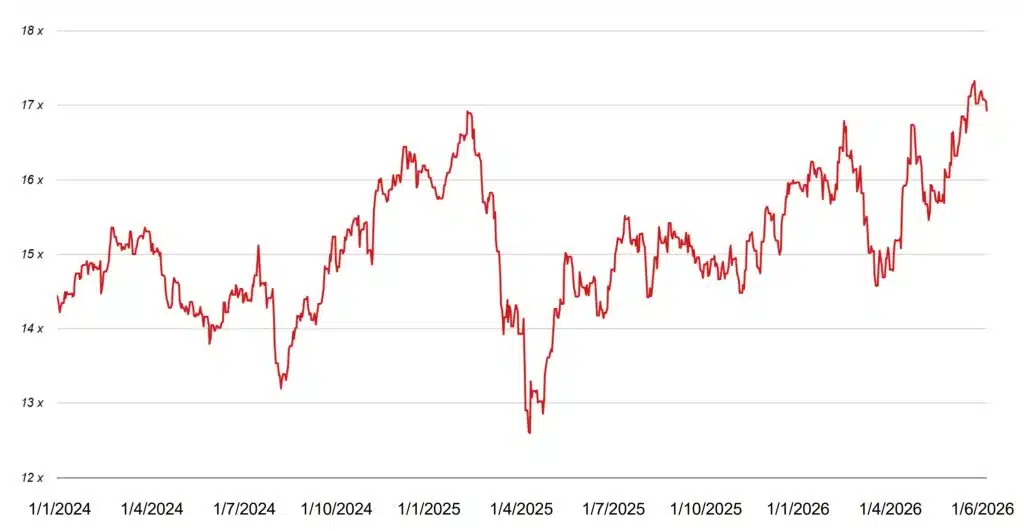
Hotel sector’s EV/EBITDA multiple1
Sources: S&P Capital IQ
Notes: (1) Based on the next twelve months’ EBITDA, the ratio represents an average of IHG, Marriott, Hyatt, Accor, Hilton and Wyndham
Hotel equities re-rated sharply through Q2 2026, with the sector’s average NTM EV/EBITDA multiple rising from c.15.0x at the end of Q1 to c.16.9x at the end of Q2, after reaching a two-year high of c.17.3x in late May.
The expansion was supported by a reassuring Q1 earnings season, with leading asset-light operators reporting resilient RevPAR, continued 4–7% net unit growth and significant shareholder returns. Importantly, the re-rating persisted despite a less supportive interest-rate backdrop, suggesting that investors are increasingly paying for the structural qualities of the asset-light model – fee growth, pipeline visibility, high cash conversion and capital returns – rather than for a broad cyclical acceleration in hotel demand.
With valuations now close to the top of their recent range, further upside is likely to require continued earnings delivery, while increasing the risk of valuation dispersion between operators able to sustain unit growth and pricing power and those more exposed to slower mid-market demand.
OUTLOOK
European hotel performance is expected to remain positive through H2 2026, but growth is set to moderate after a stronger-than-expected first half. CoStar currently forecasts c.+1.4% RevPAR growth for 2026, largely rate-driven, before growth slows to c.+0.2% in 2027. With occupancy approaching mature levels across many markets, the key themes for Q3–Q4 are increasingly dispersion, pricing power and margin conversion rather than broad-based demand growth.
1. Q3 should remain resilient, but Q4 is likely to normalise. Summer leisure demand remains supportive, with 81% of Europeans planning to travel between June and November and Southern / Mediterranean Europe still the preferred destination region. However, with occupancy already high in many markets, H2 growth should become increasingly ADR- and event-driven rather than volume-led. Spain and Italy therefore remain better positioned, while Germany is likely to stay more dependent on individual trade fairs and events.
2. Performance dispersion should widen further between markets, segments and individual assets. Luxury and Upper Upscale hotels remain supported by affluent international and experience-led demand, while price elasticity is becoming more visible in the mid-market. As broad-based pricing momentum fades, product quality, location, event exposure and revenue management should increasingly determine RevPAR growth.
3. The main H2 risk shifts from occupancy to margin conversion. Labour, utilities and operator costs are rising faster than hotel revenues in several core markets, particularly the UK. As the post-pandemic RevPAR recovery matures, positive top-line growth will not necessarily translate into equivalent GOP growth, making operational efficiency, labour productivity and ancillary revenue increasingly important differentiators.
4. Investment liquidity should remain available but increasingly concentrated on quality. Deals above €100m increased 30% YoY, highlighting strong demand for prime assets despite more limited broad-market liquidity. Stable yields and higher financing costs should constrain further repricing, while UK, Spain and France remain the main destinations for capital.
Jérémie Israël – Partner, Accuracy
Simon Perez – Partner, Accuracy
Nicolas Paillot de Montabert – Partner, Accuracy
Hospitality in Europe at a glance – Q2 2026