
The creator economy encompasses the economic activity built around creating and monetising content on digital platforms, chiefly YouTube, TikTok, Instagram and Twitch. It includes the creators themselves, as well as the platforms, agencies, brands and producers that form this ecosystem.
Once on the fringes of the audiovisual industry, the creator economy has become too large and influential to ignore. Leading creators command audiences comparable to those of major television channels, produce their own formats and run businesses that extend well beyond social media. Traditional audiovisual companies are gradually rethinking their production and distribution strategies in response.
A fast-growing but highly fragmented market
Estimated at $360 billion in 2025, the global creator economy could reach $480 billion in 2027, according to estimates compiled by Accuracy from several industry studies, including those by Goldman Sachs and Fortune Business Insights.
In France, the market was estimated at around $8 billion in 2025, up 19% year on year, according to estimates cited in Accuracy’s study. The number of creators earning revenue is estimated to have risen from 304,000 in 2024 to nearly 350,000 in 2025.
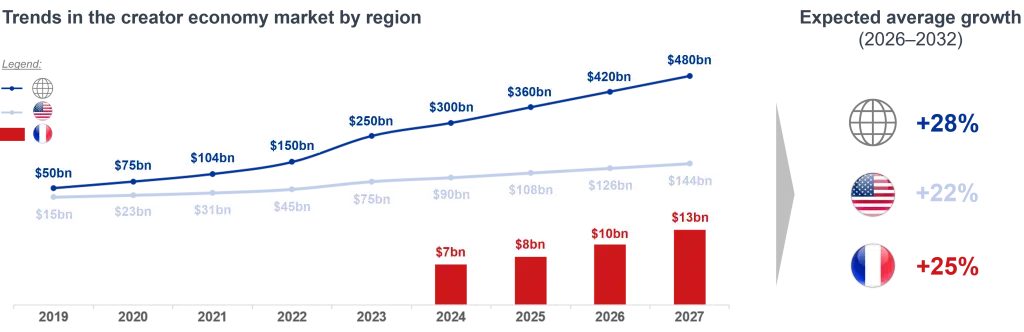
As the market grows, creators are gradually becoming more professional. Their income no longer depends solely on advertising partnerships: it now combines subscriptions, platform revenue-sharing, affiliate marketing, commerce and the commercial exploitation of content. Yet of the roughly 65 million creators worldwide in 2025, only an estimated 4% were considered professionals.
When creators become entertainment producers
Several recent events illustrate the creator economy’s growing scale.
ZEvent, founded in 2016, raised €32.9 million in donations in 2026, compared with €16.7 million in 2025. More than 300 creators took part, attracting a peak audience of 1.2 million concurrent viewers on Twitch. Beyond fundraising, its success demonstrates creators’ ability to mobilise their communities for large-scale events that now combine digital broadcasting with an in-person presence (source: ZEvent).
In the United States, MrBeast exemplifies an even more pronounced shift. With over 500 million YouTube subscribers, he has developed Beast Games with Amazon Prime Video, translating the formula of his YouTube videos into a premium audiovisual competition series. The first season attracted 50 million viewers in 25 days, half of them outside the United States. A third season has already been commissioned (source: Amazon Prime Video).
In France, Squeezie’s GP Explorer offers another example of creators and traditional broadcasters moving closer together. Its third edition drew more than 200,000 spectators to the Le Mans circuit and peaked at 1.5 million concurrent viewers on Twitch. Also broadcast on France 2, the event attracted 1.2 million television viewers. France Télévisions offered a further 24 exclusive onboard feeds on france.tv (sources: France Télévisions, Radio France).
These ventures share a common feature: they draw on communities built on digital platforms, but increasingly rely on production resources, financing and distribution arrangements comparable to those of traditional audiovisual businesses.

Competition shifts to the battle for attention
The growth of the creator economy is part of a broader shift in media consumption.
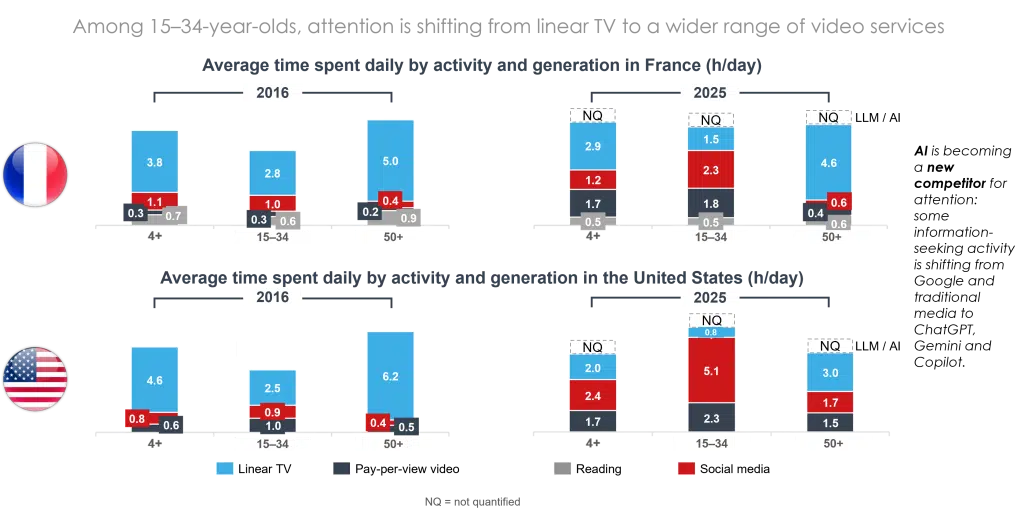
Among younger audiences, social media and video platforms are gaining ground at the expense of linear television. According to Médiamétrie and ARCOM data cited in Accuracy’s study, 15–34-year-olds now spend more time on social media than watching traditional television.
Use also varies by platform. In France, daily time spent on YouTube averages around 1 hour 16 minutes, compared with 1 hour 14 minutes on Instagram and up to 1 hour 33 minutes on TikTok, according to industry estimates compiled by Accuracy.
For audiovisual groups, this is as much a distribution challenge as a production challenge. A substantial budget and strong editorial quality do not necessarily ensure that a programme finds its audience, particularly among younger viewers.
Partnerships begin to deliver results
Partnerships between creators and traditional media are multiplying, with ambitions that extend beyond simply promoting a programme.
Inoxtag’s documentary Kaizen, about his ascent of Everest, recorded nearly 49 million views on YouTube. Its subsequent broadcast on TF1 at 11.30pm drew 329,000 viewers, with a 21% audience share among 15–34-year-olds. The result illustrates the appeal of such content as a way to reach younger audiences (sources: YouTube, TF1).
Canal+ has also expanded its collaboration with Léna Situations around the César awards ceremony. In 2026, content related to the event generated 500 million views in total across Canal+, Dailymotion and TikTok, compared with 21 million in 2023, before the collaboration was developed (source: Canal+).
These examples illustrate the commercial rationale for such partnerships. Creators bring name recognition, close ties to their communities and an ability to generate engagement. Producers and broadcasters contribute editorial expertise, financing, production resources and distribution capabilities.
The strengths are complementary, but audiences do not automatically follow. Success depends, among other things, on the format, the fit between creator and programme, and the platform used.
How traditional media are adapting
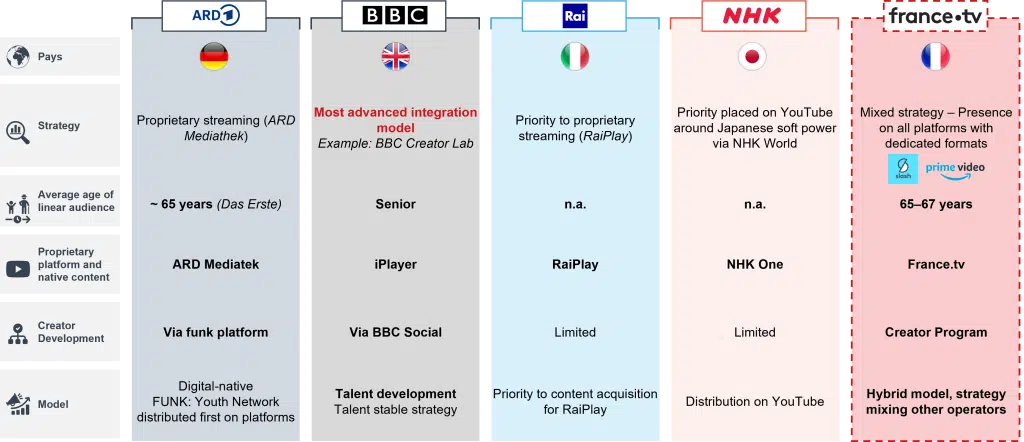
Audiovisual groups are experimenting with a range of strategies in response to these shifts.
Some prioritise distributing their content on major digital platforms to reach new audiences. Others develop programmes specifically for these platforms, adapting both formats and production methods.
The BBC, for example, launched BBC Creator Lab in 2023 in partnership with TikTok to help digital creators develop audiovisual formats. The programme aims to identify new talent and help creators move into BBC productions.
In the United States, PBS Digital Studios has taken a different approach, developing programmes directly for digital platforms. Since its launch in 2012, the initiative has produced more than 120 original series, amassing 36 million subscribers and 5.4 billion views (sources: BBC, PBS).
At the same time, broadcasters continue to invest in their own platforms, such as france.tv, BBC iPlayer and RaiPlay. The aim is to maintain a direct relationship with audiences and retain greater control over distribution, data and the commercial value of their catalogues.
These strategies are not mutually exclusive. Third-party platforms help raise visibility and attract new audiences, while broadcasters’ own platforms offer greater control over the relationship with users.
The challenge for broadcasters is to strike the right balance between these channels without losing control of their content or their business model.
Towards new business models
Closer ties between creators and traditional media businesses are likely to continue reshaping the economics of the audiovisual industry.
For producers, creators offer a pool of talent and new formats. For broadcasters, they provide a way to refresh their audiences. For creators themselves, partnerships with audiovisual groups open up access to greater production resources and financing.
Yet this convergence raises several questions. How should intellectual property closely tied to a creator’s personality be valued? How should revenues and rights be shared? And how should the profitability of content distributed across several platforms be measured when its returns sometimes extend beyond advertising revenue alone?
These questions are likely to become more pressing as the sector professionalises and productions grow more ambitious.
The creator economy is no longer a world apart from traditional audiovisual media. It is increasingly a source of talent, content and audiences, even as leading cre- ators themselves adopt models resembling those of producers and broadcasters. effort from the seller.
The question now is how the businesses involved will manage their convergence and share the value it creates.