
The hospitality industry is undergoing a transformation that goes far beyond a typical market cycle. Behind the rebound in travel demand and renewed investor interest lies a fundamental shift in how value is created across the sector.
Digital platforms are reshaping the customer journey, AI is starting to influence booking decisions, and hotel brands are expanding beyond accommodation into broader lifestyle ecosystems.
In this new environment, success depends less on occupancy and room rates alone, and increasingly on data, customer ownership, asset value creation and the ability to generate revenues beyond the room itself.
A RESILIENT SECTOR, BUT A DIFFERENT COMPETITIVE EQUATION
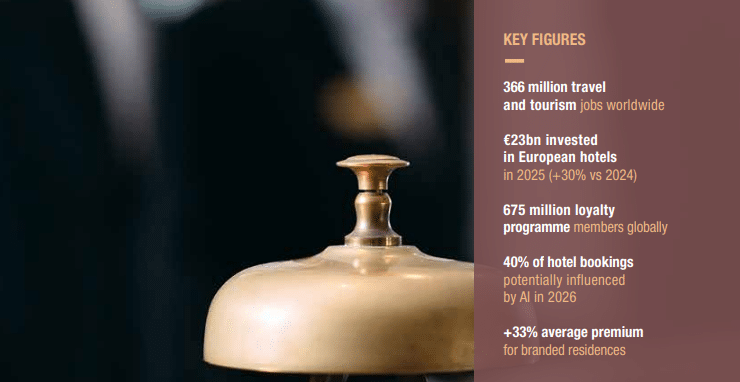
Hospitality has emerged from the pandemic with stronger evidence of structural demand. Travel has become a priority category of spend for many consumers, and international tourism has continued to expand despite inflation, geopolitical disruption and air capacity constraints. In 2025, Travel & Tourism contributed a record $11.6 trillion to global GDP, representing 9.8% of the global economy, and supported 366 million jobs worldwide. In the first quarter of 2026, international tourist arrivals reached 307 million, up 2% year on year, although UN Tourism now points to a more cautious outlook due to the Middle East conflict, transport costs and broader economic uncertainty.¹
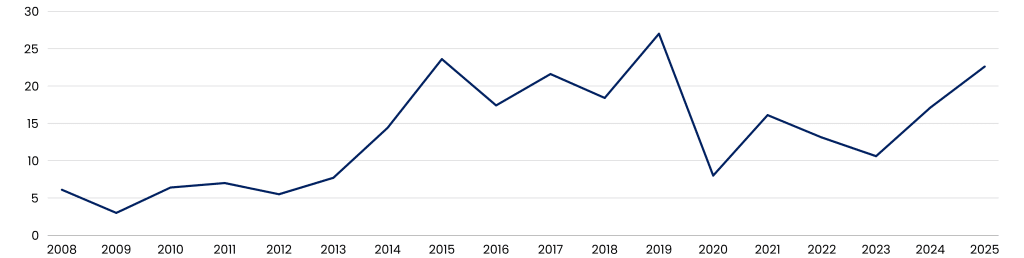
European hotel investment volume (€bn)
Source: HVS
Investment appetite is also returning. Hotel investment almost reached an all-time high in 2025, with €23bn invested in Europe (+30% compared to 2024). Stronger debt markets, high levels of available capital and renewed confidence in the sector should support further transaction growth in 2026.
However, these favourable fundamentals do not remove the pressure on business models. Operating performance is more uneven, some large leading operators have faced difficulties, labour remains tight in many markets, construction and refurbishment costs are high, and distribution economics are changing quickly. The hotel asset may be more attractive to investors, but the operator’s ability to capture value is becoming more dependent on data, brand strength, channel strategy, high-end locations and the ability to monetise space beyond the traditional room. The next cycle will therefore be defined by a broader equation: net revenue after acquisition costs, total revenue per guest, more service (even in the economy segment), operating efficiency, brand-driven pricing power and asset flexibility, in addition to the traditional occupancy and average daily rate metrics.
MIXED TRENDS ACROSS SEGMENTS AND GEOGRAPHIES: BOOMING LUXURY, DIFFICULT TIMES FOR ECONOMY & MIDSCALE
One structural dynamic deserves particular attention: the growing performance divergence between market segments and what it means for profitability. The bifurcation is visible on both sides of the Atlantic, but it takes different forms and is driven by partially distinct forces.
REVPAR evolution – 2025 vs. 2024

Source: STR, US Hotel Review, August 2025, CoStar Group, 2025.
Demand remains strong, but growth is no longer evenly distributed: it is increasingly concentrated in segments that retain pricing power.
However, a critical nuance must be introduced here: luxury does not automatically mean high margin. This is perhaps the most counterintuitive dimension of hospitality economics, and one that is often misread in conversations about segment positioning. The paradox of luxury hospitality is that its competitive advantage – the depth and consistency of service – is also its primary cost driver. Full-service and luxury hotels run GOP margins of 25–35% of total revenue, which is structurally lower than limited-service or select-service hotels, which achieve GOP margins of 35 to 50%.
The reason is structural, linked to more staff per occupied room, more complex F&B operations, costly amenities and guest experiences. ADR growth is running below the rate of inflation, which means that even segments with pricing power are not fully insulating themselves from cost erosion.
In 2024, EBITDA² per available room across the industry grew by approximately 2.5%, against overall revenue growth of nearly 7.2%. This gap between revenue and profit growth is the expression of a structural cost base rising faster than operators can reprice. The phenomenon has hit Europe hard, with some hotel operators such as Revo, one of the largest German and Austrian operators, going bankrupt in early 2026.
DISTRIBUTION: FROM OTA DEPENDENCY TO AI-MEDIATED DISCOVERY
Hotel booking channels remain fragmented
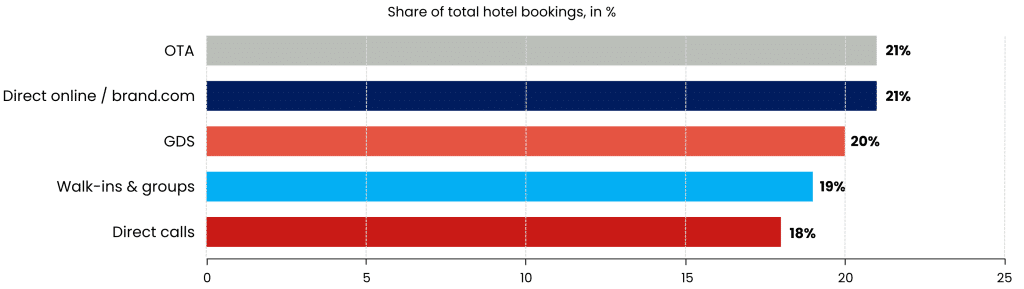
Sources: HEDNA / NYU / RateGain, State of Distribution 2025, via PhocusWire; NYU SPS / BCG, 2026; IDC forecast cited by BCG. Percentages may not sum to 100% due to rounding.
The battle is no longer only direct booking vs. OTA booking; Al shifts the market from search-and-scroll to ask-and-book.
For the last twenty years, the hospitality value chain has been shaped by digital platforms. Online travel agencies gave hotels access to global demand, particularly independent hotels and smaller groups. In return, they captured a meaningful share of booking economics and controlled a large proportion of the customer interface.
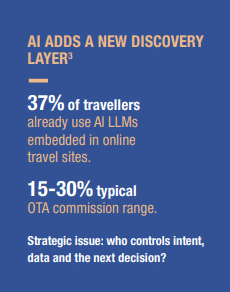
Up to 40% of hotel bookings could already be passing through AI-mediated environments in 2026, with the decision funnel significantly compressed and guests often committing to a property after a single AI response, without visiting a brand website or reading further reviews.
The generational dimension reinforces the structural nature of this shift: AI travel planning tools are already used by 26% of Gen Z and Millennial travellers, compared to just 8% among Gen X and Boomers. Demand-side receptivity is also strong: nearly 74% of travellers say they are open to hotels using AI for personalised recommendations, pricing variations or tailored offers, suggesting that resistance to AI-mediated hospitality is lower than is often assumed.
This has several implications.
First, hotels will need content that can be interpreted reliably by AI systems.
Second, hotels will need to optimise not just price, but the full offer architecture. This shift is already measurable with gains driven not only by pricing, but also by smarter segmentation, promotional timing and cross-department coordination.
Third, the direct relationship with the guest will become more strategic. CBRE estimates that hotel loyalty programme members accounted for 52.8% of occupied rooms in 2024, with total membership exceeding 675 million people, highlighting the growing strategic value of first-party guest relationships.
Finally, channel profitability must be measured more rigorously. The relevant metric is not gross ADR, but net contribution after commissions, marketing costs, payment costs, cancellation risk, loyalty cost and expected repeat value.
In short, the battle is no longer one of direct booking versus OTA booking: it is now about who controls the guest’s intent, data and next decision.
COULD AI TRIGGER A RECONNECTION BETWEEN ASSET-LIGHT AND ASSET-HEAVY MODELS?
The hotel industry has spent the last two decades moving towards asset-light models.
They remain highly attractive from a capital efficiency perspective. However, AI-driven distribution may expose one of its structural weaknesses.
In a world where hotel discovery is increasingly mediated by OTAs, large language models and AI agents, brands will need clean, structured and constantly updated property-level data; highly personalised booking engines; richer content; reliable service delivery; and distinctive experiences that can be understood and recommended by algorithms.
The data, physical spaces, service attributes and experiential proof points often sit at property level. Conversely, asset-heavy owners and operators often lack the technological scale, CRM capabilities and distribution power of the major brands.
The likely outcome is not a broad return to asset-heavy balance sheets, but a deeper operational reconnection between the two models.
In this sense, AI may not reverse the asset-light model, but it could make a purely detached version of asset-light hospitality harder to sustain.
Some early signals are already visible. In 2025, Hyatt reduced its guest services and support headcount by approximately 30%, reflecting changing guest inquiry patterns.
AI widens the gap between demand control and asset control
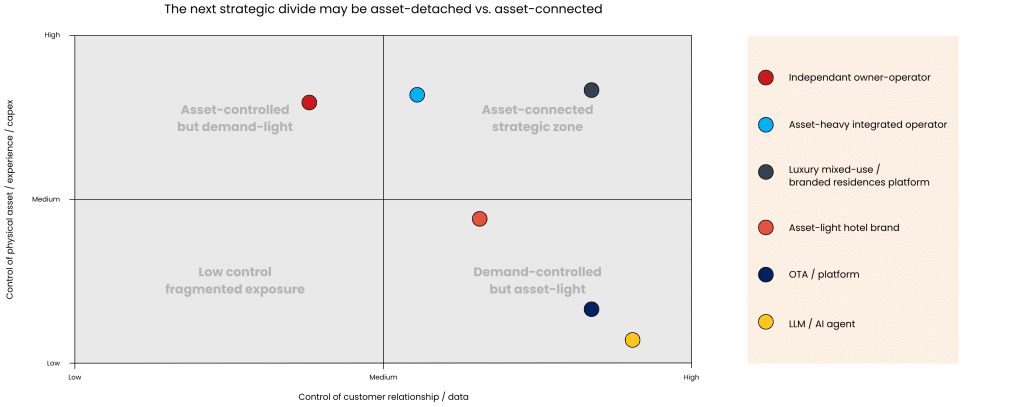
Illustrative strategic mapping.
Source: Accuracy analysis
LUXURY HOSPITALITY AND REAL ESTATE: THE RISE OF BRANDED LIVING
The second major transformation is the convergence of hospitality and real estate. Luxury hotels have always influenced property values, but the relationship has become more systematic. A hospitality brand can now serve as the anchor of a broader mixed-use development: hotel, branded residences, serviced apartments, private club, wellness centre, retail, restaurants, events and destination programming.
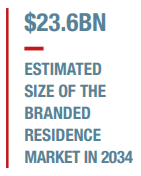
The growth of branded residences illustrates this shift.
Examples can now be found across regions and market segments, from Four Seasons Private Residences in North America to Orient Express Residences, launched by the French luxury hospitality brand, and Aman Residences, which pioneered the concept in Asia and continues to expand globally.
The logic is clear. For developers, a hospitality brand can support pricing, accelerate sales, differentiate a project and reassure buyers regarding service standards. For hotel operators, branded residences create additional fee streams, strengthen loyalty and extend the brand beyond transient stays.
For investors, mixed-use hospitality can diversify cash flows and reduce reliance on a single operating model.
For buyers, the proposition represents access to services, security, status, amenities and a curated way of life, in addition to the property itself.
The financial case for developers is equally compelling. Savills’ Global Brand Premium Study⁴ confirms that branded residences command an average price premium of 33% over comparable unbranded properties globally, rising to 39% in resort locations and holding at 30% in both established and emerging cities.
For a developer, attaching a recognised hospitality brand to a residential scheme effectively creates a structural repricing of the asset.
This convergence is changing the way value is created and assessed. Instead of looking solely at hotel EBITDA and cap rates, the economics of a hotel-led project may include residential sales proceeds, brand licence fees, management fees, club memberships, food and beverage revenues, wellness revenues, rental pool income, property management fees and long-term asset appreciation.
It also introduces execution risk.
A hospitality brand must be strong enough to justify a real estate premium but disciplined enough to avoid diluting itself. Service promises made at the point of sale must be delivered for years. Governance between hotel guests, residents, developers, operators and homeowners’ associations can become complex. In some projects, the most profitable element may be the residences; in others, the hotel remains essential to drive destination appeal and sustain the brand halo.
The model is not infallible, however, and the sector already carries cautionary examples. Some resort operators have struggled to manage the interface between transient hotel guests and permanent residents, whose expectations, rhythms and governance rights are fundamentally different. Some branded apartment schemes have failed to sustain the service promises made at the point of sale, creating reputational damage that flows back to the parent hospitality brand.
The lesson is simple: convergence is easy to design and difficult to operate.
When the most profitable element of a project is the residential component, there is a structural temptation to underfund the hotel operations that create the brand halo justifying the premium in the first place.
Protecting that halo, over years and market cycles, is the central discipline of branded hospitality real estate.
The key issue is therefore choosing which operating and financial structures will capture the value without compromising service quality, brand integrity or long-term asset performance.

HYBRID TRAVEL: HOTELS AS PLACES TO LIVE, WORK AND BELONG
The third transformation concerns the use of space. The boundaries between business and leisure, short stay and long stay, hotel and residential, and work and lifestyle have become increasingly permeable.
Hybrid work is changing travel behaviour. Business trips are extending into leisure stays, while leisure travel increasingly incorporates working days. Demand is also shifting towards longer stays and more residential amenities.
Savills’ 2026 European Serviced Apartment Report highlights growing demand for serviced apartments offering kitchens, laundry facilities and reliable connectivity, a trend reinforced by stricter regulation on informal short-term rentals in parts of Europe.
For hospitality players, this creates opportunities but also requires a different asset and operating mindset.
Hotel lobbies evolve into workspaces, social clubs, retail interfaces and food and beverage destinations.
Meeting rooms, wellness facilities and underused areas are being repurposed to maximise utilisation throughout the day, while some properties are repositioning towards extended stay, serviced apartments or mixed-use formats.
This evolution also challenges traditional performance metrics. RevPAR remains relevant, but it is no longer sufficient. Operators and investors are therefore looking elsewhere, increasingly focusing on total revenue per available room, revenue per square metre, ancillary spend per guest, membership revenue, space utilisation by daypart and customer lifetime value.
The success of hybrid formats therefore depends on a delicate balance: increasing revenue per square metre through additional services while using automation selectively to protect margins and preserve high-value guest interactions.
The recovery and transformation of MICE (meetings, incentives, conferences and events) further reinforces this shift, becoming a key driver of hotel space reconfiguration.
For hotels, this supports the case for more flexible meeting rooms, offsite formats, private dining, hybrid event infrastructure and experience-led corporate gatherings. MICE therefore represents another reason why hotel assets need to monetise space throughout the day, not only through overnight stays.
CONCLUSION: HOSPITALITY AS AN OPERATING SYSTEM
Technology, platforms and real estate are reconfiguring the hospitality industry. The hotel of the future will still depend on location, service, design, operational excellence and human attention. But these traditional strengths will need to be combined with new capabilities: data control, AI discoverability, direct customer ownership, mixed-use real estate structuring, flexible asset programming and disciplined revenue management. In the previous cycle, scale and distribution were decisive; in the next one, the winners will be those who can turn hospitality into an operating system, a platform that connects guests, places, services, data and capital.
That shift will not make hospitality less human. On the contrary, it may make the human element more valuable. As booking, pricing and routine operations become increasingly automated, differentiation will come from what cannot be automated easily: trust, taste, emotion, community and the quality of the welcome.
In a world where the first recommendation may come from an algorithm, the last memory will still come from a human.
The question for hospitality leaders is not how to compete with AI, but how to build businesses where the human element becomes the margin. That is, ultimately, what the best hospitality has always done: turn the quality of presence into the source of value.