
A challenging market offering significant opportunities for entrepreneurs, investors and strategic buyers.
With involvement in more than 40 transactions (both buy- and sell-side) in the digital agency sector over the past five years, Accuracy has developed deep insight into the challenges and developments shaping the Dutch market. While interest in consolidation and investment temporarily decreased during the COVID period, primarily due to uncertainty in client demand, confidence in the sector has now fully returned.
By Leontine Koens-Betz & Martijn Vogelaar
The landscape: market dynamics and buy-and-build
The Dutch digital agency sector has evolved significantly in recent years. The market is characterised on one side by increasingly dominant full‑service platforms, and on the other by a vibrant and expanding group of niche agencies. This combination of scale and specialisation creates a complex landscape, but also meaningful opportunities for entrepreneurs, investors and strategic buyers.
Consolidation is still a key theme: the market is large, accessible and fragmented, enabling the creation of scalable platforms through targeted acquisitions. Private equity investors play an important role in driving this growth, providing both capital and networks.
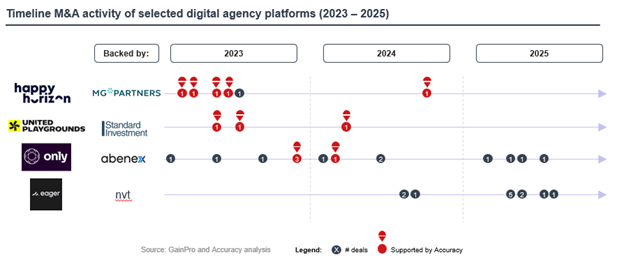
The buy‑and‑build movement emerged more than a decade ago, when Accuracy and others advised We Are You, supported by Capital A, on the execution of a focused acquisition strategy. Within a few years, We Are You grew into a full‑service international agency, inspiring many to follow. The company was later acquired by Intracto Group, now known as iO, as part of its ambition to build a fully integrated digital services platform.
Today, consolidation is moving in new directions. Mature platforms are placing increasing emphasis on internal synergies and performance optimisation within their existing labels. Acquisitions serve more often to address specific capability gaps rather than pursuing scale or international expansion. At the same time, relatively new platforms – such as Only, with approximately 14 transactions over the past 2.5 years, and Newww Media Group (recently rebranded as Eager), with 10 transactions in 2025 – demonstrate that buy‑and‑build is not confined to established players. With a clear strategic focus, smaller platforms can achieve substantial growth in a relatively short period.
Rapid change and technological pressure
The continued but renewed interest in acquisitions and investments is driven by several trends transforming the sector.
Digital agencies must adapt their business models even faster due to technological and economic shifts. Three structural forces are currently driving the pace of change: AI, data privacy and talent. Clients expect faster, cheaper and more scalable creative and media production, powered by generative AI. This pushes agencies to rethink their business models and adopt new ways of working. More agencies position themselves as “AI‑native”, developing proprietary tools, training employees and building brand differentiation around technological expertise, thus strengthening their appeal to both clients and investors.
Data privacy is also becoming increasingly important. As third‑party cookies disappear, clients depend on agencies to develop first‑party data frameworks, implement Customer Data Platforms and develop compliant funnels. Agencies that excel in these areas significantly enhance their strategic relevance.
Automation is contributing to margin improvement, but the scarcity of creative strategic talent remains a structural challenge. When Accuracy assesses digital agencies, workforce dynamics are one of the most important themes: human capital is still the most critical asset. Inflation and talent shortages are pushing wage costs up, and due to legacy or multi‑year contracts, these costs cannot always be passed on to clients.
The ratio of wage costs to revenue is therefore a key performance indicator; revenue per employee is another. Strategic advisory work typically commands higher fees than execution‑focused services such as development. Agencies with well‑structured project administration gain the insight needed to monitor utilisation and actively manage productivity improvements.
“Being able to directly oversee the financial and operational data of our various labels provides us with valuable insights to further optimise. That was exactly the goal of our collaboration with Accuracy,”
Marten Post, founder of Eager
Macroeconomic factors also have a direct impact on profitability, particularly for agencies with significant exposure to a small number of major clients. Reductions in marketing budgets can affect results immediately, while growth sectors may create unexpected uplifts. For smaller agencies, client concentration introduces a clear risk. The value of a client relationship is driven by accumulated expertise, preferred‑supplier status and the continuity of ongoing campaigns. Contracts are often multi‑year but rarely include hard revenue guarantees, making clients the second major theme for Accuracy.
M&A trends: data, AI and selectivity
These trends translate directly into the M&A landscape. Large networks and holding companies continue to consolidate through acquisitions, prompting independent agencies to choose between specialisation and sale. Meanwhile, the investment logic has shifted: where buyers once sought creative capacity and scale, the focus now is on technology and data.
Buyers are willing to pay a premium for agencies with proprietary tools, strong data governance and AI‑driven processes. One example is the acquisition of DotControl by Dekuple, supported by Accuracy, earlier this year, which strengthened the agency’s data and identity capabilities and created a clear strategic advantage.
“We are particularly interested in agencies with scalable delivery, recurring revenue and proven technological differentiation. The right companies remain highly attractive, even at competitive valuations.”
Quinten Birkhoff, partner of Capital A
Private equity and strategic buyers remain active but are increasingly selective. The message is clear: agencies that combine creative excellence with technological and data‑driven capabilities are positioned as the winners in today’s M&A market.
Post‑deal integration: balancing scale and culture
Once a deal closes, the real work begins. In the digital agency sector, the integration phase significantly influences long‑term success. The challenge lies in achieving the right balance: determining how much centralisation of processes, systems and governance is beneficial without constraining the entrepreneurial culture. Excessive integration can limit creativity and agility, whereas thoughtful operational alignment can unlock efficiencies and meaningful economies of scale.
Strategic intent is decisive. Will the agency be fully integrated into a broader full‑service platform, or will it maintain its own brand identity and specialisation? Should the focus be on cross‑selling opportunities, or is the agency more successful when it remains dedicated to its core expertise?
Branding and talent are closely interconnected. Retaining key employees and maintaining cultural alignment require deliberate choices in leadership, communication and decision‑making. When executed effectively, this creates strong opportunities for cross‑selling, operational synergies and international expansion.
Opportunities and exit readiness
We expect the consolidation wave to continue in the coming years – albeit potentially at a slower pace – with an increasing focus on data, AI and commerce capabilities. Growing international interest and further European integration may, over time, result in larger cross‑border transactions.
Private equity, together with strategic buyers, will remain a key driver of consolidation. The presence of agencies at different stages of maturity, from emerging players pursuing buy‑and‑build strategies to more established firms nearing the end of their investment cycle, creates a dynamic mix within the M&A landscape.
For the latter group, exit readiness is essential. A successful transaction requires reliable, transparent and consistent financial information. Buyers place significant value on data integrity and clear governance; a well‑structured financial foundation helps prevent discussions and valuation pressure during due diligence. Equally important is a compelling equity story: what makes the organisation attractive, and how do the growth assumptions support future potential?
Agencies that invest seriously in this preparation not only enhance their chances of a successful transaction but also strengthen the foundation for long‑term value creation – for clients, employees and investors alike.