
In 2023, China’s BeiDou satellite navigation system was incorporated into the standards of the International Civil Aviation Organisation (ICAO), joining the systems already recognised for global civil aviation. This official integration facilitates its adoption by airlines and equipment manufacturers alike. As a result, compatible equipment becomes more attractive, investment concentrates on technologies using this framework and new entrants have an incentive to align with it in order to access the market. Gradually, the standard shapes the industrial ecosystem that forms around it.
In electric vehicles, batteries, onboard systems and communication networks, standards define the rules that allow technologies to function together. They guide investment decisions and influence innovation trajectories, in addition to determining market access conditions. The ability to contribute to their definition thus becomes a lever of lasting influence over the future organisation of value chains.
China has progressively made this dimension a central pillar of its industrial strategy. Through close coordination between public authorities and industrial actors, it has strengthened its capacity to exert influence within the main international standard-setting bodies. This growing presence enables it both to shape the evolution of standards and to promote the diffusion of frameworks compatible with technologies developed by its firms. Its approach operates simultaneously on several levels: contributing to the development of international standards, gradually aligning its domestic normative corpus with global frameworks, and promoting standards compatible with its technologies among partner countries. As these standards spread, they reinforce the integration of industrial ecosystems structured around Chinese actors and consolidate their position within global value chains.
Standards have become a central arena of industrial and geopolitical competition. The European Union retains considerable assets, notably a significant internal market, recognised regulatory capacity and a strong industrial base. However, this regulatory strength translates less readily into durable international normative influence, as it is primarily designed to frame the practices of actors seeking access to its market. The fragmentation of initiatives, combined with the absence of clearly defined common priorities and insufficiently coordinated participation in certain international bodies limit Europe’s capacity to shape the standards that will structure future technologies.
Yet, as critical technologies increasingly coalesce around shared frameworks, the ability to participate in their definition becomes a matter of sovereignty. States that contribute to writing the rules gain lasting influence over value chains, whereas those that adopt them see their room for manoeuvre gradually diminish. The tensions observed in 2025 over rare earths underscored how a position built over time within a critical value chain can be rapidly mobilised as a lever of economic negotiation. Industrial sovereignty is now determined as much by the definition of rules as by control over the technologies themselves. In this competition, the ability to influence standards increasingly determines the ability to influence markets.
Introduction
Industries built on complex systems are shaped by technical standards. These standards define interfaces between technologies, organise value chains, guide investment and ultimately determine market access. In fields such as electric mobility, connected vehicles and semiconductors, they constitute part of the invisible infrastructure underpinning long-term industrial competitiveness.
China has steadily turned this terrain into a central pillar of its industrial strategy. Its growing influence within international standard-setting bodies reflects a coherent ambition: to define the rules that will govern future technologies, platforms and ecosystems. Each adopted standard steers technological choices, favours certain architectures and enhances the appeal of compatible solutions.
Its growing rivalry with other major powers unfolds far from end markets and rarely produces open conflict. The decisions that shape future industrial balances emerge instead in technical committees, interoperability protocols, certification frameworks and data architectures. Largely invisible to the public, these mechanisms nonetheless have lasting effects on value distribution and ecosystem design. Organisations such as ISO ¹, the IEC ² and the UNECE ³ have become arenas for strategic competition, where the ability to draft standards determines future control over critical technologies. The implications for Europe are profound: weak coordination between regulation and industry – or dependence on foreign standards – can transform isolated industrial successes into structural vulnerabilities.

This article explores two key dimensions: the rise of China’s normative influence and the responses available to Europe to safeguard its sovereignty. It examines the integrated state–industry–standardisation model deployed by China and identifies the levers Europe must pull if it is to avoid a passive role. Standard-setting emerges as one such lever, an invisible instrument of power structuring access to future technologies, platforms and value chains.
I. From technical standardisation to rivalry
Standards have always shaped industrial power dynamics. Once established, they organise value chains, influence investment decisions and favour the firms best aligned with them. Major industrial powers have repeatedly used standards to consolidate their positions, diffuse their industrial architectures and lock in value chains, extending their influence far beyond their borders. In the automotive sector, for example, connector and tooling standards imposed by Germany and Japan in the 1970s and 1980s created durable competitive advantages ⁴. Similarly, in digital technologies, control over Wi-Fi and 5G standards illustrates how defining norms determines access to markets and critical infrastructure ⁵.
Today, the automotive and electric mobility markets are at the heart of normative competition. Each communication protocol, safety rule or charging norm ultimately shapes vehicle architecture and the associated industrial platforms. Standards such as ISO 17515-3:2019, which governs interoperability for connected vehicles and their communication networks ⁶, demonstrate how normative power structures value chains durably. Indeed, ISO emphasises that standards are a key driver of China’s technological strategy and its ability to steer innovation on a global scale ⁷, confirming that the battle for industrial power is shifting to international standard-setting arenas.
Once adopted, standards generate lock-in effects that go beyond their technical function. They steer investment decisions, define product design and determine market access. China has deliberately elevated this mechanism into a state strategy.
For Europe, the challenge is therefore to produce norms that influence and structure global architectures. If it fails, its internal regulatory influence may not translate into external normative power. It is no longer simply a matter of producing or investing: it is a matter of defining the global rules of the game.
II. China’s normative strategy: from industry to rule-making
China’s rising normative power reflects a long-term strategy closely integrating the state, industry and technical bodies. Over the past two decades, Beijing has invested heavily in international standard-setting institutions, developed its own technical frameworks and coordinated corporate participation to increase its influence over global standards.
The aim is clear: to embed Chinese technologies within the reference architectures of strategic sectors and, by extension, to shape future industrial balances.
1. An integrated state–industry–research doctrine
At the heart of this strategy lies China Standards 2035 ⁸, a project that extends standardisation beyond domestic policy into a tool of global influence. It seeks to establish Chinese standards as international benchmarks in key sectors such as 5G, artificial intelligence, electric vehicles and digital communications. The project combines national objectives for technological competitiveness with a strategy to exert influence within major standardisation organisations ⁹.
This approach rests on close coordination between public authorities, which set objectives and incentive mechanisms, and leading companies (Huawei ¹⁰, ZTE ¹¹, etc.), which are encouraged to participate actively in the development of international standards. At the same time, institutions like the Standardisation Administration of China (SAC) ¹² play a central role in coordinating technical proposals and preparing Chinese experts to participate in international forums.
A notable illustration of this collaboration is the adoption of polar codes in 2016 by the 3GPP for 5G control channels.
Promoted by Huawei and backed by a broad coalition of Chinese stakeholders in opposition to a Western consortium advocating LDPC and turbo codes, this marked China’s first major contribution to the architecture of a global mobile generation, illustrating the shift in its role from adopter to standard-setter.
The scale of this system is considerable. The European Union Chamber of Commerce in China, in its Position Paper 2025/2026 ¹³, states that at the time of writing (April 2025), China had published 2,138 new national standards (including 154 mandatory ones), 4,023 sectoral standards and 11,433 local standards on the SAC’s national information platform since the start of 2025. As of the same date, the platform also listed 104,500 standards from social organisations (of which 104,472 were in force) and, as of February 2025, 563,045 corporate standards. The MIIT’s 2025 annual plan adds 1,800 new industrial standards to this framework, as well as the creation of five additional sectoral technical committees and China’s leadership in the development of at least one hundred new international standards. What can be observed is not merely a policy of influence, but fully-fledged normative infrastructure.
2. Influencing international standard-setting bodies
On the international stage, China has expanded its presence in major organisations such as ISO, the IEC and the ITU, aiming to secure leadership positions within technical committees and expert groups. This allows it to influence both the drafting and prioritisation of standards. Indeed, Beijing has stepped up the participation of its experts in international technical committees, significantly increasing the volume and quality of its contributions ¹⁴.
In practice, this increased presence has translated into a surge of standardisation proposals aligned with sectors where Chinese companies hold competitive advantages, particularly 5G networks, electric vehicle charging and integrated digital platforms. The institutional strategy grants China a structural capacity to influence the technical rules governing mobility, energy and connected industrial systems.
However, this strategy is not without controversy. In 2019, leaked documents revealed that Chinese companies (ZTE, China Telecom, Dahua) were proposing facial recognition and video surveillance standards to the ITU-T that could be adopted without debate in developing countries, highlighting that standardisation is also a political battleground, reflecting underlying values and governance models ¹⁵.
China’s weight in 5G standardisation is illustrative of its growing normative influence: its entities accounted for 33.96% of adopted proposals amongst the top ten contributors as of March 2024, with Huawei leading.

Source: World Bank, China’s Evolution in International Standardization, page 24 https://thedocs.worldbank.org/en/doc/ a588e8a85c44aca841687aff78d25a54-0050062025/original/John-Jiong- Standardization-in-China.pdf
In addition, China promotes its standards through bilateral and regional agreements, particularly under the Belt and Road Initiative (BRI). This strengthens China’s ability to participate in the development of global standards and influence their future direction.
3. Aligning domestic standards with international frameworks to facilitate wider adoption
China’s involvement in international committees is accompanied by a less visible but equally significant parallel movement. The Ministry of Industry and Information Technology’s (MIIT) 2025 annual plan, as reported by the European Chamber, sets China a target of adopting 88% of international standards identically within its domestic system ¹⁶. By gradually aligning partner countries’ standards with its own, Beijing seeks to reduce technical trade barriers whilst creating normative dependencies that favour its industrial architectures and value chains. This process operates in both directions: China exports its standards whilst importing international norms, progressively reducing the distance between the two. Such dissemination contributes to the globalisation of standards that are technically compatible with Chinese platforms, thereby strengthening the influence of Chinese companies on a global scale.
This diffusion is underpinned by concrete measures. By June 2023, China had signed 107 standardisation cooperation agreements with 65 BRI partner countries (including Pakistan, Russia, Greece, Ethiopia and Costa Rica), covering civil aviation, electric vehicles, construction materials and pipelines. The official integration of the BeiDou navigation system into ICAO standards in 2023, making it one of four global systems recognised by the UN for international civil aviation, represents another regulatory achievement with lasting strategic implications ¹⁷.
This strategy is gradually redefining the international regulatory landscape in favour of an approach where economic power is also expressed through rule-making.
China is explicitly demonstrating its desire to set and impose the new standards to be used by all, which has profound implications for the competitiveness of European players and for the EU’s regulatory sovereignty.
III. Standards, platforms and control of industrial architectures
Standards produce their most durable effects when they become embedded within the technical architectures organising industrial ecosystems. At this level – software interfaces, communication protocols and interoperability conditions – the standard ceases to function as a technical reference and becomes a platform lock-in mechanism.
A concrete example of this dynamic is the Eclipse Software Defined Vehicle (SDV) platform, which illustrates how an open software ecosystem can structure the automotive industry around specific standards ¹⁸. By defining interoperability protocols and software architectures, this standard dictates manufacturers’ technological choices and limits compatibility with alternative systems. Similarly, the Catena-X initiative, supported by the European Union, demonstrates that shared data and interoperability frameworks can strengthen value-chain resilience, but only if Europe plays an active role in defining them ¹⁹.
The most striking example is that of fast charging. The GB/T family of standards (GB/T 20234 for connectors, GB/T 27930 for the communication protocol) has been adopted across the entire Chinese market – the world’s largest market for electric vehicles – creating an ecosystem incompatible with the European CCS standard ²º. The 2023 ChaoJi-1 update (GB/T 18487.1-2023, GB/T 27930-2023, GB/T 20234.4-2023) increased charging power to 1.2 MW and, crucially, was designed to be compatible with CHAdeMO 3.1, paving the way for Sino-Japanese convergence vis-à- vis Western standards ²¹. More recently, the March 2025 CATL–NIO strategic agreement on battery swapping explicitly provides for the joint formulation of national battery-swapping standards, a new industrial architecture driven by upstream standardisation ²².
Architectural lock-in may also operate through statistical parameters. The Several Provisions on Automotive Data Security Management (Trial), in force since 2021, classify as ‘important data’ all customer data held by a car manufacturer once it exceeds 100,000 users in China, a threshold reached by any commercially significant brand. The European Chamber notes in its Position Paper 2025/2026 ²³ that this single parameter automatically triggers localisation requirements, cross- border transfer restrictions and security assessments ²⁴. In this case, the standard effectively produces an architectural lock-in without formal prohibition: through a single threshold, it reconfigures the entire governance of connected vehicle data.
Such normative dominance is accompanied by standardisation of value chains, where Chinese companies and their foreign partners must comply with prevailing standards to remain competitive. The consequences are twofold: industrial dependence deepens and the strategic room for manoeuvre of European actors diminishes, even when they possess technological or financial advantages ²⁵ ²⁶.
These dynamics lead to a central question: how does Europe, endowed with a major internal market and recognised regulatory capacity, position itself within this normative competition?
IV. Europe at risk of normative downgrade
1. When regulating its own market is not enough to impose its standards
The European Union possesses considerable assets: a vast single market, recognised regulatory capacity and a leading industrial base. European regulations structure the single market and regularly influence the practices of foreign actors seeking access to it. However, their effects remain mainly concentrated within Europe and are less easily translated into lasting international normative influence, in the absence of an outward-looking strategy.
Yet Europe produces an abundance of legislation. The European Commission, Parliament and Council adopted around 13,000 new legislative texts between 2019 and 2024, a level far higher than that of comparable political blocs. This internal proliferation of norms, championed as a vehicle for harmonisation, is regularly criticised for its complexity and unintended economic consequences ²⁷. What is more, Chinese and North American industrial architectures continue to develop according to their own logics, outside the reach of the European regulatory framework.
2. Why Europe struggles to turn its presence into influence
European positions, largely based on a consensus-driven, bottom-up approach, often remain fragmented across member states and national bodies. In the absence of systematic coordination and without a clear political framework defining international normative priorities, national efforts tend to diverge or dissipate, resulting in a dilution of European influence. In contrast to China’s more structured state-led approach, which seeks to align its national institutions behind announced and strategically clear industrial objectives, European participation in international standard- setting bodies remains fragmented and insufficiently coordinated.
This vulnerability primarily reflects institutional fragmentation. The multiplicity of actors – the European Commission, Parliament, Council and member states – creates diverging priorities and slows the development of a unified normative strategy. Even when coordination is attempted, as with the 2022 European standardisation strategy, operational resources and investment capacity remain insufficient to compete with centralised approaches such as that of Beijing ²⁸. The result is a form of passive normative power: Europe produces significant rules yet remains compelled to adopt standards developed elsewhere in order to remain compatible with global industrial architectures.

The case of automotive cybersecurity illustrates this paradox. UNECE WP.29 Regulations R155 (cybersecurity) and R156 (software updates), adopted in 2021 under European leadership, have been mandatory for all vehicles sold in the European Union since July 2024 ²⁹, ³º. They apply equally to Chinese manufacturers exporting to Europe, demonstrating that Europe’s normative power remains effective when mobilised. However, their scope remains essentially defensive. These regulations reinforce control over access to the European market, but they do not shape the global industrial architectures within which competitors operate.
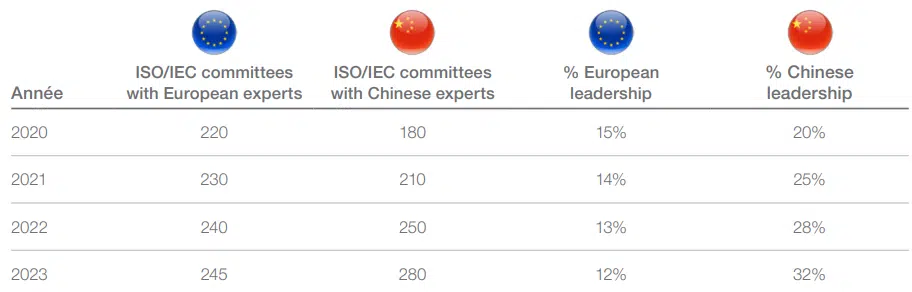
Source: Clingendael Institute, Standardisation with Chinese Characteristics, July 2025 https://www.criticalinfralab.net/wp-content/uploads/2025/07/Standardisation_with_Chinese_Characteristics.pdf
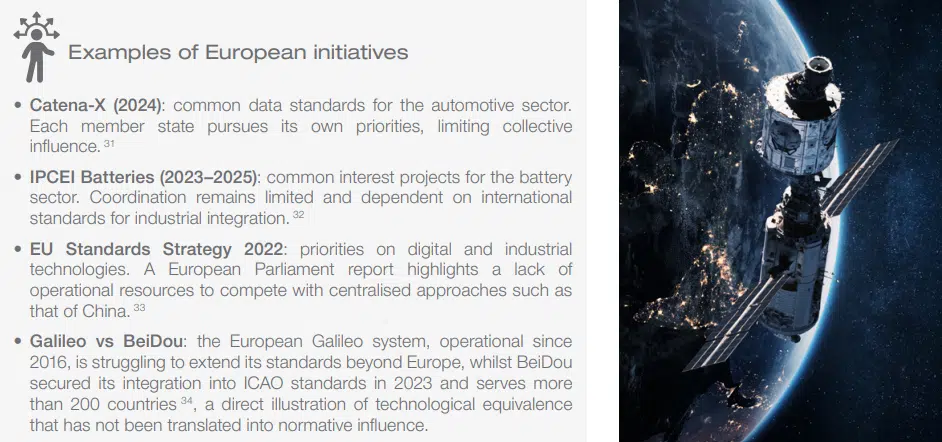
Thus, although Europe remains a normative power in certain areas – particularly data governance and consumer protection – it must recognise that normative capacity does not automatically translate into normative influence. The central issue is now its ability to embed this capacity within a coherent and sustained strategy. Failing this, normative dependence will progressively deepen, as global rules are defined elsewhere, and Europe will be compelled to align with them.
V. The implications of normative dependence
When the rules governing technologies, platforms and value chains are defined externally, the consequences gradually permeate the entire industrial ecosystem. The implications extend beyond the technical sphere to encompass industrial, economic and geopolitical dimensions.
From an industrial and economic perspective, European fragmentation and the continent’s relative position in international standardisation bodies expose companies to foreign standards, often without any opportunity to influence upstream decision-making ³⁵. According to the OECD (2025), this dependence may reduce the effectiveness of public policies and create lasting asymmetries in value chains ³⁶.

The events of spring 2025 show how industrial dependence can rapidly evolve into an instrument of economic pressure. In response to escalating trade tensions with the United States, China imposed export controls in April 2025 on seven specific medium and heavy rare earth elements (samarium, gadolinium, terbium, dysprosium, lutetium, scandium, yttrium), as well as on associated products such as alloys and permanent magnets. The European Parliament deemed the situation critical enough to set up a dedicated Export Control Task Force in July 2025 ³⁷.
This episode demonstrates that a strategic position built up over time can be rapidly mobilised as a lever for economic negotiation. Conversely, accumulated dependencies constrain the strategic autonomy of those subject to them and increase exposure to external decisions.
Such vulnerability becomes geopolitical when standards determine market access and serve as instruments of power projection. Tensions between China and the United States have shown how bilateral decisions can produce effects far beyond the actors directly involved. By adopting foreign standards, Europe indirectly relinquishes levers of sovereignty, limiting its capacity to protect strategic technologies or to steer the energy and digital transitions.
Dependence thus no longer concerns access to a given technology or resource; it concerns the capacity to preserve decision-making autonomy within a system where industrial interdependencies increasingly function as instruments of leverage.
VI. Towards assertive European normative sovereignty
The European situation calls for a shift from a reactive posture to a more assertive approach, in which standardisation is treated explicitly as an instrument of sovereignty.
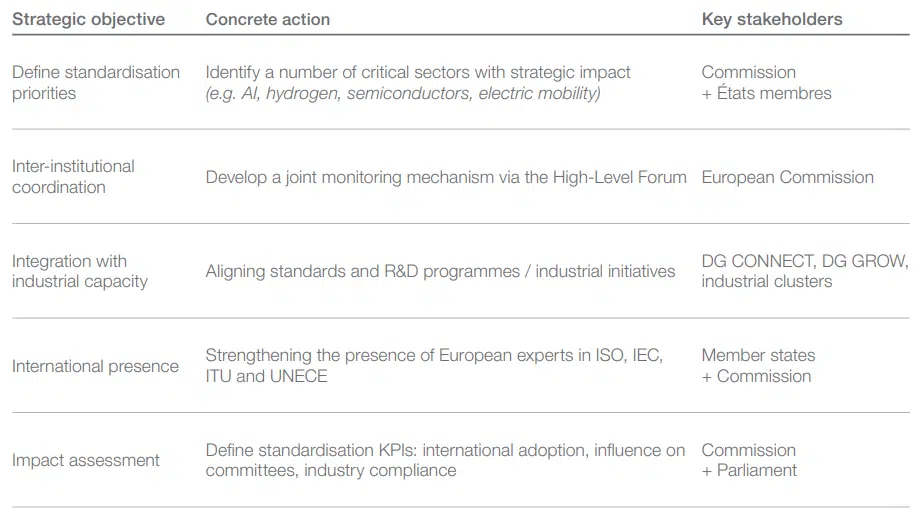
Europe already has the institutional foundations in place: the European Commission’s communication An EU Strategy on Standardisation: Setting global standards in support of a resilient, green and digital EU single market, adopted on 2 February 2022, formalises the role of standards as a lever of competitiveness, the green and digital transitions, and international influence ³⁸. However, without an explicit strategic doctrine that connects standards with industrial and geopolitical power, this framework risks remaining fragmented.
Creating assertive normative sovereignty would require several complementary actions:
- The formalisation of a coherent normative doctrine, identifying sectoral priorities (for example, semiconductors, electric mobility, AI or hydrogen) and aligning standards with industrial strategy. Standards must be designed not only to regulate the internal market, but also to condition access to global markets and structure value chains.
- Strengthened institutional coordination, drawing on the High-Level Forum on European Standardisation, established in January 2023 to align the priorities and efforts of member states, the Commission, industry and the research community ³⁹.
- Closer articulation between standards and industrial capabilities, connecting standards to European R&D programmes (Horizon Europe, Digital Europe) and joint industrial initiatives (IPCEI, sectoral clusters), thereby transforming standardisation into a driver of competitiveness.
- The development of evaluation mechanisms, including performance indicators measuring international adoption of European standards, influence within technical committees and capacity to shape global regulatory frameworks.
The OECD emphasises that integrating standardisation and quality assurance systems into public policy is essential to ensure coherence and strategic impact ⁴⁰.
Recent policy instruments provide an opportunity to operationalise this approach. Initiatives such as the Clean Industrial Deal (February 2025) and the proposed Industrial Accelerator Act (March 2026) could integrate explicit normative components, linking funding and accelerated procedures to active participation in international standard-setting bodies such as ISO, IEC, UNECE or ITU ⁴¹.
1. Indicative roadmap for European standards sovereignty
Conclusion
Normative sovereignty is not a purely technical issue. It is a lever of power that shapes, over the long term, the structure of value chains and the trajectory of innova- tion. A Europe that continues to produce standards in a fragmented manner, without linking them to its indus- trial policy, will remain a prescriptive power internally but a passive player internationally. China, through China Standards 2035, has taken the opposite approach, artic- ulating industrial doctrine and normative influence, and it is already deriving tangible benefits from it.
Reversing this dynamic for Europe requires an explicit strategy, mechanisms for assessing normative per- formance, and sustained engagement in international forums. Standards would then cease to be the adminis- trative by-products of technical choices and return to what they have always been: instruments of power.
The issue applies equally to semiconductors, artificial intelligence, hydrogen and energy. To relinquish a position establishing the rules is to accept being subject to them.
Normative sovereignty is not an option; it is the underlying condition for European power in the 21st century.
Frédéric Recordon – Partner, Accuracy
Normative power and rivalry: the invisible levers of industrial sovereignty