
Food crises, with their resulting famines, have marked the history of the world. They are still very much part of the present in poorer countries, but this is no longer the case in the developed world, despite ‘pockets’ of poverty still existing. Whether in the United States or in Europe, a sense of security has developed, with the weight of food in the household shopping basket falling significantly over time (in France, for example, from 30% in 1960 to 17% in 2020) and food price developments remaining both low and steady. The question of purchasing power was more a matter of income and price dynamics in other areas, like energy sometimes and housing often. But this stable and reassuring landscape has been transformed (or should that be deformed?) in recent years, with the Covid-19 pandemic followed by the Russian war in Ukraine. Now, we must all pay attention again to the price of what we put on our plates. What happened exactly?
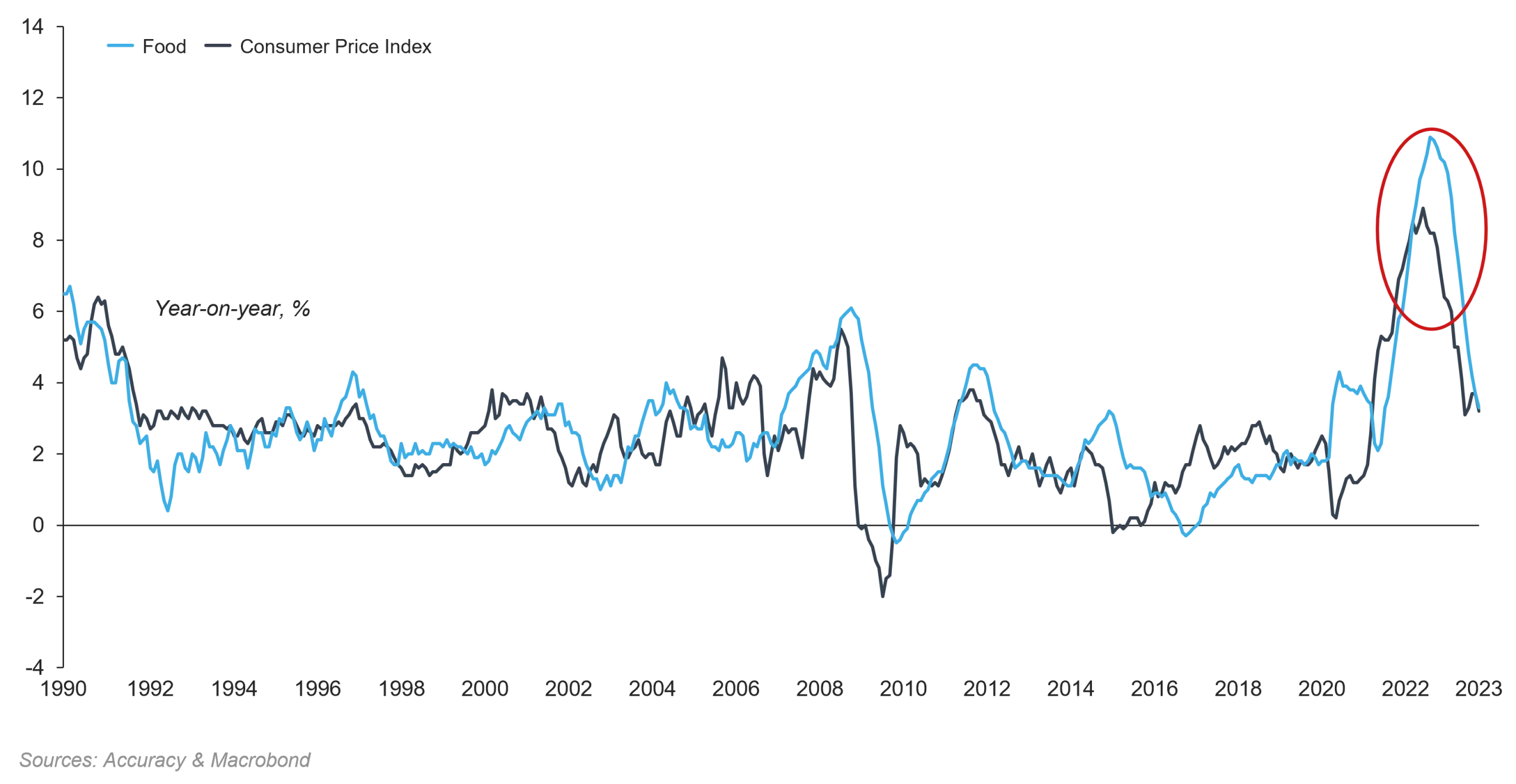
Let’s look at the American case (the analysis can be duplicated for the eurozone). We can see an initial acceleration phase in food prices in spring 2020 (a doubling of the year-on-year increase, but still a reasonable trend overall; put simply, from +2% to +4%), then a second phase two years later (up to +10%). The slowdown starts at the beginning of 2023, but a return to normal is still not fully reached by the end of the year. This, of course, contributed to the stronger overall inflation trend (food accounts for more than 14% of the general consumer price index), though energy, which became much dearer, goes further to explain the rise.
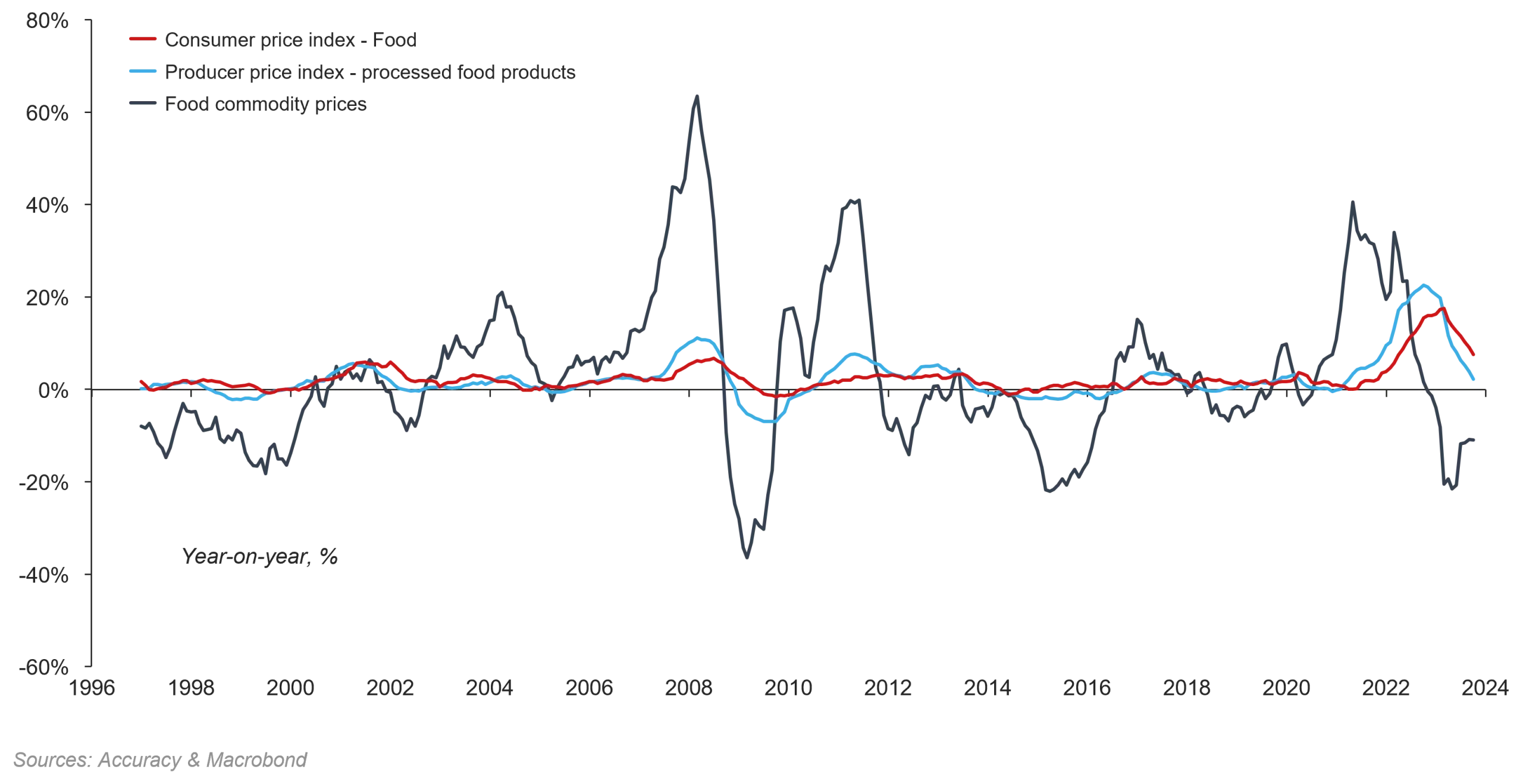
The public health and geopolitical context of the last three years or so has obviously been exceptional. Nevertheless, it is worth taking a closer look at the process that led to the acceleration of food prices. To do so, let’s head to Europe (once again, the demonstration is largely valid on both sides of the Atlantic). We can go upstream in the processing of food products and stop at the commodity level. Prices are volatile; this comes as no surprise. Usually, at least over a period of more than 25 years, the ‘line loss’ shock absorption, starting with a sometimes brutal bullish movement in commodities and then moving downstream (i.e. following the transformation process from commodity to finished product available to the consumer), is significant, with price acceleration becoming increasingly attenuated the further downstream we go. This was the case in 2007–2008 and again in 2010–2011; the sharp rise in the index of food commodity prices only led to a relatively moderate rise in food prices, first at producer level and then at consumer level. This time, however, following an initial shock on a relatively ‘normal’ scale, the downstream reaction was much more significant. Why?
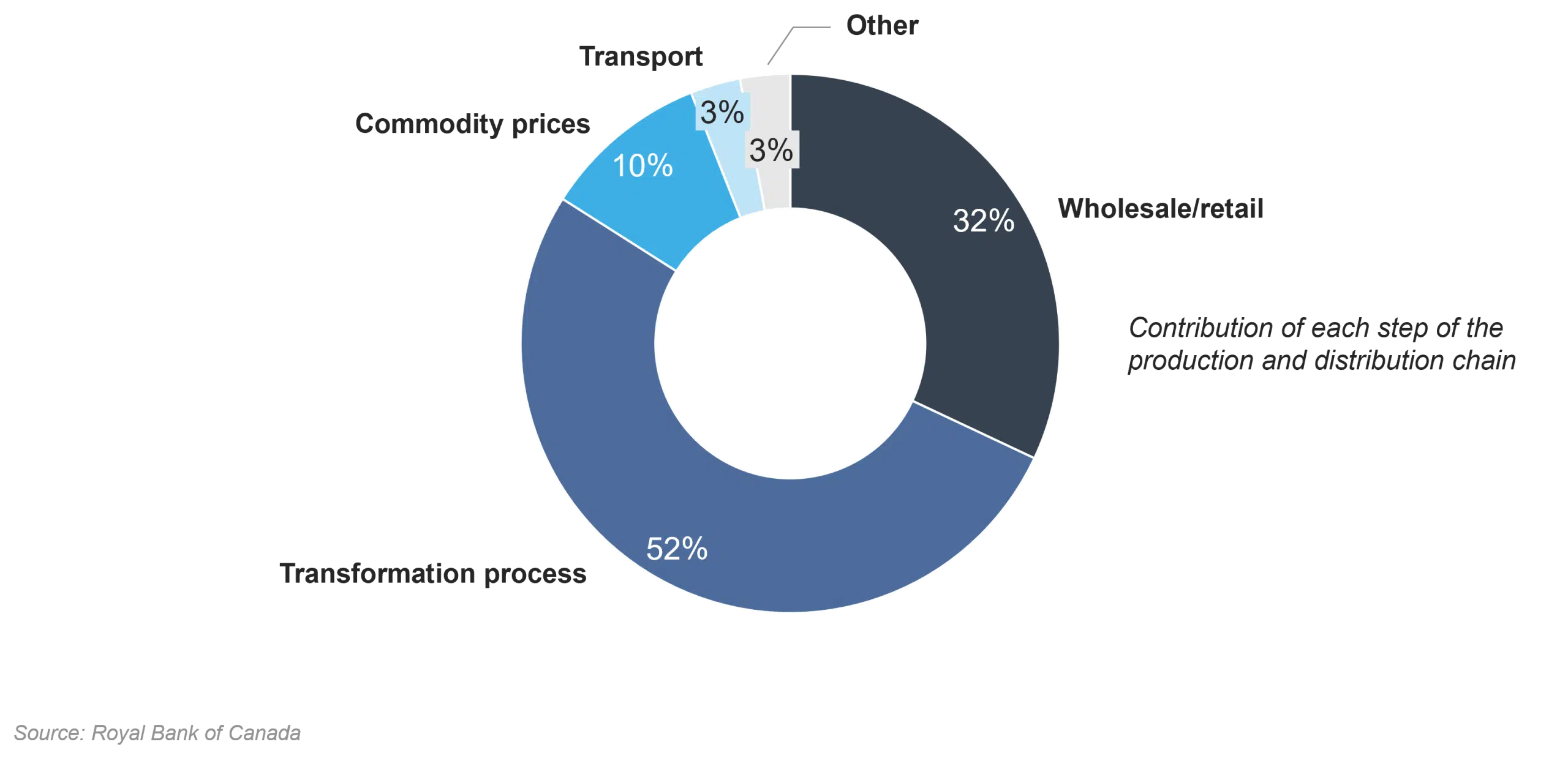
Food commodity prices are sensitive to climatic conditions and any other events that can hinder production or transport. Geopolitical crises come to mind here. Whilst demand is more stable, uncertainty around supply explains the permanent sense of nervousness. It is normally absorbed for the most part, simply because the weight of these raw commodities in price formation for end-consumer demand is fairly modest: 10% in the case of Canada. It is not too different for many other developed countries. We can conclude then that the issue also – and above all – lies elsewhere.
What has happened over the past few years? A lot!
- The crises we have already mentioned have hampered harvests and their commercialisation. And let’s not forget the work done by professionals on the futures markets. The prices thus formed, or at least their movements, influence those shown on the spot markets.
- Disruptions along the supply chain have made the prices of progressively processed products and transport more expensive.
- Tensions in the labour market have raised the cost of labour, and it is worth remembering that over most of the period considered, productivity has been lax.
- Economic policies, for a time, have been highly expansionary, sustaining demand that was constrained at the height of the lockdowns put in place to fight against the pandemic. The support has lasted longer than the moments when economies were effectively ‘sealed off’, thanks to a rise in household savings that are only gradually being used up.
We can see it in the graphs above; normalisation is under way. But how far will it go? Two opposing forces stand out. Global warming, a geopolitical environment that remains unstable and a labour market that is structurally tighter due to ageing populations suggest that this normalisation process will only be partial. By contrast, tightening economic policies could slow demand and weigh on price dynamics. How can we summarise all this?
There is probably some inclination to consider that the current downturn will not bring prices back to the same level as before the series of crises of recent years. They will end up higher, but it will be difficult to say by how much. With this in mind, the next – and certainly more important – question is what economic policy measures should be put in place to contain the upward risks. We can suggest a few.
Let’s start with those to put in place quickly. It seems quite clear that improving access to food products and stimulating their distribution are two essential initiatives. It also seems necessary to ensure that the mix between budgetary and monetary policies continues with the aim of reducing inflation. This would facilitate the downturn in food price dynamics downstream of the production, processing and distribution chain.
In the more medium term, better market transparency and the creation ‘strategic’ stocks are worth considering. We must also make sure that productivity gains are strengthened. This objective is obviously macroeconomic in scale, but its application to agri-food sectors is a must. And all this while fully pursuing the transformation process necessary to achieve climate objectives.
Hervé Goulletquer – Senior Economic Adviser
Accuracy Talks Straight #9 – Economic point of view