
France and Europe are right to want to reindustrialise. But industrial sovereignty can no longer be measured simply by bringing factories back home. It now depends on control over the architectures, standards and partnerships that determine, upstream, who truly shapes industrial trajectories.
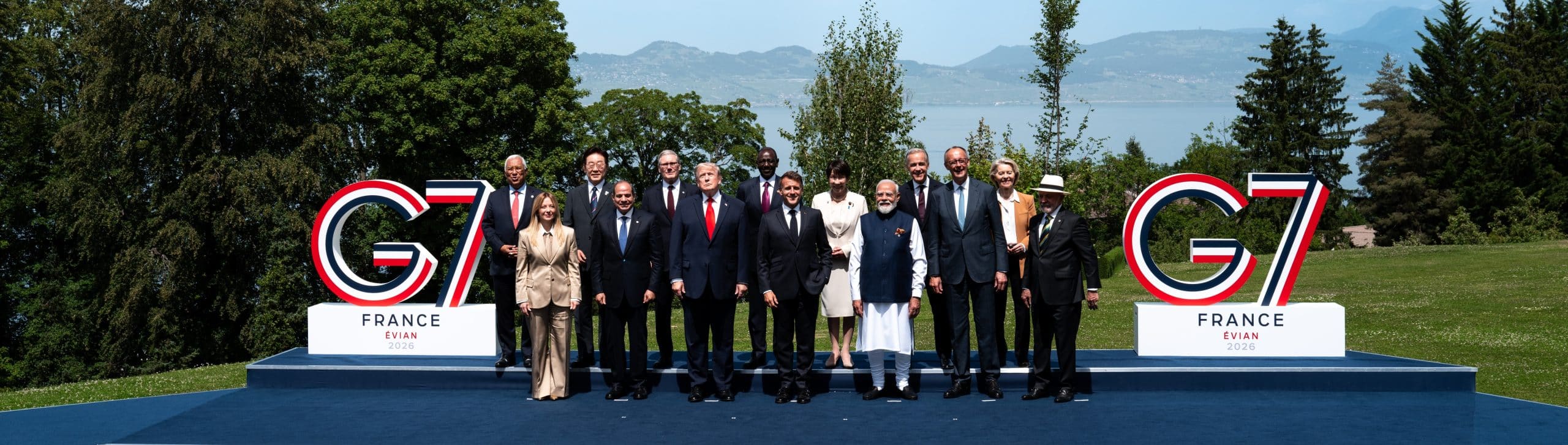
The G7 is often criticised as a club out of step with the world. The point is not without merit. But it misses what matters most if it focuses only on who sits around the table. The real issue is less who is present than how deeply the problems are understood.
In Évian, heads of state will return to a familiar agenda: securing supply chains, containing tensions and protecting strategic sectors. All of this is legitimate. Yet these issues are still too often addressed with the tools of a world in which sovereignty was measured by the depth of the productive base and the trade balance.
That world offers only an imperfect understanding of industrial power. An aircraft, an electric vehicle, a data network, or a battery and charging system are less objects than systems. Their value lies in software, interfaces, standards, certification procedures and data flows. It is possible to produce locally while still depending on rules written elsewhere. It is possible to keep factories and yet lose control over the choices that will shape their future.
This is the level at which sovereignty is now decided, far more than at the level of production sites themselves. In systems industries, power belongs to those who set the interfaces and define the standards. In other words, to those who control the architecture. The rest still matters, but it comes later.
Europe’s aerospace industry makes this plain. It is deeply globalised, yet it has not surrendered its decision-making capacity. Why? Because it rests on institutions, standards and certification procedures that allow Europe to govern interdependencies it has never sought to eliminate.
Europe’s car industry is, in many respects, following the opposite path. In the space of a decade, electrification and digitalisation have shifted the vehicle’s centre of gravity towards batteries, software platforms, charging standards and data systems. Yet these transformations have moved faster than the instruments needed to govern their effects. Europe can still produce and attract industrial investors. But it risks doing so within architectures designed elsewhere.
This is the particular risk of sovereignty reduced to assembly. It is reassuring: factories remain open and jobs are protected. But it can conceal a deeper loss: the ability to steer the systems in which those capabilities sit. A factory located in Europe does not automatically reduce dependence. If software platforms, data standards, charging protocols or product-evolution rules remain external, dependence merely changes form. It becomes less visible, and therefore all the harder to remedy.
The United States and China have each understood this in their own way. The former secures architectural nodes through its standards, software, control regimes and ability to impose conditions of access. The latter combines technological upgrading, deep roots in foreign ecosystems and patient influence over norms. In both cases, the issue is no longer production alone, but how the system is organised.
Europe, for its part, has begun to name its vulnerabilities. It speaks of economic security, critical dependencies and resilience. But its doctrine still too often stops halfway. It continues to favour what can be seen: reshoring, investment volumes and nominal capacity. Yet the decisive question lies elsewhere. Do we still decide the rules by which we produce?
That is the question France and Europe should keep in mind at this G7. Identifying critical raw materials was a first step. The challenge now is to know who controls the architectures, software, standards and certification procedures. Investment becomes strategic only when it strengthens our capacity to decide. Openness, meanwhile, makes sense only if Europe keeps a firm grip on the steering wheel.
The French presidency has a particular responsibility here. It can content itself with accompanying what has become an established discourse on reducing dependencies. Or it can go further and secure recognition that industrial sovereignty is no longer something to be held like a stock of assets. It is exercised as a capacity to make decisions over complex systems.

Ultimately, the question posed in Évian is this: does industrial Europe merely want to bring capabilities back home, or does it want to remain able to write the rules of the systems into which those capabilities fit? The answer will determine how much room for manoeuvre the continent retains in ten years’ time. The rest – factories and subsidies – matters only on that condition.