
In this year-end edition of the Economic Brief, we explore three themes shaping the close of 2025: the US vision for global order, the fragile interplay between markets and monetary policy, and the promises and pitfalls of artificial intelligence.
A world without universal values? The US strategic lens
The latest National Security Strategy published by the White House in November offers a candid view of how it interprets international relations. Gone are the references to multilateral institutions and universal values that defined the post-war era. Instead, the framework rests on three pillars: a hierarchy of actors, relationships and world organisation, and US positioning.
- Actors and hierarchy: Foreign policy is the domain of nation-states, ranked by power, wealth and leadership. This hierarchy must be assessed in terms of both current dynamics and accumulated strength.
- Organisation: While universal values are dismissed, a multipolar world requires some form of balance. The model is that of the Concert of Europe (1815), which maintained negotiated peace for nearly a century, based on the concept of a balance of power.
- Implications: The US and China sit at the ‘big table’, and perhaps Russia too. Latin America is firmly in Washington’s sphere of influence, as is Europe, unless it becomes marginalised under the weight of immigration, regulatory excess and internal fragmentation. In Asia-Pacific, the strategic and economic status quo must prevail, with freedom of navigation in the South China Sea preserved.
The conclusion? The world remains open, but without an ‘American world order’. Whether this vision is credible remains an open question.
Markets and the Fed: a dangerous game of mirrors
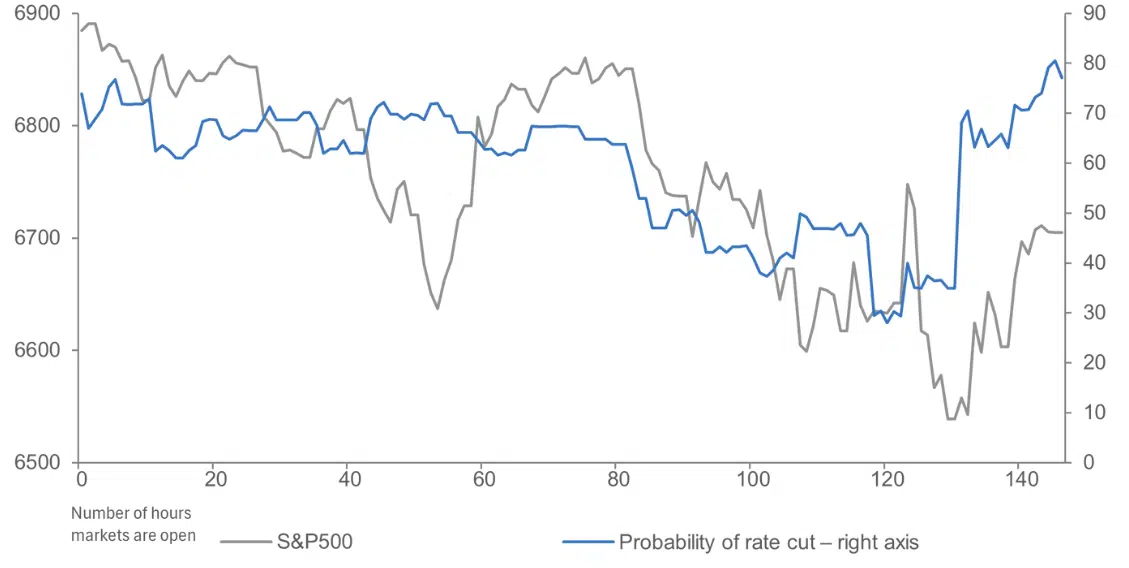
November’s market swings highlight a recurring paradox: are markets following the Fed, or is the Fed following the markets? Despite Nvidia’s record-breaking earnings, tech stocks faltered recently, only to rebound days later on speculation of a December rate cut. The shift was triggered not by fundamentals, but by comments from the Federal Open Market Committee member John Williams.
This dynamic recalls the ‘Greenspan Put’ era, where the Fed seemed to rescue markets in distress. Today, the feedback loop is even tighter: markets anticipate policy moves, while policymakers monitor market signals. The risk is that a parallel reality emerges, one where financial dynamics decouple from economic fundamentals, amplifying volatility and systemic fragility.
Immediate market reaction to probability of rate cut
Source: Bloomberg, Accuracy
AI: between exuberance and disillusion
Artificial intelligence remains the headline act of 2025, with tech giants pledging $5 trillion in investments by 2030. To justify these outlays, annual revenues must soar to $650 billion, up from $50 billion today. Markets appear convinced of an AI-driven revolution, but measuring the resulting macroeconomic effects remains tricky. Though enablers (infrastructure and processing power providers) and monetisers (model developers) seem all in on the technology, adopters (end users, particularly businesses) appear to be less enthusiastic. Indeed, the adoption metrics tell quite a different story:
- Only 11% of US firms report using AI to produce goods and services.
- Workplace use of generative AI fell from 46% in June to 37% in September.
So, why is AI use slowing down? Worker resistance, fears of job displacement and growing doubts about productivity gains are among the major reasons. As with past technological shifts, adoption will likely proceed in waves, not leaps.
Interestingly, some researchers like Yann LeCun argue that current large language models have hit a ceiling; the next breakthrough may hinge on ‘world models’, a paradigm still in development.
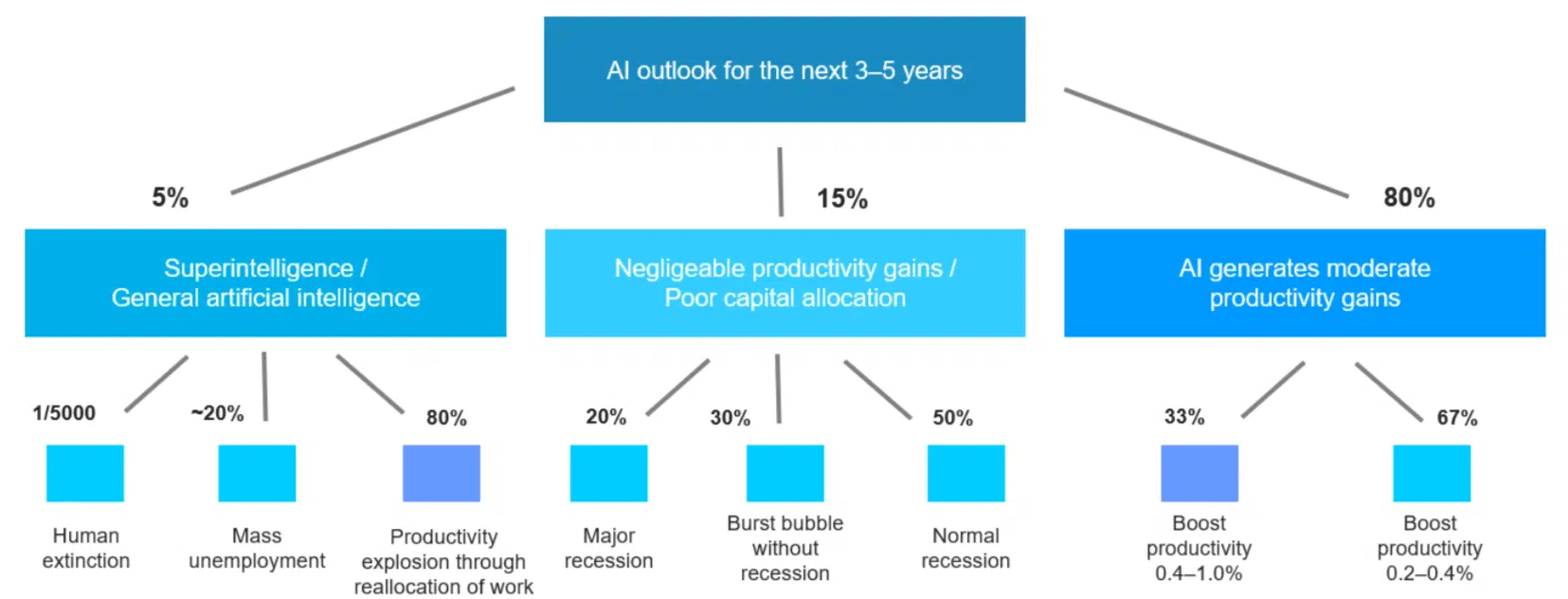
BCA Research, an independent research firm, outlines three scenarios for AI over the next 3–5 years, ranging from transformative gains to tempered expectations. For now, the gap between investment exuberance and real-world impact remains wide.
Growth likely, a burst bubble even more so
Source: BCA, Accuracy