
In this edition of the Economic Brief, we explore three major themes shaping the global economic landscape: the uncertain impact of US trade policy, the productivity puzzle in the age of AI and the growing disconnect between financial markets and economic fundamentals. Let’s take a look.
US trade policy: who’s really paying the price?
Six months after the so-called ‘Liberation Day’, US trade policy remains in flux. Despite repeated threats, including a recent proposal to impose 100% tariffs on pharmaceutical imports, the tariff regime is still far from settled.
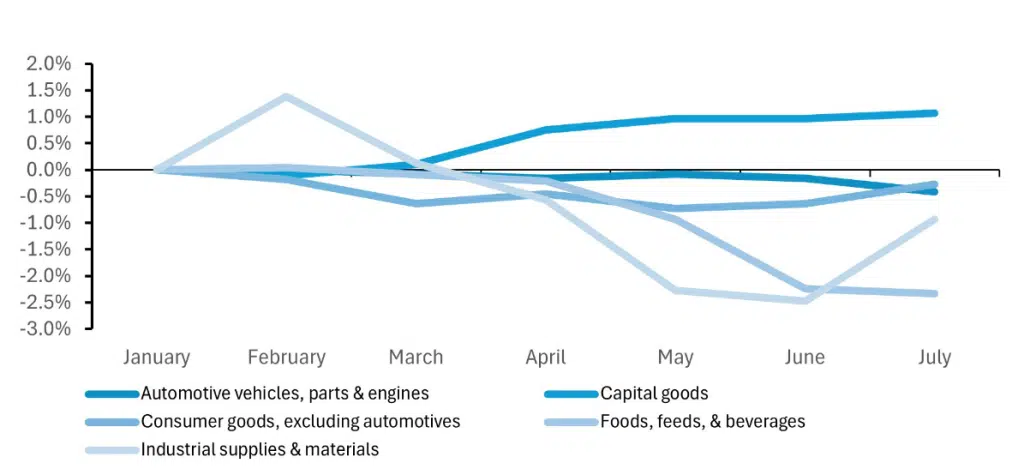
While the average tariff rate has climbed to around 18%, consumer prices for goods (excluding energy and food) have only risen by about 1% since the start of the year. Interestingly, the price of imported goods has increased less than that of many domestically produced items (e.g. electricity – a major contributor to current inflation).
Cumulative variation over the year in prices paid to foreign exporters
Sources: BEA, Accuracy
So, who’s footing the bill? Contrary to President Trump’s claims that foreign exporters are absorbing the cost, the data suggests otherwise: export prices have not significantly declined, and consumer prices have remained relatively stable. Thus, the burden appears to fall on US importers, who are absorbing the cost through margin compression.
In effect, tariffs are functioning as a new tax on American businesses. While the inflationary impact remains limited for now, the long-term sustainability of this margin squeeze is questionable. Over time, importers may pass on the costs to consumers, spreading the burden more widely.
Productivity and AI: a promise yet to materialise
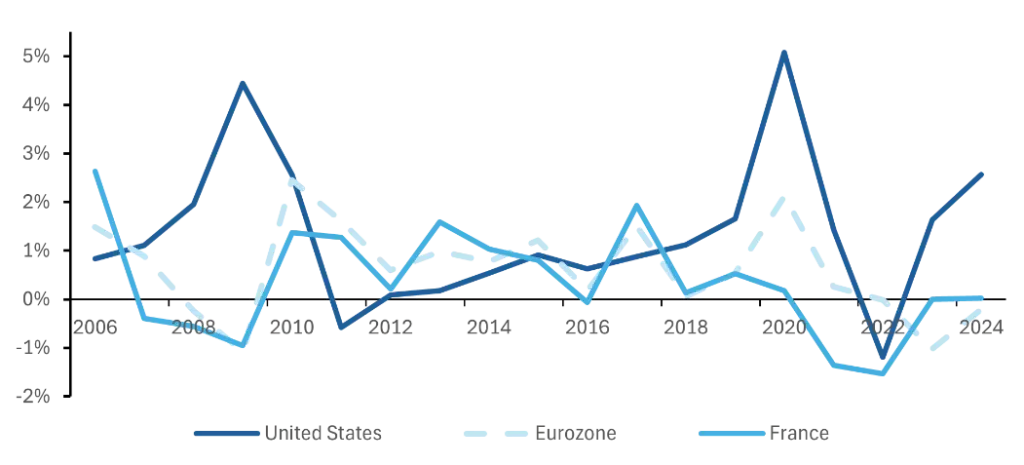
The OECD’s latest report on global productivity paints a sobering picture. In 2023, labour productivity (measured as GDP per hour worked) grew by just 0.6% across OECD countries. The US posted a respectable 1.64%, but France stagnated at 0%, and the Eurozone declined by 1%, with Italy and Estonia seeing drops of -4.17% and -6% respectively.
The culprits? Weak capital deepening and stagnant workforce quality in Europe, both of which remain mildly positive in the US.
Development of productivity
Sources: OECD, Accuracy
In this relatively bleak landscape, artificial intelligence is often hailed as the next big productivity driver. Yet, despite rapid adoption – 23% of employees in the US were reportedly using AI tools by the end of 2024 – tangible productivity gains remain elusive. There are a couple of reasons for this: AI adoption requires time for learning and integration; and gains are likely to be gradual, not immediate.
Moreover, early research from the St. Louis Fed suggests a positive correlation between AI exposure and rising unemployment, particularly in sectors like IT, engineering and mathematics. While these findings are preliminary and may reflect broader economic conditions, they raise important questions about the labour market risks of rapid technological change.
Financial markets and AI: rational investment or bubble brewing
While real-world productivity gains from AI remain modest, financial markets are already pricing in massive returns. In the first half of 2025, tech investment, which was largely AI-driven, accounted for the bulk of US GDP growth contributions.
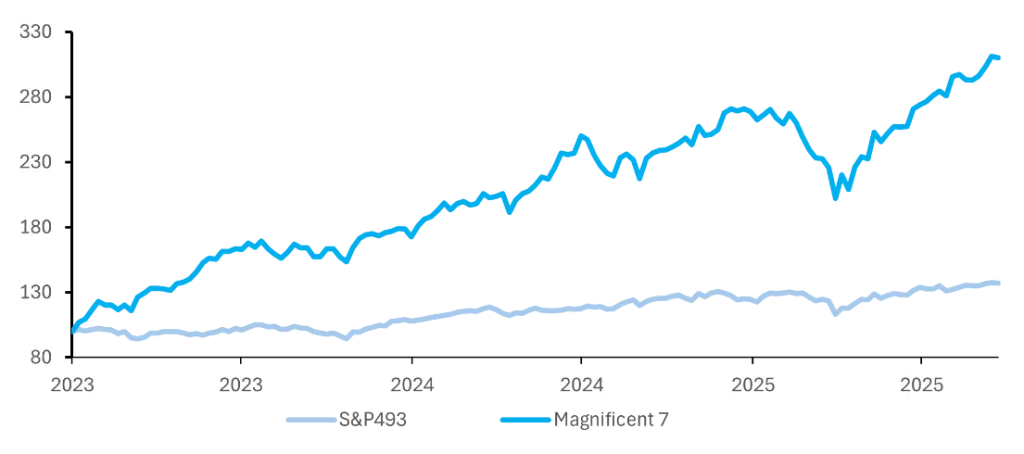
Big Tech has made bold promises: Apple and Nvidia alone have pledged over $500 billion in AI-related investments. But the scale of these commitments raises concerns about overvaluation. The surge in the market capitalisation of the ‘Magnificent 7’ (Alphabet, Amazon, Apple, Meta, Microsoft, Nvidia and Tesla) echoes the exuberance of the early 2000s dotcom bubble.
Magnificent 7 and S&P493 (Base 100 = 2021)
Sources: Bloomberg, Accuracy
Should this bubble burst, the consequences could be severe, with estimated losses of $20 trillion for US households and up to $15 trillion for foreign investors (according to Gita Gopinath, former IMF Deputy Managing Director).
In short, a significant portion of global – and especially American – financial stability now rests on fragile foundations. Caution is warranted.