
Executive Summary
EV charging infrastructure in Europe is at a critical inflection point. Profitability remains elusive despite substantial investments in both AC (alternating current) and DC (direct current) charging networks. The sector faces a fundamental structural challenge: low utilisation rates and high capital expenditure are threatening the financial viability of the entire ecosystem, not just individual operators.
AC charging includes Level 1 (standard home charging) and Level 2 (faster home or workplace charging), where the vehicle’s onboard charger converts AC to DC for the battery. By contrast, DC fast charging, or Level 3, delivers DC directly to the battery.
While AC slow chargers achieve relatively higher utilisation rates – often between 20% and 30% – DC fast chargers, with capital costs reaching up to €80,000 per unit, typically operate at utilisation rates closer to 10%, falling well short of break-even thresholds. As a result, most networks today remain dependent on subsidies and struggle to achieve sustainable returns.
This article questions whether EV charging, as currently deployed, can evolve into a broadly profitable business, or if profitability will remain limited to specific locations, operators, and business models. Although modest improvements in utilisation, smart site selection, and diversified revenue streams (e.g. advertising, fleet partnerships, subscription models) can enhance local profitability, the overall industry still faces systemic risks: heavy reliance on public subsidies, intense price competition, and uncertain regulatory environments.
As government support diminishes and competition intensifies, a fundamental rethinking of the sector’s economics is needed. The future of European EV charging will depend not just on scaling up infrastructure, but on rebalancing high capital costs with realistic demand forecasts and exploring new value-creation strategies, all while acknowledging that some areas (particularly rural and lower-traffic routes) may never achieve commercial viability without continued public support.
Introduction: The Profitability Challenge
Over the past decade, billions have been poured into building EV charging infrastructure – from AC slow chargers (Level 2) and destination charging in public city parking, to DC fast-charging (Level 3) stations along motorways and commercial parking locations. Oil giants, nimble startups, and an array of players in between have entered the market with divergent strategies: some are betting on high-traffic locations; others are expanding aggressively in subsidised positions; and still others are focusing on low-capex, low-maintenance sites. Yet despite this massive investment, one critical question remains unanswered: can EV charging ever become a profitable, sustainable business?
Many assumed that profitability would naturally follow increasing EV adoption – a belief that helped secure early-stage financing for many projects. However, scale alone does not guarantee success. The reality is more complex: low utilisation rates across vast parts of the network, high capital expenditure, and uncertain maintenance costs have left most players struggling to turn a profit.
Recent data shows that the average utilisation of DC fast chargers across several European markets remains around 8–15%, whereas utilisation rates for AC slow chargers are typically higher, ranging from 20% to 30%. These differences largely reflect a combination of technological advances and user preferences: as battery ranges increase and home or workplace charging becomes more accessible, many drivers prefer to start trips with a full battery, avoiding en-route charging unless necessary. This behaviour underscores a key distinction from traditional fuel models, where refuelling during trips is standard practice. In addition, some EV owners may experience range anxiety and therefore avoid longer routes or opt to use an internal combustion engine (ICE) vehicle for such trips.
Fast charging business models are particularly sensitive to utilisation rates and often rely on supplementary revenue streams (e.g. advertising, retail partnerships, or premium services) to achieve financial viability. Similarly, the success of destination charging depends not only on utilisation, but also on collaboration with property owners or integration into broader service offerings.
Why Current Business Models Struggle
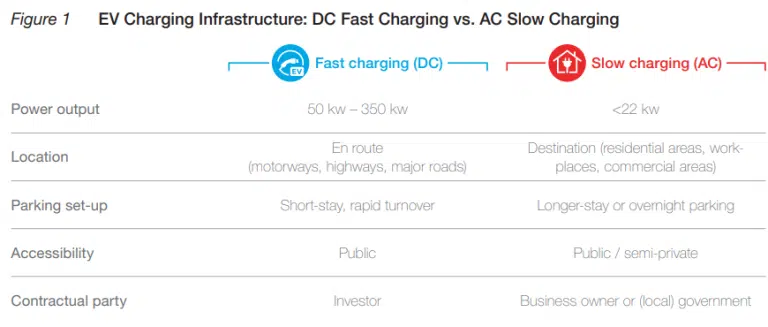
Many operators initially assumed that as more EVs hit the road, demand for public charging would naturally rise and drive profitability. In practice, however, improvements in battery range and the growing convenience of home and workplace charging have reduced reliance on en-route public charging.
Industry estimates suggest that DC fast chargers require a utilisation rate of about 15–20% just to break even. Yet, given the high capital expenditure and ongoing maintenance costs associated with the technology, even reaching this threshold might not be enough. Ambitious projections aiming for 30% utilisation by 2030 would mean each charger must operate around seven hours per day – a level of use currently seen only in dense urban centres or along peak holiday routes. Achieving this consistently across a broad network would be extremely challenging. Moreover, high utilisation itself introduces new risks, such as congestion and long wait times, forcing operators to invest further in site expansion, thereby increasing capital intensity and potentially eroding profitability gains.
Across the sector, a variety of strategies have emerged to address the persistent challenge of low utilisation, with varying degrees of success. While some integrated models, such as Tesla’s Supercharger network, have shown that optimised eco- systems can improve economics in certain contexts, most operators continue to struggle to achieve consistently high use.
The following examples illustrate different approaches and their respective limitations:
- Fast Charging Networks (e.g. Fastned)
Fast charging networks (Level 3), such as Fastned, invest heavily in high-power DC chargers, with unit costs between €40,000 and €80,000. Despite this substantial investment, utilisation rates often remain below the 20% threshold needed for profitability, particularly during off-peak hours or in regions with slower EV adoption.
- Integrated Ecosystems (e.g. Tesla Superchargers)
Tesla’s Supercharger network integrates hardware, software, and vehicle design to optimise the user experience. Strategic site selection has allowed Tesla to achieve relatively higher utilisation rates in some regions, and cost-efficient construction (up to 50% cheaper than competitors) has increased site profitability. However, even within Tesla’s network, utilisation can vary widely by location and season, reflecting how sensitive profitability is to local demand patterns.
- Retail and Destination Charging (e.g. PowerDot)
Slow charger (Level 2) operators like PowerDot focus on retail locations where dwell times are longer. These locations benefit from lower hardware costs (€200–€1,000 per charger), and utilisation rates are typically higher (20–30%) compared with fast chargers.
However, the lower revenue per session limits overall profitability, making financial sustainability highly dependent on location quality and customer volume.
In summary, while some models succeed better than others in managing utilisation, the industry’s structural challenge remains: the financial viability of EV charging networks depends not just on deploying infrastructure, but on achieving and sustaining sufficiently high, location-specific utilisation rates – a goal that remains elusive across much of the European market.
The Financial Reality: A High-Capex, Low-Margin Industry
The financial dynamics of EV charging infrastructure are stark. Establishing a fast charging (Level 3) station involves significant capital outlay, not only for hardware, which typically accounts for about 50% of the initial capex, but also for installation, grid upgrades, permitting, and additional infrastructure improvements, which collectively make up the remaining half. Moreover, operational expenses such as energy procurement, routine maintenance, and land leases can rapidly erode profit margins.
In a highly competitive environment, price pressure further complicates matters. With many operators slashing prices to attract customers, revenue per charge is under constant strain. Many business models have relied heavily on subsidies and regulatory incentives. But what happens when these incentives are phased out? Without them, a subsidy-driven expansion strategy could leave many operators exposed in a market where margins are already razor-thin (see sidebar 1 and sidebar 2).
Moreover, the industry faces additional risks such as regulatory delays, grid connectivity challenges, and intense competition, all of which contribute to a high-capex, low-margin reality that makes long-term profitability a steep uphill battle.
Scenario Analysis: Can Charging Become Profitable?
A key challenge facing EV charging infrastructure is the inherent unpredictability of station use, which has a direct impact on profitability. To gauge how much this matters, we modelled two ten-year demand paths for a single greenfield site: a Base Case that freezes today’s load factors and a Best Case in which the utilisation rate increases steadily until it reaches double the current level. For each scenario, we then calculated the following two key metrics:
- Net present value (NPV)
This corresponds to the cumulative ten-year cash surplus (revenues minus operating expenses, taxes, and reinvestments), discounted at the applied interest rate. The calculation accounts for both the initial capital expenditure and any additional investment required during the asset’s life, such as mid-life maintenance or hardware replacement.
- Annualised discounted return on investment (DROI)
This is calculated as the ratio of NPV to the present value of total invested capital (including initial capex and any reinvestments such as mid-life replacement or maintenance). This measure reflects the average annualised return generated by the project over its lifetime after accounting for the time value of both costs and cash inflows.
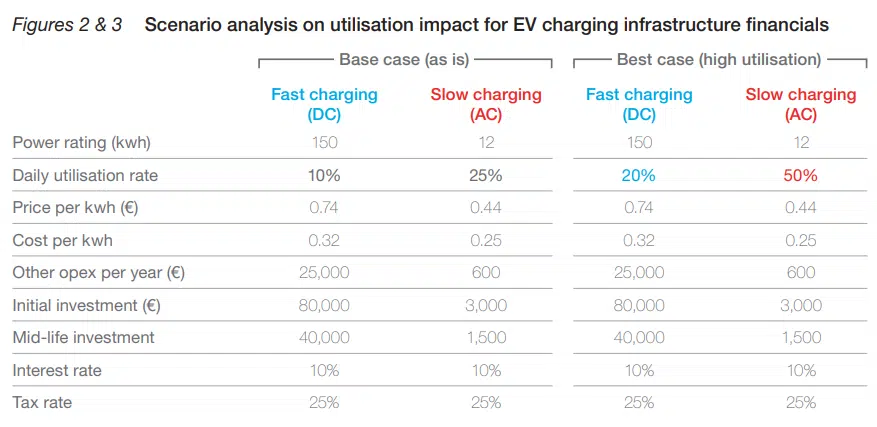
Scenario Analysis: Can Charging Become Profitable?
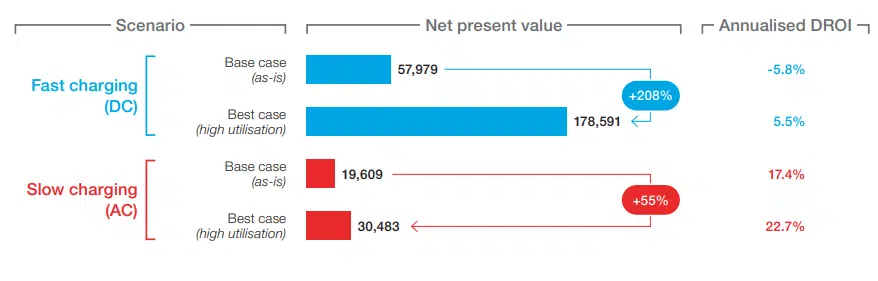
Fast charging remains a scale – and patience – game. Even when utilisation doubles, the DROI for a DC fast charger only reaches the mid-single digits. The relatively high NPV in the best case (≈ €180k) reflects strong cash flows over time, but because they arrive late in the project life, they do not translate into a strong annual return.
Slow charging looks more attractive in percentage terms but is modest in euro terms. Because capex is so much lower, an AC charger already delivers a positive return at today’s 10% utilisation levels, and the DROI rises above 20% when use doubles. However, the total value it generates over ten years is far smaller than what a fast charger delivers in the best case.
The scenario analysis points to several practical implications for charging infrastructure strategies.
First, DC charging sites are unlikely to deliver attractive financial returns on their own. Even in the Best Case scenario, annualised returns remain in the mid-single digits. To make these assets viable from an investment perspective, additional sources of value, such as revenues from adjacent services or broader balance-sheet benefits, are likely to be needed.
Second, AC destination charging offers stronger financial returns relative to cost but remains limited in scale. While individual sites can be financially attractive, the total euro value created per charger is modest. As a result, AC is unlikely to make a material impact at portfolio level for operators pursuing large-scale deployment.
Taken together, these findings highlight the importance of aligning deployment choices with the underlying economics of each charging format. Operators and investors will need to balance short-term financial performance with longer-term strategic positioning, recognising that neither technology offers a complete solution on its own. Building a viable public charging business will depend on combining disciplined capital allocation, targeted utilisation gains, and, where appropriate, complementary revenue sources to improve overall project viability.
Beyond Charging: The Path to a Profitable Business Model
Clearly, charging fees alone will not be enough to turn the tide. Operators must explore diversified business models to build a sustainable future in the EV charging space. A key consideration is that while a good strategy can optimise locations, this may not be viable for rural areas. We set out below several promising strategies to boost profitability.
- Fleet solutions
Partnering with logistics firms, rideshare services, or taxi fleets can secure stable, high-utilisation contracts. Such partnerships can provide a steady stream of revenue, helping to offset the variability of individual consumer charging behaviour.
- Advertising opportunities
Integrating digital advertising displays at charging stations offers a supplementary income stream. However, the success of this model depends on high utilisation rates to attract advertisers. For instance, Numbat, a European EV charging network that incorporated digital out-of-home advertising, faced insolvency partly due to lower charger use than expected, highlighting the risks associated with relying solely on advertising revenues. (1)
- Subscription services
Offering subscription-based models can provide operators with predictable and consistent revenue. Companies like IONITY have implemented monthly subscription plans, allowing customers to benefit from reduced charging rates across their European network. These plans are designed to appeal to regular users by offering cost savings compared with pay-as-you-go options.
- Retail partnerships
Many charging points are located near shops, offering potential for partnerships and cross-promotions. Indeed, in Europe, 28% of chargers are within 100 metres of retail locations. Collaborations with retail businesses can enhance the attractiveness of charging stations and create mutual benefits for both parties. For example, E.ON Drive Infra- structure partners with retailers, hotels, and restaurants to install charging points, thereby increasing customer traffic and providing added convenience for EV drivers. Such partnerships not only generate additional revenue for charging operators but also support the host businesses by attracting a broader customer base.
In short, while charging fees remain the cornerstone of revenue, a sustainable business model for EV infrastructure – particularly in the context of a continent-wide roll-out – would rely heavily on complementary strategies. These may include advertising, subscription services, fleet partnerships, and retail integration. Each offers its own potential and risk profile, and success will depend on tailoring the approach to location, demand patterns, and user behaviour.
1. Sidebar: Reliance on Subsidies and Regulatory Incentives
a. Introduction
As EV charging companies navigate the challenge of profitability, their reliance on subsidies and regulatory support has become increasingly apparent. Government incentives have significantly boosted growth and facilitated infrastructure roll- out. Indeed, the role of the government so far has been essential, particularly given ambitious targets for EV adoption and infrastructure deployment. There is a strong argument for greater government intervention to meet the European Commission’s target of 3.5 million public charging points by 2030, especially in light of rising grid constraints, growing capital intensity, and the need for infrastructure expansion beyond urban centres.
Nevertheless, the industry’s heavy dependence on public support introduces significant business model vulnerabilities, highlighted by recent developments across Europe. Regulatory shifts and subsidy withdrawals in the Netherlands, such as the phasing out of purchase incentives, upcoming tax increases on EV ownership, grid congestion challenges, and fragmented permitting processes, underscore the challenges posed by reduced governmental support. Similarly, Germany’s abrupt termination of its EV subsidy scheme and the subsequent sharp drop in EV sales illustrate the immediate risks to market stability when public incentives diminish.
Additionally, the current geopolitical climate compounds these vulnerabilities. Growing economic protectionism, trade tensions, and regionalisation of supply chains may increase hardware costs and further complicate infrastructure deployment. These shifting regulatory and geopolitical landscapes demonstrate the sector’s vulnerability to external changes and highlight the need for charging operators and investors to closely monitor and anticipate government actions and international developments. Ultimately, the future of EV infrastructure success in Europe may depend heavily on navigating these combined governmental and geopolitical uncertainties.
b. Heavy Dependence on Subsidies and Regulatory Incentives
The industry has relied on government support to offset high costs, but this comes with risks. While the Netherlands continues to support EV adoption, recent regulatory changes also present challenges:
• End of purchase incentives – The government is phasing out EV subsidies for private buyers, making new EVs less affordable and potentially slowing adoption rates.
• Tax increases – From 2025, EVs will no longer be exempt from BPM (registration tax), and the motor vehicle tax (MRB) discount will decrease, raising ownership costs. (2)
• Grid congestion – The rapid expansion of charging infrastructure is straining the electricity grid, causing delays in new connections and increasing costs for operators. (3)
• Complex permitting – Local regulations for public charging stations remain fragmented, leading to long approval processes and inconsistent infrastructure roll-out.
Germany recently ended its EV subsidy scheme, which had previously provided financial incentives to buyers, significantly boosting adoption rates. The abrupt termination of these subsidies at the end of 2023 led to an immediate and sharp decline in EV sales in early 2024, as consumers rushed to purchase vehicles before the incentives expired.
According to MIT Technology Review, registrations of battery electric vehicles (BEVs) in Germany dropped by over 50% in January 2024 compared with the previous month. This shift highlights the extent to which EV adoption in Germany has been dependent on government support, raising concerns about the market’s ability to sustain growth without continued financial incentives. The impact is particularly pronounced among private buyers, who now face higher upfront costs, potentially slowing down Germany’s transition to electromobility. (4)
While these changes aim to balance government spending and infrastructure growth, they may also slow EV adoption and create financial hurdles for charging operators.
c. Regional Variations
In Europe, the landscape of incentives for EV charging infrastructure is notably diverse, with each country implementing distinct schemes to promote the adoption of EVs. This variability poses challenges for companies aiming to expand their operations across multiple European markets, as they must navigate and comply with a complex array of national and regional regulations and benefits.
d. Finland’s Incentive Structure
Finland exemplifies this regional variation through its specific subsidy programmes designed to encourage the development of public EV charging stations:
• Subsidy for standard public charging stations – The Finnish government offers a 30% subsidy for the construction of public charging stations with a capacity exceeding 11 kW.
• Subsidy for fast public charging stations – For fast-charging stations with capacities exceeding 22 kW, the subsidy increases to 35%.
These targeted incentives are part of Finland’s broader strategy to promote sustainable transportation and reduce carbon emissions.
e. Comparative Insights
The Finnish model contrasts with incentive structures in other European nations:
• Poland offers grants covering up to 25% of eligible costs for constructing charging stations with a power of at least 22 kW, applicable to various entities including local governments and entrepreneurs.
• The United Kingdom provides a voucher-based scheme covering up to 75% of purchase and installation costs for companies installing charging stations, with tax benefits for expenditure on charging infrastructure. (5)
Such disparities illustrate the complexity of cross-border expansion for EV infrastructure providers, necessitating tailored strategies that align with each country’s regulatory and incentive frameworks.
f. Conclusion
These shifting regulatory landscapes clearly demonstrate the sector’s vulnerability to policy changes and emphasise the need for charging operators and investors to closely monitor regulatory trends. A proactive strategy – anticipating subsidy reductions and regulatory shifts – will be essential for long-term viability and strategic planning across the European EV charging market.
2. Sidebar: Impact of Competition – Price Wars and Margin Erosion
a. Introduction
As the EV charging market expands, intensifying competition among operators has triggered aggressive pricing strategies, putting additional pressure on an already challenging path to profitability. This competitive dynamic has a direct impact on margins, posing risks that must be carefully managed to sustain long-term viability.
b. Price Wars
As more companies enter the EV charging sector, the heightened competition has led to aggressive pricing strategies. Operators are reducing charging fees to attract customers, initiating price wars that diminish profit margins. This trend is expected to escalate, especially as EV sales growth shows signs of slowing and carmakers continue to increase EV production. Such market dynamics may result in an oversupply of charging stations relative to demand, further intensifying price competition.
c. Margin Erosion
Several factors contribute to the erosion of profit margins for charging station operators:
• High installation costs – Establishing charging infrastructure requires substantial capital investment, encompassing expenses related to equipment, installation, and compliance with varying regional regulations.
• Underutilisation – Many charging stations face low utilisation rates, prolonging the return-on-investment period and straining financial viability.
• Lack of differentiation – With numerous operators offering similar services, distinguishing between offerings becomes challenging, leading to commoditisation and reduced pricing power.
These challenges call for strategic responses from operators, such as exploring additional revenue streams, enhancing service differentiation, and pursuing economies of scale to maintain profitability in a competitive European EV charging market.
d. Conclusion
Given these intensifying competitive pressures, operators must carefully balance pricing strategies against profitability.
Developing differentiated business models and additional revenue streams, such as advertising, fleet partnerships, or subscription models, will be increasingly critical. Proactively addressing these margin pressures is essential to securing a stable position within Europe’s evolving EV charging landscape.
The Future: Who Will Survive?
As public funding tightens and subsidies begin to wane, market consolidation appears inevitable. Vertically integrated players (e.g. BP, Shell, and TotalEnergies) that control large parts of the energy value chain and operate within proprietary ecosystems, are well-positioned to lead the next phase of market development. Their ability to cross-subsidise charging infrastructure, leverage energy trading capabilities, and integrate with vehicle platforms provides a distinct competitive edge.
By contrast, independent charge point operators (CPOs) lacking scale, differentiation, or diversified revenue streams are likely to face rising pressure. Without a clear path to profitability, many may struggle to survive in a market that is becoming more mature and more competitive.
Regulation will also play a decisive role in shaping the future landscape. If authorities enforce open-access policies to foster interoperability and fair competition, pricing pressure may intensify, further compressing already narrow margins. The industry is transitioning from an initial growth phase focused on rapid deployment and subsidised expansion to a more selective and disciplined phase centred on business model viability and strategic positioning.
This evolution raises important questions for independent players: even with differentiated offerings, can smaller operators truly achieve sustainable profitability if fundamental utilisation challenges persist? Or will their most viable path be to seek acquisition by larger integrated groups? While private innovation and niche positioning may create opportunities, the realities of capital intensity, utilisation dependence, and driver behaviour suggest that achieving standalone success will become increasingly difficult without scale or strategic partnerships.
Recent trends highlight this shift. Operators like Tesla and Powerdot have demonstrated that integrated, location-optimised strategies can yield profitability. However, replicating these successes at scale, particularly across the diverse geographies of the EU, remains a formidable challenge.
A deeper policy question is also being raised: is it solely the responsibility of private operators to create a profitable charging network, or should governments and OEMs play a more proactive role – particularly in ensuring en-route and rural charging coverage that may never become commercially viable on its own? (see sidebar 1)
While private innovation and investment are critical, a sustainable, inclusive charging network will likely require a blended approach, involving public-private partnerships, regulatory support, and targeted incentives to close the gaps where market forces alone are insufficient.
Conclusion: Rethinking EV Charging Profitability
The EV charging sector can no longer rely on the assumption that simply adding more chargers will automatically lead to profitability. The reality is that scale alone is not enough. The industry must move beyond a pure infrastructure mindset and embrace smarter, more strategic business models that optimise utilisation, improve cost efficiency, and diversify revenue streams.
Success will depend on creating value beyond just selling electricity, whether through retail integration, fleet partnerships, energy market participation, or innovative subscription models. Investors and policymakers must reassess their approach to EV charging, fostering an environment where profitability and sustainability go hand in hand. The coming years will be decisive in determining whether EV charging evolves into a profitable, self-sustaining component of the energy transition, or whether it remains a heavily subsidised necessity with no clear path to financial viability.
Attention Points for Investment Decisions
As the EV charging sector faces structural profitability challenges, investors and corporates must make well-informed decisions before committing capital. Understanding market dynamics, assessing business model viability, and conducting rigorous scenario analyses are crucial to navigating this changing landscape.
The road to profitability in EV charging is complex, but with the right analytical approach, investors can identify sustainable, value-generating opportunities rather than relying on assumptions of scale or continued subsidies.
At Accuracy, we combine financial expertise with deep market insights to help our clients evaluate investment opportunities, stress-test business plans, and develop resilient strategies. Our integrated teams go beyond purely commercial or financial analysis, providing 360-degree assessments that ensure every decision is based on robust financial and strategic considerations.
Note
1) Sixteen Nine – https://www.sixteen-nine.net/2024/08/13/dooh-bolstered-ev-charging-network-in-europe-now-insolvent/
2) RVO – https://www.rvo.nl/onderwerpen/elektrisch-vervoer/financiele-ondersteuning
3) Netbeheer Nederland – https://www.netbeheernederland.nl/artikelen/nieuws/uitbreidingen-van-het-net-worden-goed-zichtbaar-wachtrijen- blijven-bestaan
4) MIT Technology Review – https://www.technologyreview.com/2024/09/23/1104247/ending-ev-subsidies/
5) EVBox – https://blog.evbox.com/ev-charging-infrastructure-incentives-eu
Martijn Vogelaar – Director – Accuracy
Bianca Van Zijderveld – Senior Manager – Accuracy
Sven Van Wijk – Senior Associate – Accuracy