What is a car? The usual definition is as follows: a light, motorised land vehicle, generally with four wheels, designed for the individual transport of people and luggage. The need for such means is enduring, but the way it is met – and therefore the product itself – can change. The economist would add that it is a durable consumer good, meaning a product designed for repeated and prolonged use over time. Since one does not buy a car every day, sales and production follow a cyclical pattern. Booms and slumps frame more typical periods.
Predicting what will happen tomorrow is, therefore, rather complicated. The sociologist, tempted to add her grain of salt, would note that the way we use cars, and therefore our interest in them, evolves in line with societal changes. For instance, the middle class disturbed by shifts in the economic system alters demand segmentation (entry-level and luxury vehicles gain ground to the detriment of mid-range models).
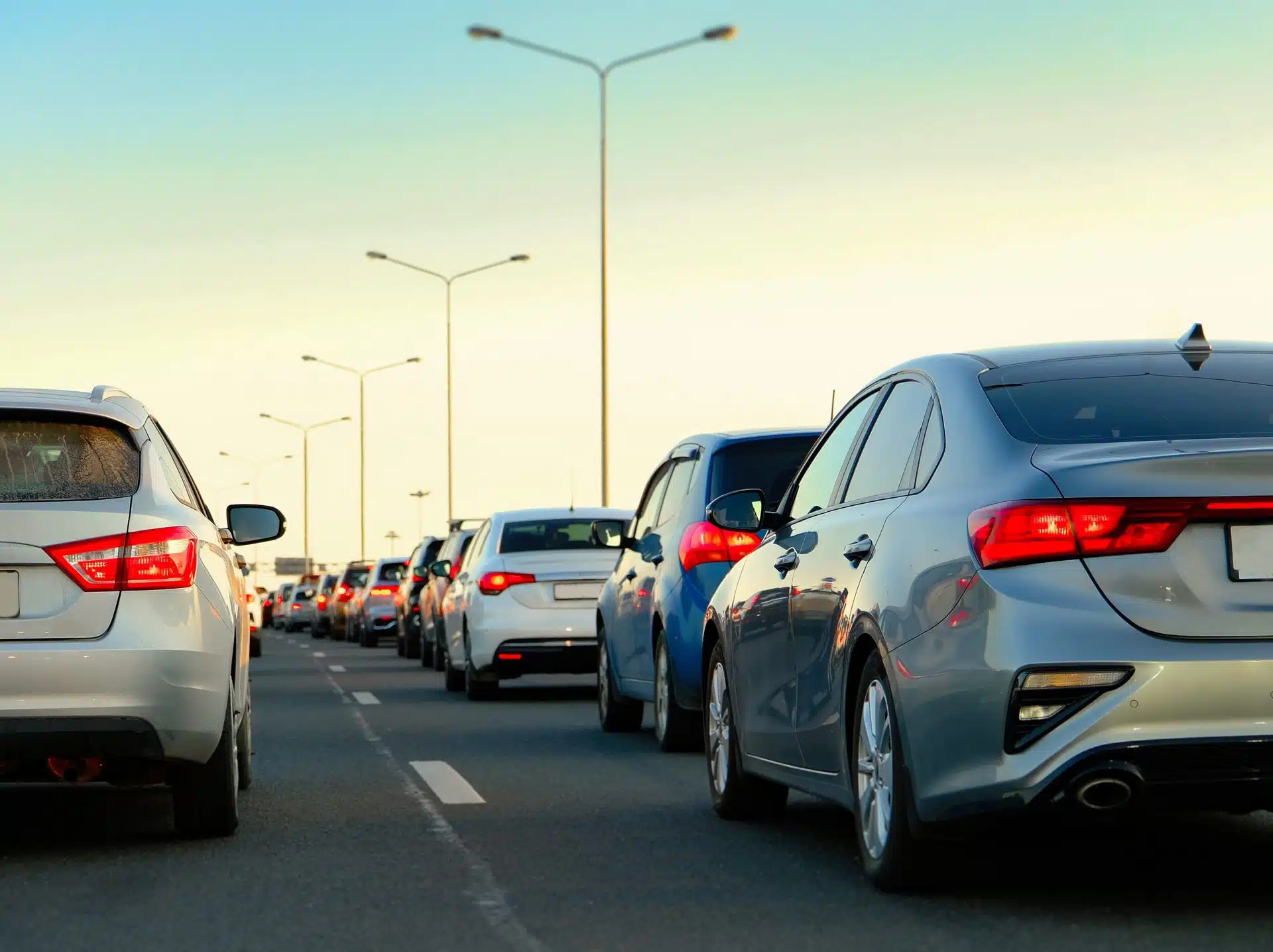
Even the anthropologist, who studies the long-term trends and the constants of human societies, finds his convictions shaken. Roland Barthes, admittedly more of a semiologist than an anthropologist, wrote in 1957 that ‘cars today are almost the exact equivalent of the great Gothic cathedrals… consumed in image if not in usage by a whole population which appropriates them as a purely magical object.’ The symbol of freedom long associated with the car is now being called into question. Increasing congestion on road networks makes alternative, often collective, solutions more attractive. And although internal combustion engines are efficient and inexpensive, they pollute.
In today’s world, marked by a long series of transformations (from environmental and technological shifts to changes in lifestyles, mobility needs and socio-economic structures), the car must adapt. The challenges in the coming years will likely follow two main trajectories: autonomous and shared mobility on the demand side, and a circular economy on the production side (drawing here on the ideas of the futurist Michel Levy Provençal).
Reducing both urban congestion and pollutant emissions, while improving road safety, requires a rethink of mobility. In parallel to technological advances (vehicles will gradually become electric and autonomous), business models will evolve, with mobility services developing alongside vehicle sales (autonomous fleet management, leasing, shared journeys, etc.).
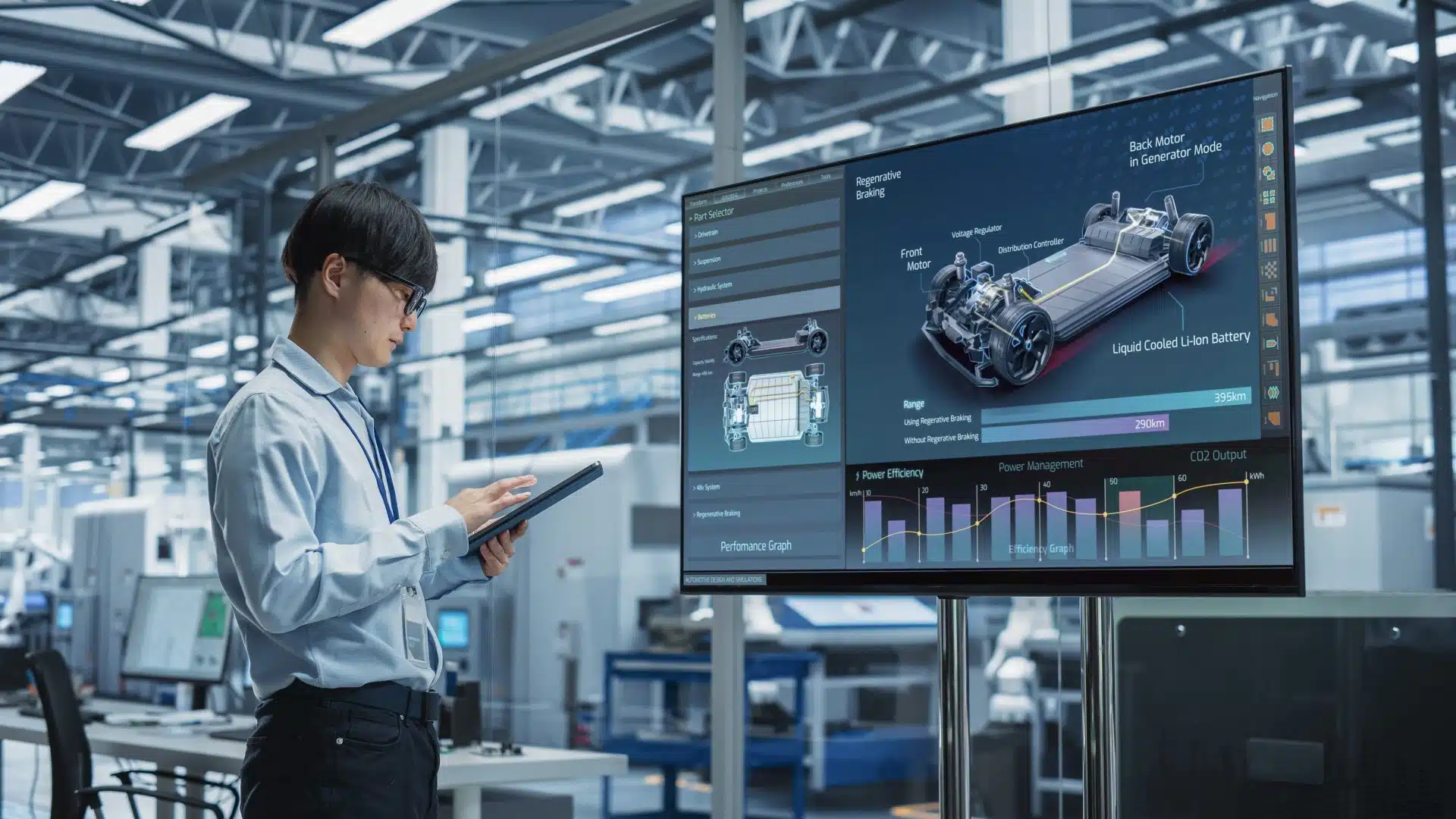
Of course, the challenges ahead are significant: access to appropriate technologies, the cost and financing of transformations – whether in manufacturing or infrastructure – regulatory changes and social acceptance.
The automotive sector must also embrace the circular economy, from vehicle design and manufacture to the introduction of new infrastructure, such as electric vehicle charging stations and battery reconditioning at end-of-life.
This represents a potential rupture with current practices. Over the past decades, and still today, the automotive industry has exemplified both the international division of labour and commercial integration. Producing cars (and similar professional vehicles) requires sophisticated supply chains, often designed globally, and the manufacturing location often depends on a mix of market size, production costs and economies of scale.
That is the roadmap. Implementing it will mean overcoming two major obstacles.
First, there is the competition from Chinese manufacturers for traditional carmakers. Backed by its government, China’s electric vehicle industry has become, if not the global benchmark, then a formidable and unavoidable competitor. Is this acceptable to the big names in the sector, be they American, Korean, European or Japanese? If the answer is no, will the Chinese model, despite criticism, be one to follow (and to what extent?)?
Second, there is an uncertain international economic environment, which is not conducive to risk-taking and therefore slows decision-making. US trade policy seems to be heading in a direction not seen for nearly a century. What impact will this have on growth, inflation, interest rates and exchange rates?
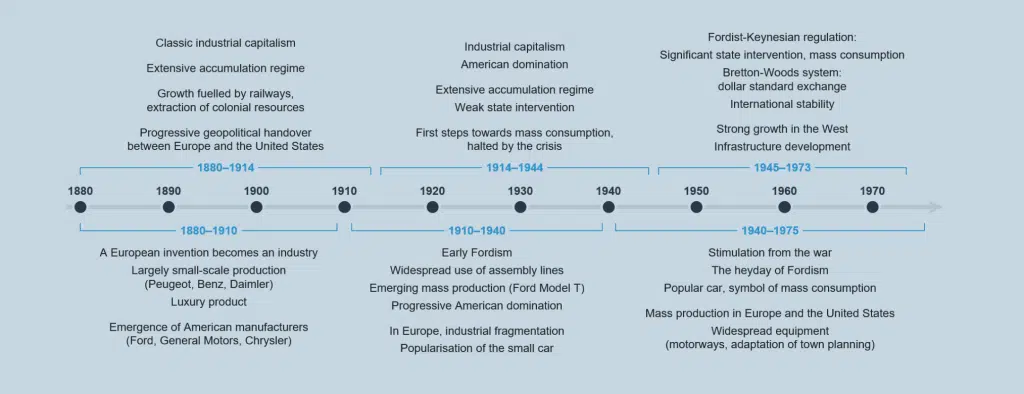
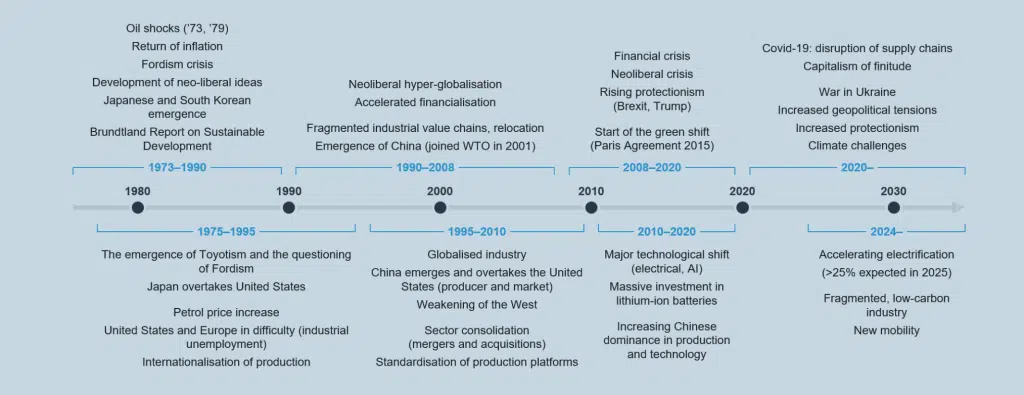
The diagnosis appears rather bleak, with the sense that the hurdle to adapting to the new ‘rules of the game’ is extremely high. Might traditional manufacturers find that the bar is simply too high to clear? Perhaps – at least for some of them. Nonetheless, a look back at the automotive adventure since its beginnings almost a century and a half ago reveals two things: a mirror effect between economic transformations and those in the automotive industry and, following this, a Schumpeterian logic of creative destruction. Everyone is seeking to adapt, but there will be winners and losers.
Can we already identify them?