
Investment arbitration is often reduced to two headlines: who prevailed and how much was awarded. These indicators undoubtedly matter. Yet they can obscure the full quantum picture and the broader financial consequences of a dispute.
As is often the case, the significance lies in the details. A party may be found liable yet face limited financial exposure if the tribunal substantially reduces the claimant’s quantum. Conversely, the consequences of arbitration often extend beyond the damages awarded and encompass legal costs, management distraction, reputational impacts and potential effects on future investment. These issues may arise in different forms and materialise over different time horizons, making a broader assessment essential to understanding the true financial implications of a dispute.
This article draws on a study of investment arbitration cases involving African states or Africa-related investments over the ten years between 2015 and 2025. The study considered cases across arbitral fora, using publicly available information, including data available through the United Nations Conference on Trade and Development, supplemented by other public sources on the relevant arbitrations.¹
The objective is not to offer an exhaustive econometric analysis, nor to suggest that publicly available data capture the full picture. Rather, it is to identify the broad trends that can be observed from available information: case volume, outcomes, amounts claimed and awarded where known, sector distribution and the implications for states, investors and financial experts.
Study scope and methodology
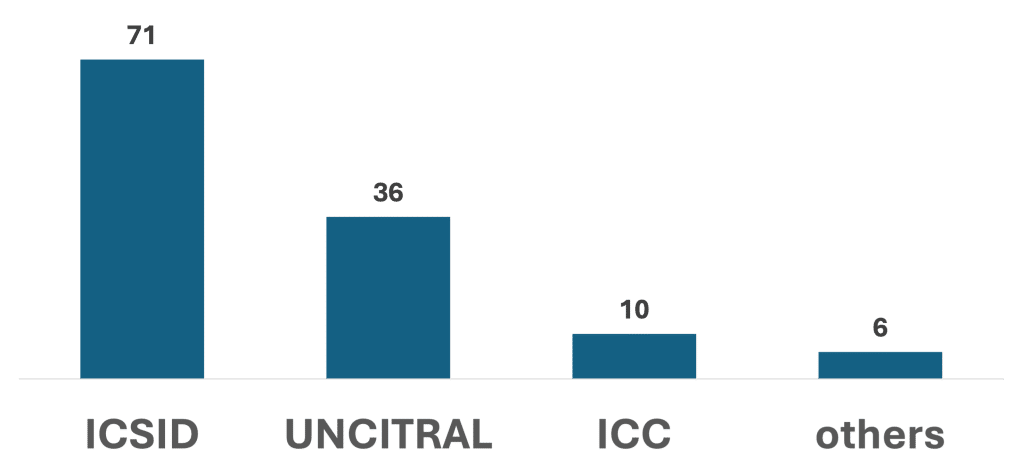
The study reviewed investment arbitration cases involving African states over a ten-year period from 2015 to 2025, across all available fora. The dataset comprises 123 cases. The majority were administered by the International Centre for Settlement of Investment Disputes, with 71 ICSID cases identified. A further group of slightly more than 34 cases proceeded under the UNCITRAL rules. Approximately ten cases were identified before the International Chamber of Commerce, with a small number of additional cases before other fora.
Number of arbitration cases involving African states over 2015–2025 by forum
As the study is based on publicly available information, this creates several limitations. First, not all investment arbitrations are public, and even where the existence of a case is known, pleadings, awards, settlement terms and quantum materials may not be available. Second, the public record is uneven across fora. ICSID cases are generally more visible than many ad hoc or contract-based arbitrations, and UNCITRAL cases may vary significantly in the degree of transparency. Third, data on amounts claimed and awarded are not always disclosed.
These limitations are important. The figures presented below should therefore be understood as indicators derived from available public information, rather than as a complete statistical account of all Africa-related investment arbitration activity. Where the available data do allow meaningful observations, however, several patterns emerge.
Evolution of Africa-related investment arbitration since 2015
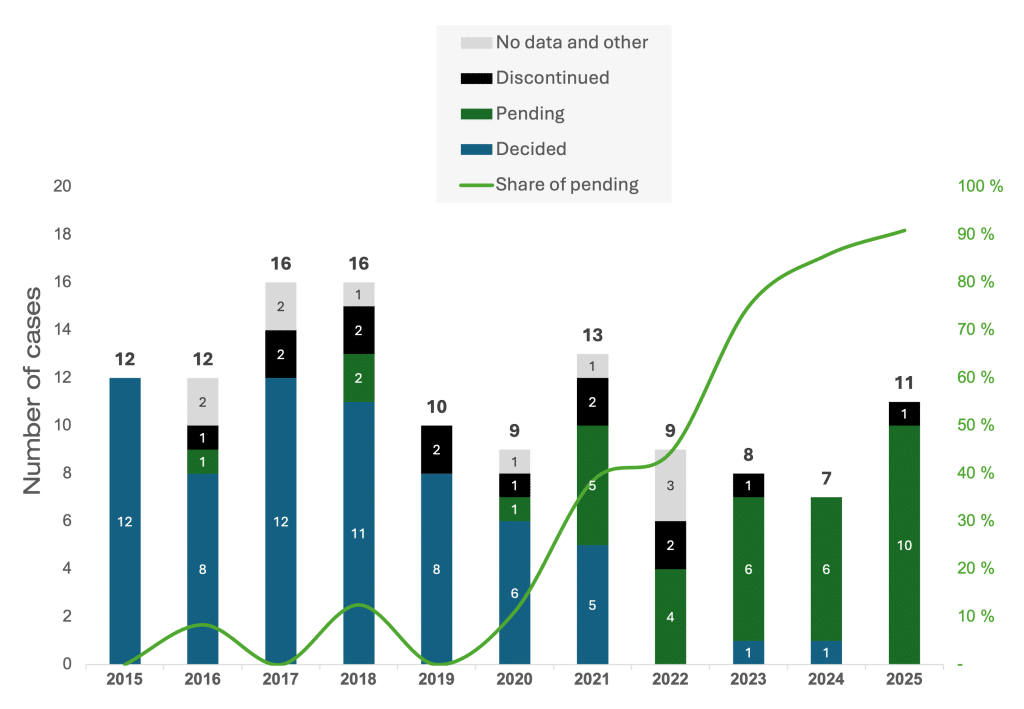
The first notable finding is the volume of disputes. Slightly more than 120 investment arbitration cases involving African states or Africa-related investments were identified between 2015 and 2025. This is a substantial number over a ten-year period and confirms that investment arbitration remains a significant feature of the legal and financial landscape on the continent.
Of these cases, around 35 cases, or approximately one third of the total, remain pending at the time of the study. Other proceedings were discontinued or otherwise did not result in a final adjudicatory outcome. In total, 65 cases had resulted either in a decision or in a settlement.
This represents approximately half of the cases opened during the period under review.
That such a large proportion of cases remains pending is itself significant. Investment arbitration is typically a multi-year process. For states, this means that the financial and institutional burden of a dispute may extend well beyond the moment at which the arbitration is filed. For investors, it means that recovery, even where ultimately achieved, may be delayed for several years. For lenders, sponsors and financial experts, the prolonged duration of a dispute may become a material factor in assessing project value, enforcement risk, country risk and the cost of capital. For tribunals, pre- award interest is of considerable importance due to the length of the proceedings.
Number of arbitration cases involving African states over 2015–2025 by year²
Sector analysis
The distribution of cases by sector confirms the continuing importance of capital-intensive, state- regulated industries.
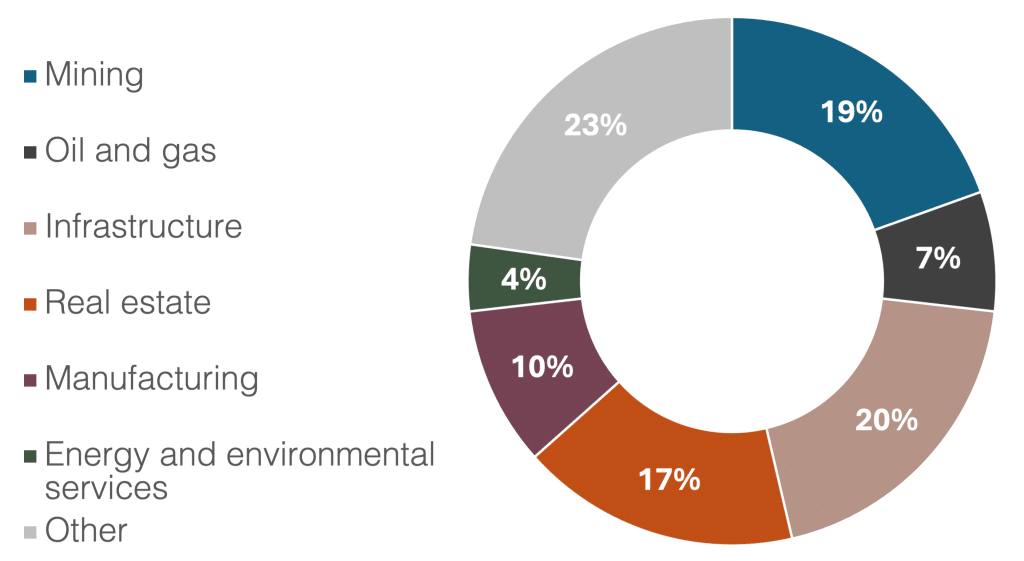
Over the period reviewed, mining, infrastructure, and oil and gas together accounted for approximately half of the investment arbitration cases involving African states or Africa-related investments. These sectors therefore remain central to the arbitration landscape. This finding is also consistent with the longer-term picture reportedly identified in an analysis by the Nigerian law firm G.O. Sodipo & Co. with respect to ICSID cases involving African states.³
Sector representation in arbitration cases involving African states over 2015–2025
The reasons are not difficult to identify. Investment arbitration tends to arise where private investors commit upfront significant capital in a sector heavily shaped by public regulation, licensing, concessions, taxation, local content rules, environmental controls or state participation. Mining, oil and gas, and major construction and infrastructure projects fit that profile closely. They often involve long development periods, high upfront capital expenditure, exposure to commodity prices, evolving regulatory frameworks and complex relationships with state entities.
However, the other half of the dataset is equally important. It shows that Africa-related investment arbitration is not confined to extractive industries and infrastructure.
This diversification is significant. It reflects, at least in part, the gradual diversification of African economies and of foreign investment on the continent. As investment expands beyond traditional extractive sectors, disputes also emerge in a wider range of industries. This does not mean that mining, construction and hydrocarbons have become less important. They remain highly prominent. But the arbitration landscape increasingly mirrors a broader investment landscape, including manufacturing, services, real estate, agribusiness, logistics and environmental activities.
For practitioners, this sector diversification has consequences. Different sectors raise different quantum issues. A mining valuation may depend heavily on reserves, commodity price forecasts, permitting, construction schedules and discount rates. A construction dispute may turn on delay, disruption, variations, termination and project financing. A manufacturing claim may require analysis of capacity utilisation, input costs, market access and operating margins. Financial services, hospitality, media and logistics each raise their own valuation and causation challenges. Sector expertise is therefore central to both liability strategy and quantum analysis.
Outcomes and awards
Among the 65 cases that had reached either a decision or a settlement, the outcomes show a relatively balanced, albeit state-favourable pattern.
Approximately 26% resulted in a decision in favour of the investor, while 45% resulted in a decision in favour of the state, meaning that the investor’s claims were rejected. The remaining 28% ended in settlement.
Outcomes in arbitration cases involving African States over 2015–2025
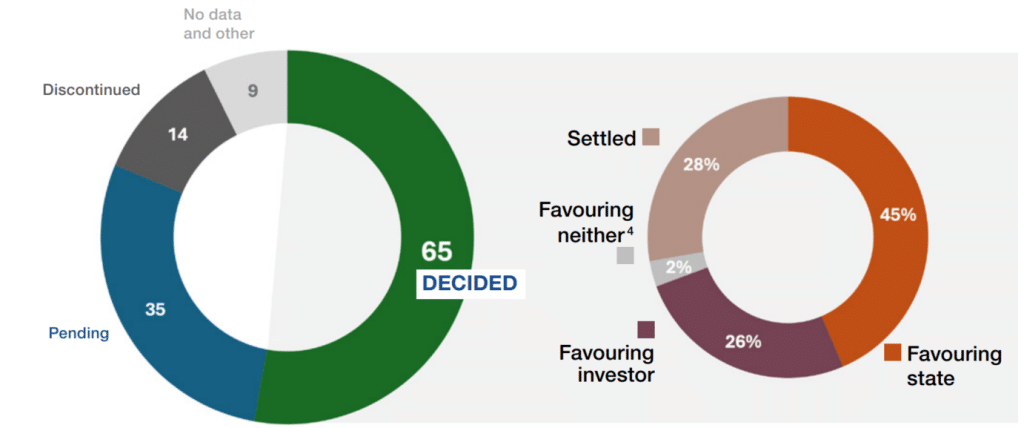
These figures can be read in two different ways.
On the one hand, if settlements are treated as at least partially favourable to investors, then investors obtain some form of positive outcome in roughly one case out of two. That interpretation is plausible in many cases because settlements often involve some form of compromise, payment, renegotiation or commercial accommodation. However, settlement terms are often confidential, and the public record does not always disclose whether the investor received monetary compensation or some other benefit.
On the other hand, if settlements are excluded and only adjudicated decisions are considered, the picture is more favourable to states. On that basis, approximately one third of decisions are favourable to investors, with the remainder being favourable to states.
The outcome data therefore supports a nuanced conclusion. Investment arbitration does not appear, on the basis of this dataset, to result systematically in investor victories against African states; indeed, states prevail in a significant proportion of adjudicated cases. At the same time, investor success is not rare, and settlements form a substantial part of the overall picture.
Amounts claimed and amounts awarded
From a financial perspective, an important question is often not how many cases are brought, but how costly the adverse cases can become.
Investor claims in the dataset can be very large. Public information on amounts claimed remains limited, but figures were available for slightly more than 70 cases. In that sample, claimed amounts ranged from approximately USD 2 million to USD 2.7 billion. The average claimed amount was approximately USD 370 million.
Claimed amounts in arbitration cases
involving African states over 2015–2025 (in USDm)
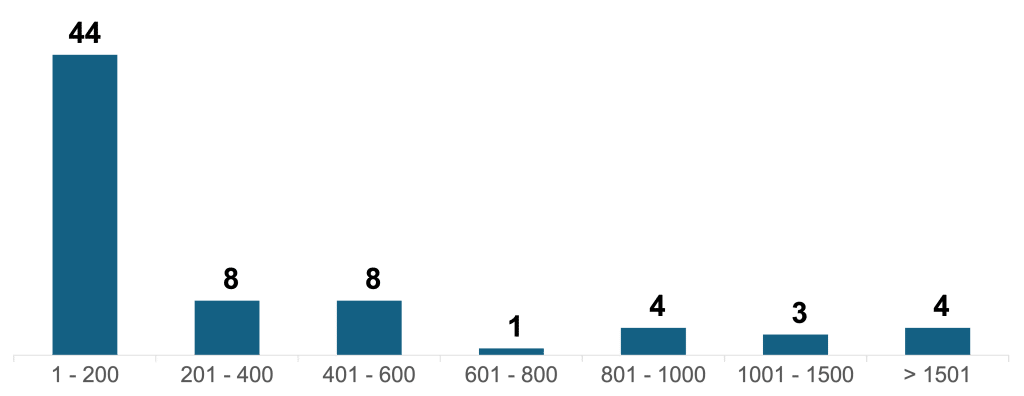
These figures confirm that the theoretical exposure faced by states can be significant. Claims in the hundreds of millions of dollars, and in some cases in the billions, can be brought even where projects are not yet fully developed. This is familiar in quantum practice. Investors may advance claims based on projected cash flows, expected future profits, sunk costs, lost opportunities or enterprise value. Depending on the assumptions adopted, such claims may produce very high damages figures.
The more revealing question, however, is what tribunals do with those claims when they find in favour of investors.
In the sample reviewed, 17 awards were identified as favourable to investors. In those cases, the amounts ultimately awarded ranged from approximately USD 5 million to USD 270 million. The mean amount awarded was approximately USD 65 million, with a median of around USD 40 million. Three awards exceeded USD 100 million, and the remaining awards were below USD 85 million.
When considering the 11 investor-favourable cases for which both claimed and awarded amounts were publicly available, investors recovered on average around 10% of the amounts claimed. When excluding the two largest claims (over USD 1 billion), investors recovered around 25% of the amounts claimed. The data also shows only a limited correlation between the size of the claim and the amount ultimately awarded. While some larger claims resulted in higher awards, the relationship is weak and awards generally remain a small fraction of the damages sought.
Claimed and awarded amounts in arbitration cases involving African states over 2015–2025 (in USDm)
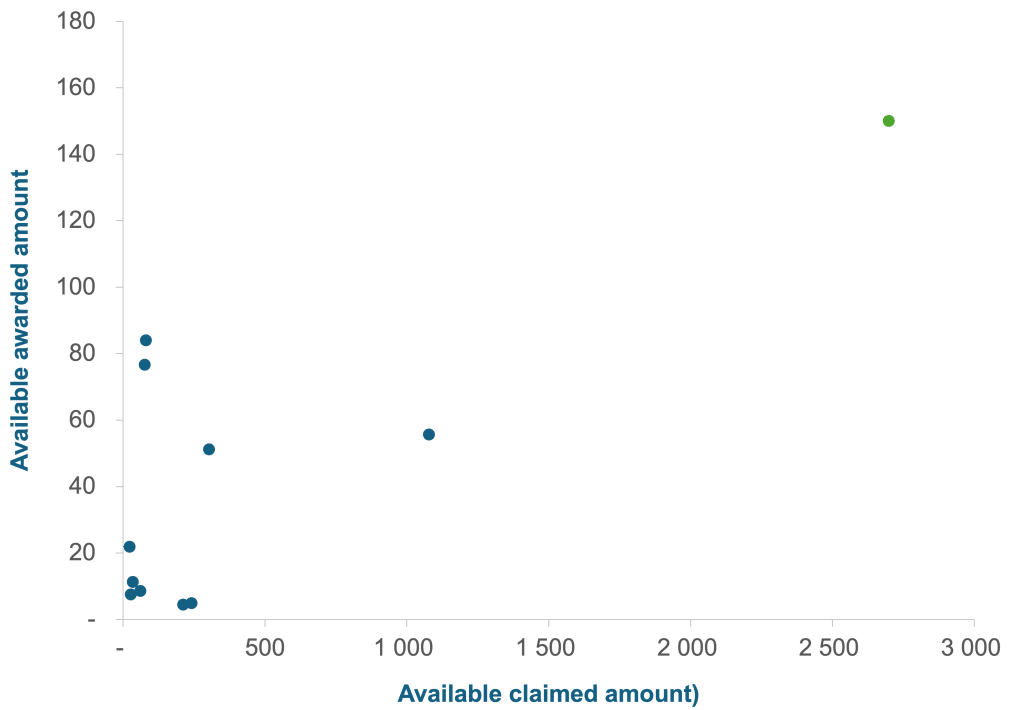
Several observations follow.
First, the risk of substantial liability is real. Awards above USD 100 million are not merely theoretical. For many states, an award of that size can have a material fiscal impact, particularly when combined with interest, costs and potential enforcement expenses.
Second, there is a clear distinction between amounts claimed and amounts awarded. Very large claims, including claims in the billions of dollars, do not necessarily translate into awards of equivalent magnitude. The average amount claimed in the available sample was around USD 370 million, whereas the average award in investor-favourable cases was around 10% of the amounts claimed (or 25% excluding the billion-dollar claims). Although these figures are not derived from a complete dataset and should not be overinterpreted, the gap is striking.
Third, very large awards exist, but they appear relatively rare in the available sample. The awards above USD 100 million are important outliers, but they do not define the entire pattern. Most investor-favourable awards in the sample were significantly lower.
This suggests that tribunals have exercised substantial scrutiny at the quantum stage. Reductions may arise for several reasons familiar to arbitration practitioners and quantum experts: uncertainty surrounding project development, causation issues, speculative assumptions, insufficient evidence of future profitability, regulatory or political risks, weaknesses in the valuation date or counterfactual scenario, and contributory conduct by the investor. These factors may significantly reduce damages even where a breach of an investment treaty or investment obligation is established.
The practical lesson is that liability and quantum should not be conflated. A state may lose on liability but avoid a financially catastrophic outcome because the tribunal rejects or discounts large parts of the investor’s damages case. Conversely, investors should not assume that a high pleaded claim will be accepted purely because liability is established. The quality of the financial evidence, the credibility of the valuation assumptions and the causal link between the state measure and the alleged loss remain decisive.
The broader cost of investment arbitration for states. The financial cost of an investment arbitration does not begin or end with the award. For states, the direct amount ordered by a tribunal is only one component of the overall economic burden.
At a minimum, states incur the cost of legal defence and expert evidence. These costs may be significant, particularly in complex disputes involving large infrastructure, mining, energy or industrial projects. They also require the mobilisation of public officials, technical agencies, ministries and state-owned entities over several years. That institutional burden can be substantial.
There are also costs that are more specific to states. An investment dispute may affect lenders and development finance institutions. It may influence the bankability of future public-private partnerships or infrastructure projects. It may complicate negotiations with existing investors or creditors. It may affect the perceived reliability of the regulatory environment and, more broadly, the assessment of country risk.
These effects are difficult to quantify. The available data do not provide a reliable basis for measuring the aggregate impact of investment arbitration on sovereign borrowing costs, project finance terms or investor perceptions. Nevertheless, the mechanism is clear. A pending dispute may delay financing, complicate restructuring, freeze an investment decision or increase the cost of capital. Even a moderate award, or no award at all, may therefore be accompanied by wider economic consequences.
This is an important point for state representatives and financial advisers. The risk associated with investment arbitration should not be assessed solely by reference to the probability-weighted value of a potential award. It should also include defence costs, administrative burden, reputational effects, financing implications and opportunity costs.
Conclusion: key trends and lessons
We can extract several takeaways from the data point on investment arbitration involving African states.
The first is that the number of Africa-related investment arbitration cases since 2015 is significant, but not all cases reach an award. A large proportion remains pending, and a number of cases end in settlement or are discontinued. This reinforces the need to treat arbitration as a process rather than as a single outcome.
The second is that the sector profile combines persistent concentration with increasing diversification. Mining, construction, and oil and gas remain central, together representing approximately half of the cases, reflecting their high capital intensity, long project horizons, and significant state involvement; at the same time, the presence of other sectors such as manufacturing, real estate, energy and environmental services, financial services etc. suggests that investment arbitration involving African states increasingly mirrors the changing structure of investment across the continent.
The third is that states prevail in a majority of adjudicated decisions in the available sample. This does not eliminate the possibility of investor success, but it challenges any simplistic assumption that investment arbitration is systematically unfavourable to African states.
The fourth concerns quantum discipline. Claimed amounts may be very high, but tribunals appear to apply careful scrutiny to damages claims. In investor-favourable cases, awards were materially lower than many of the amounts claimed. This reflects the importance of causation, evidence, valuation methodology and the treatment of uncertainty.
The study highlights the need to distinguish legal outcomes from economic consequences. A state victory may still be costly, and an investor victory may result in a much lower award than the claim advanced. The financial reality of a dispute is therefore more complex than the binary question of who won and who lost. Success in investment arbitration depends not only on prevailing in the legal issues, but also on presenting a persuasive and robust quantum case. Strong legal arguments and rigorous financial analysis are often equally decisive in shaping the ultimate outcome of a dispute.
Delphine Sztermer – Partner, Accuracy
Africa-related investment arbitration since 2015: sector trends, outcomes and quantum
Delphine Sztermer would like to thank Anastasia Pojoga Morali, Director, and Pascal Chen, Senior Associate, for their highly valuable contribution to this analysis.