
Outlook: the path of prices in the wake of a US–Iran war with no end in sight raises questions for central banks and bond markets
The US–Iran agreement of 17 June did not last. The war has resumed, and its nature has changed. Tehran has no intention of giving way, while Washington is playing an economic-and-military game. The aim is to prevent Iran from engaging in commercial and financial transactions with the rest of the world, while continuing operations designed to destroy ballistic capabilities that the country appears able to rebuild quickly. The impact of this reversal is visible in the crude oil market. Brent, which in early July was trading at a little over $75 a barrel, is now close to $95. The economy seems to be withstanding the shock, and yet the price outlook is deteriorating. To attenuate that, and thereby avoid calling the underlying trend in real activity too much into question, a tightening of monetary policy is expected. But how can long-term interest rates be prevented from being contaminated by higher short rates? The question applies first and foremost in the United States, where the central bank and the Treasury appear less than fully aligned.
War in Iran
1 – Iran is betting on escalation. Can the United States afford it?
The conflict rests on two opposing considerations of time: Iran believes it can absorb losses over the long haul, while Washington is seeking a quick exit, even without a decisive military victory.
We are a long way from the truce of 17 June 2026 and the Memorandum of Understanding that had halted fighting between the two sides.
Tehran never regarded the truce as lasting, and the increase in the US military presence in the region has reinforced the conviction that Washington was above all trying to buy time before a new phase of confrontation – all the more so as the dispute over control of the Strait of Hormuz allows Tehran to exert pressure on global energy markets, as well as on future negotiations.
Despite the Trump administration’s desire to see the Iranian regime collapse, the first geo-economic objective remains the durable reopening of the strait. For now, the diplomatic route looks to be at an impasse, while the military route has not, at least with the means currently being deployed, delivered the expected success. What should be done?
On 23 August 2026, Scott Bessent, the US Treasury Secretary, announced in the Financial Times, in the martial register favoured by the Trump administration, that American economic power was preparing to launch an “economic D-Day” against the Islamic Republic of Iran. To countries maintaining the economic circuits that allow Tehran to breathe (that is, supporting imports and exports), Bessent offered an ultimatum: comply with US demands or risk exclusion from the dollar system. To paraphrase Blaise Pascal, and to quote Secretary Bessent, uncertainty does not absolve men or nations of their errors.
The Trump administration is here reactivating an arsenal already widely deployed since 2011: secondary economic sanctions designed to asphyxiate the targeted economy. After six months of a military campaign unable to produce a decisive victory, the extraterritoriality of the dollar would become a substitute strategy, allowing the confrontation to be prolonged without immediately bearing its military and political cost. That matters particularly as the midterm elections approach, with the war unpopular and the cost of living dominating voters’ concerns. Yet the temptation to pursue economic and military initiatives in parallel remains. So…
Economic asphyxiation does not mechanically bring down a repressive regime, as Russia’s experience in the context of the war in Ukraine illustrates.
Iran is already suffering from inflation of 87.9% in July and a collapsing rial, the country’s currency. The real effectiveness of sanctions depends above all on two factors:
- How open the economy in question is to the outside world
- Its ability to find substitute partners.
In Iran’s case, the economy has for many years been largely cut off from part of the world, while China and Russia provide more or less discreet support.
On the American side, then, this is a conditional threat. It reveals a diplomacy of escalation, composed of lists of demands, confidential timetables and deadlines, whose effectiveness rests on the assumption that the indispensable actors, China and Russia, will prefer access to the dollar over trade with Iran.
2 – America’s “Economic D-Day” meets the China test
China has no interest in joining America’s game. For Beijing, yielding today would amount to recognising the United States’ power to subject global trade to its own discipline, at the risk of seeing that precedent turned against China itself tomorrow. Moreover, as the initiative to raise US tariffs has shown, Beijing is capable of “sanctioning” the American economy through export authorisations for rare earths.
In these circumstances, the Chinese government has the capacity to keep Iran on life support and thereby secure essential imports. It should be noted, however, that each new weaponisation of the dollar over the past 14 years has resulted in an increased global role for the yuan and China’s payments system.
By threatening Beijing in order to isolate Tehran, Washington could accelerate China’s strategy of reducing its dependencies and building an order less centred on the dollar and less permeable to American discipline. Beijing has already announced that it would take “all necessary measures” should it be hit by sanctions targeting Iran.
US growth
Encouraging signs on both the demand and supply sides
United-States: respectable growth, with a notable contribution from business investment
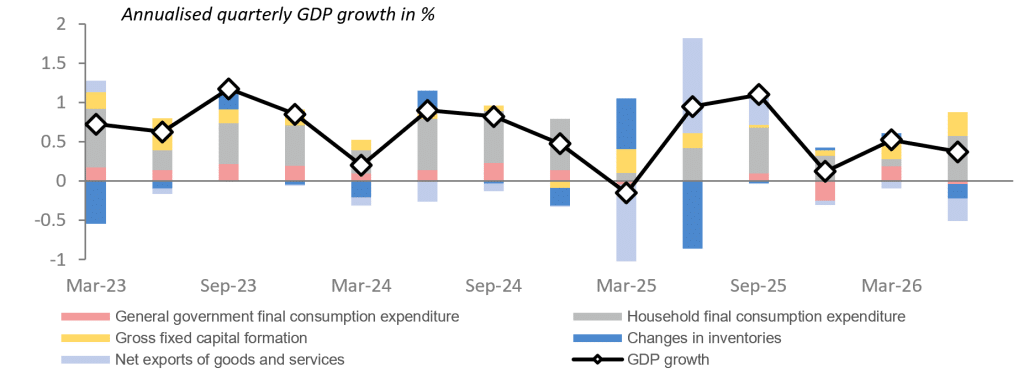
Sources: Accuracy, Eurostat, Macrobond
United-States: job creation is slowing, yet the labour market remains balanced – why?
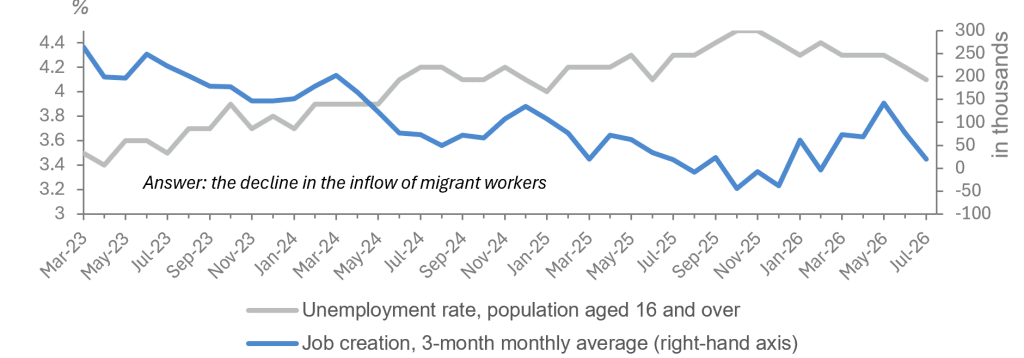
Sources: Accuracy, BLS, Macrobond
United-States: productivity has made a notable contribution to economic growth in recent years
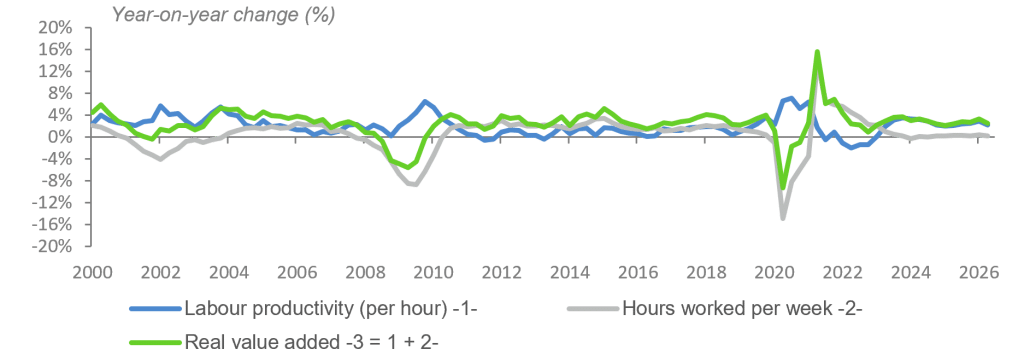
Sources: Accuracy, BLS, BEA, Macrobond
United-States: initially, strong productivity helps ease inflationary pressures from the labour market
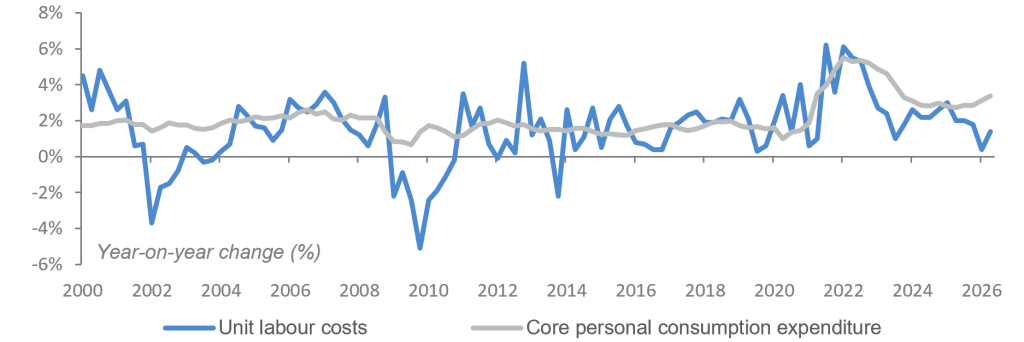
Sources: Accuracy, BLS, Macrobond
Eurozone growth
Good news in Germany; less encouraging news in France
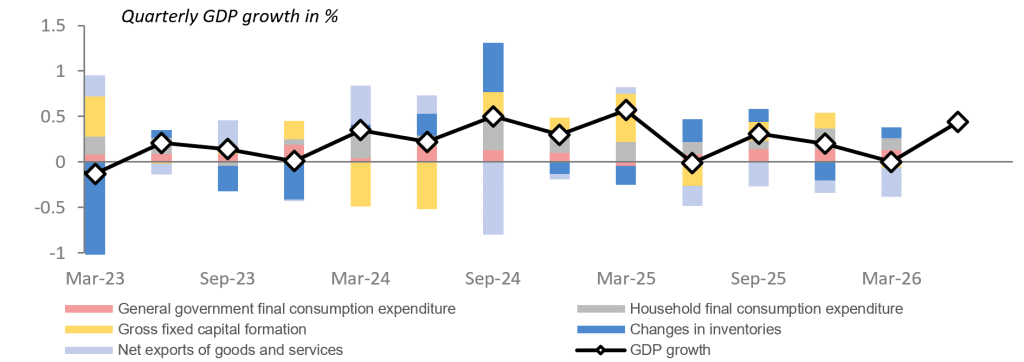
Eurozone: contribution to quarterly real GDP growth
Sources: Accuracy, Eurostat, Macrobond
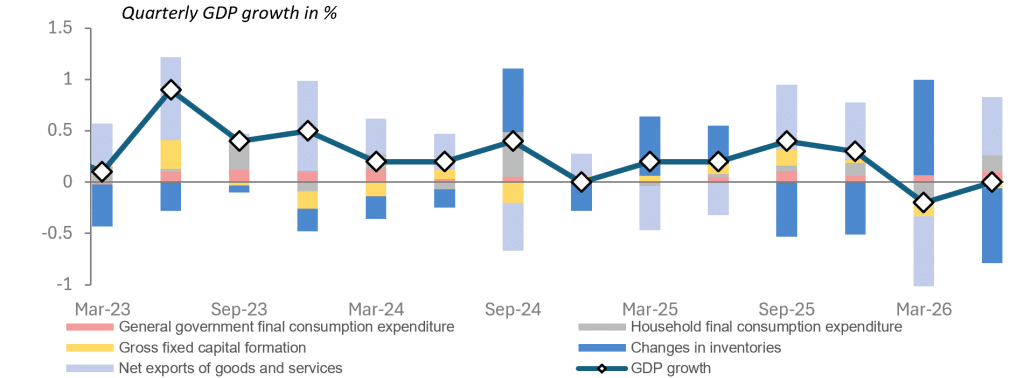
France: contributions to quarterly real GDP growth
Sources: Accuracy, Eurostat, Macrobond
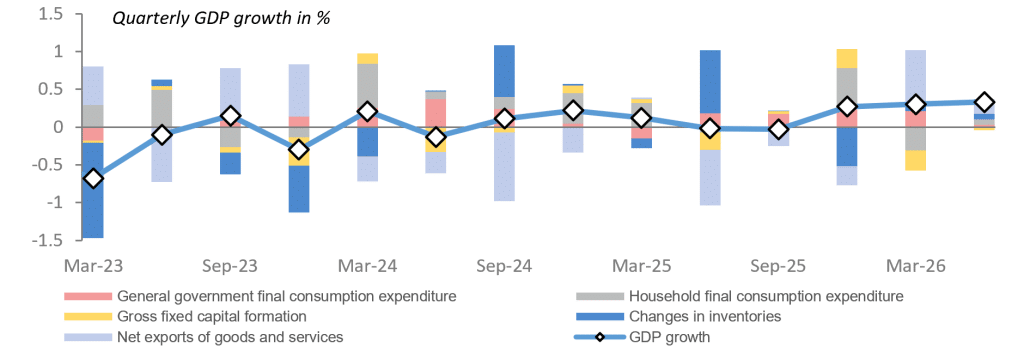
Germany: contributions to quarterly real GDP growth
Sources: Accuracy, Eurostat, Macrobond
- Eurozone
GDP rose by 0.4% quarter on quarter in Q2, after stagnating in Q1, taking annual growth to 1.0%. The recovery nevertheless remains uneven across countries: Spain continues to expand at a solid pace (+0.7%), while Germany is growing more modestly and France is stagnating. Overall, however, the data confirm an improvement in European activity after a sluggish start to the year.
- France
In France, GDP stagnated in the second quarter after contracting by 0.2% in Q1, narrowly avoiding a technical recession. Foreign trade was the main support, adding 0.6 percentage points, driven by a rebound in exports, particularly in aerospace. The underlying momentum remains fragile, however: investment fell for the second consecutive quarter (-0.3%) and purchasing power per consumption unit contracted sharply (-0.6%).
- Germany
The German economy continued to recover in the second quarter, supported mainly by trade with the rest of Europe and therefore by strong exports (+2.0% quarter on quarter). Industry also confirmed its improvement, with manufacturing value-added rising. Domestic demand, however, remains the main weak spot.
Eurozone activity
Measuring the impact of climate disruption
Direct damage | Pertes économiques |
These are the physical losses directly attributable to the event. They mainly measure the destruction of wealth and productive capacity, but do not necessarily imply a fall in GDP:
| Economic losses measure the effects on output and income. They can be significant even where physical damage is limited.
|
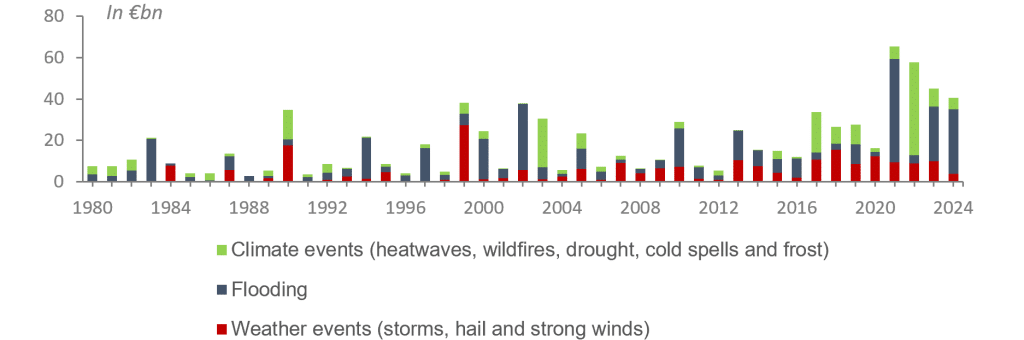
Annual economic losses in EU countries caued by extreme weather and climate events
Sources: Accuracy, EEA
A few figures:
- Average ecological losses linked to all weather and climate events in Europe between 2021 and 2024, in constant 2024 euros, amounted to €54bn annually. That is equivalent to 0.3% of European GDP each year.
- Heatwaves, droughts and wildfires over the 2021–2024 period accounted for 30% of all losses recorded since 1980 and associated with these three risks. In other words, losses have become increasingly concentrated in the recent period.
- On average, only 10% of losses attributable to heatwaves, droughts and wildfires are insured, compared with almost 50% for storms and 37% for floods. The cost is borne by households, companies and the public finances.
- The short-term economic impact of the heatwaves, droughts and wildfires of summer 2026 is likely to amount to 0.2–0.4% of GDP over the year. After reconstruction and the resumption of activity, the final effect could be brought down to 0.1% or 0.2%.
Ultimately, the multiplication of extreme events increases the volatility of growth and prices, with sharply differentiated effects across countries and sectors. It also raises the need for public spending precisely when most losses linked to heatwaves, droughts and wildfires remain uninsured.
Global activity
PMI surveys: holding up well
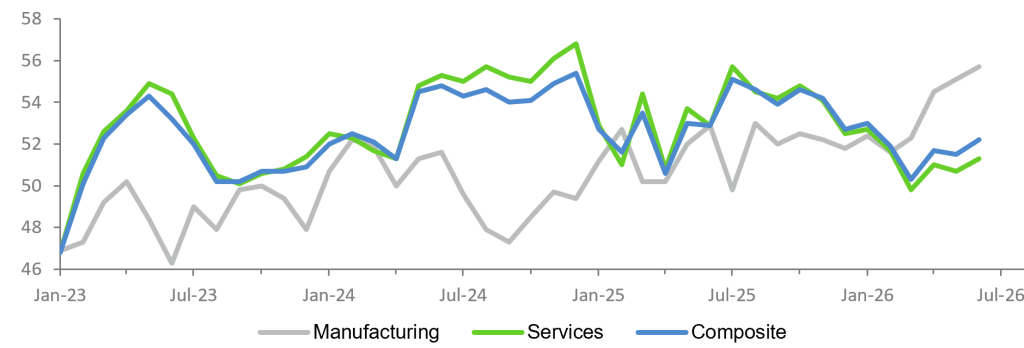
United-States PMIs: still pointing upwrds, but watch the underlying signals
Sources: Accuracy, S&P Global, Macrobond
After already accelerating in July, US activity continued to strengthen in August, with the composite PMI reaching its highest level since April 2022.
The manufacturing sector, by contrast, lost momentum, with output expanding at its slowest pace for thirteen months. This deceleration reflects, among other things, a smaller build-up of precautionary inventories and persistent supply difficulties, with delivery times still among the longest recorded in four years.
Services therefore appear to be the main engine of activity in August, recording their strongest growth since December 2024. Demand remains robust, and companies are stepping up hiring to deal with fuller order books.
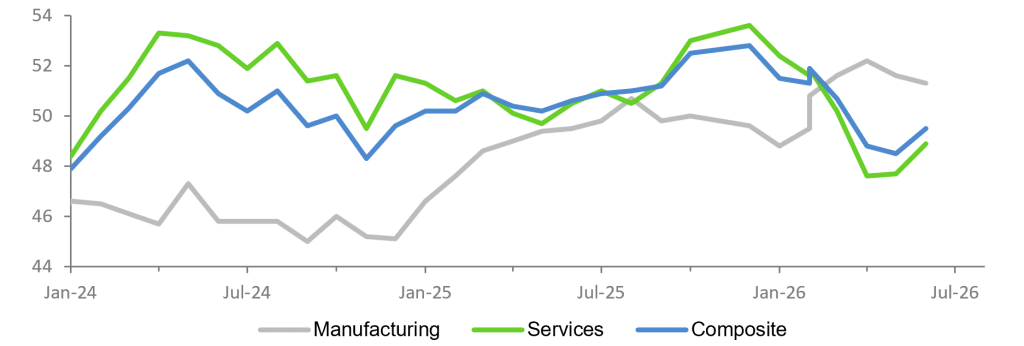
Eurozone: easing pressures and renewed optimism
Sources: Accuracy, S&P Global, Macrobond
The eurozone PMI reached its highest level in July since the start of the war between the United States and Iran, mainly thanks to fuller order books and cheaper inputs, with energy prices falling temporarily. The August composite index, however, showed a loss of momentum, although it remained above consensus forecasts.
Manufacturing nevertheless continued its upward trend from July into August, supported by a rebound in new orders, which also lifted employment figures, and by a continued decline in input prices following May’s peak.
The services sector is harder to read. After three consecutive months of growth, it consolidated in August. Successive heatwaves and major wildfires weighed on tourism, transport and retail activity.
European sector activity
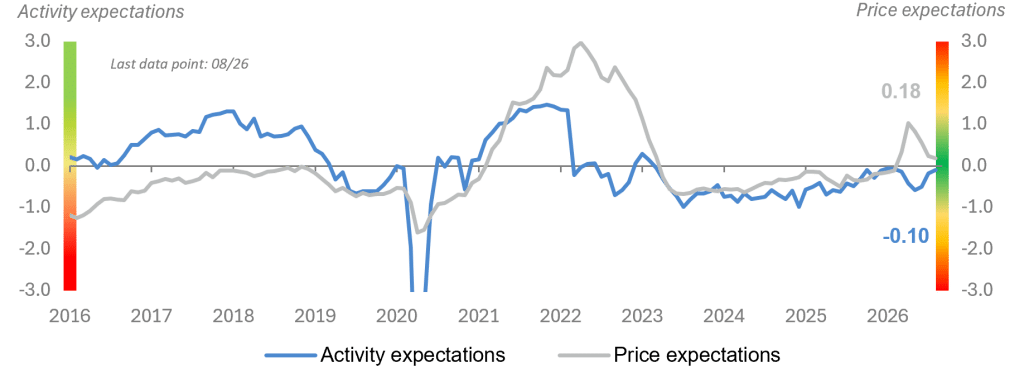
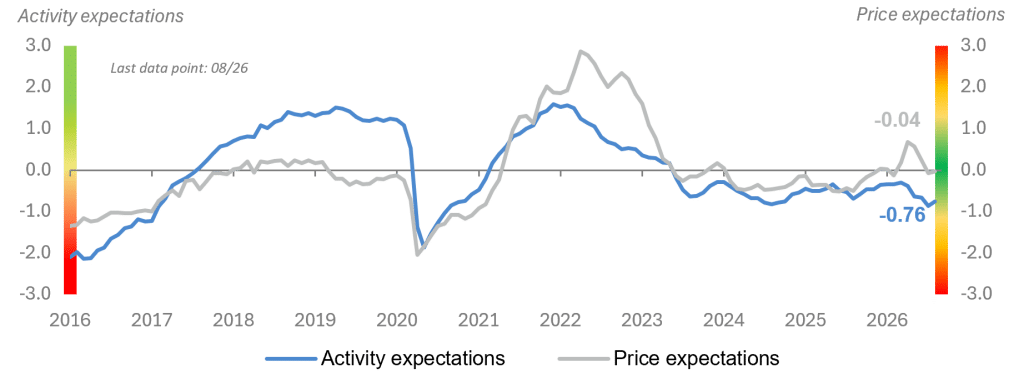
1 – European Union: normalisation under way, except in construction
European Union – Industry: outlook
Sources: Accuracy, European Commission
European Union – Construction: outlook
Sources: Accuracy, European Commission
European Union – Services: outlook
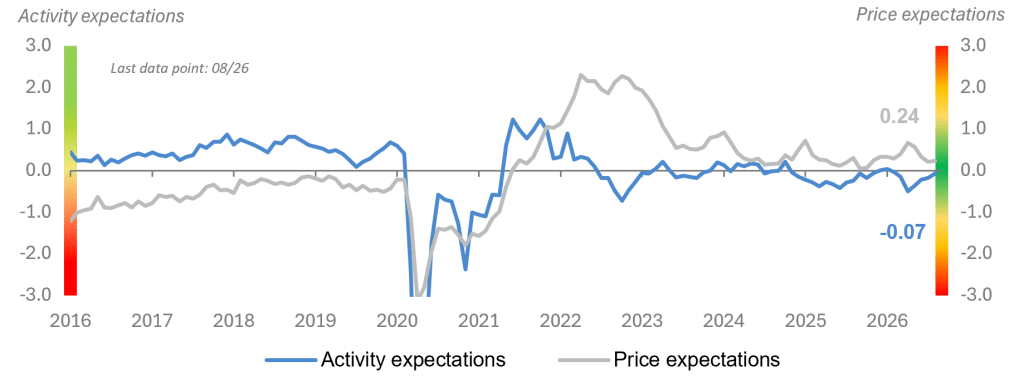
Sources: Accuracy, European Commission
European Union – Trade: outlook
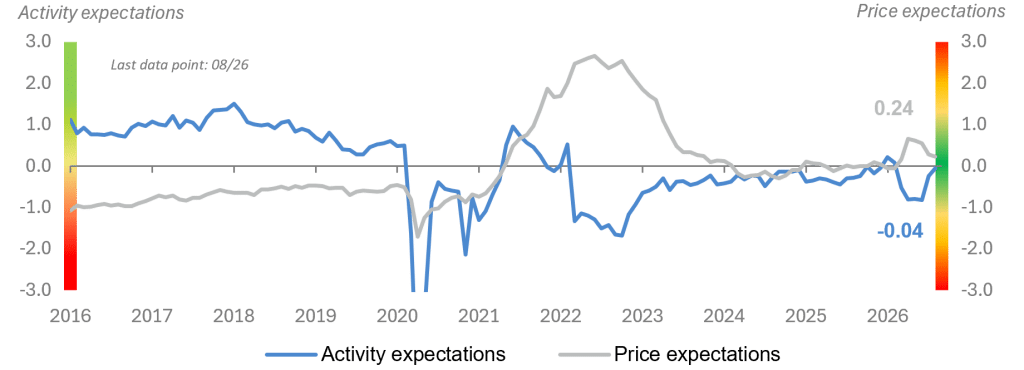
Sources: Accuracy, European Commission
2 – France: trade and construction under greater pressure
France – Industry: outlook
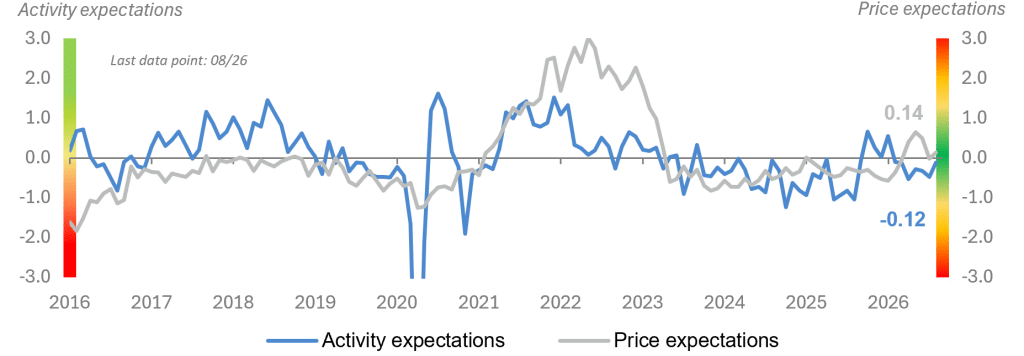
Sources: Accuracy, European Commission
France – Construction: outlook
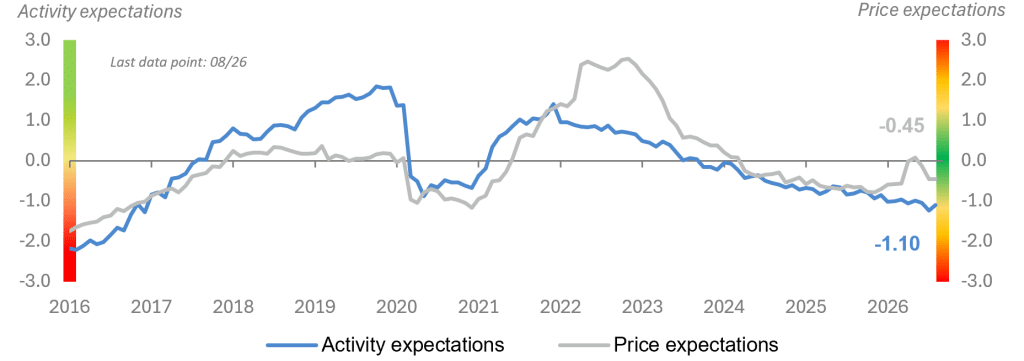
Sources: Accuracy, European Commission
France – Services: outlook
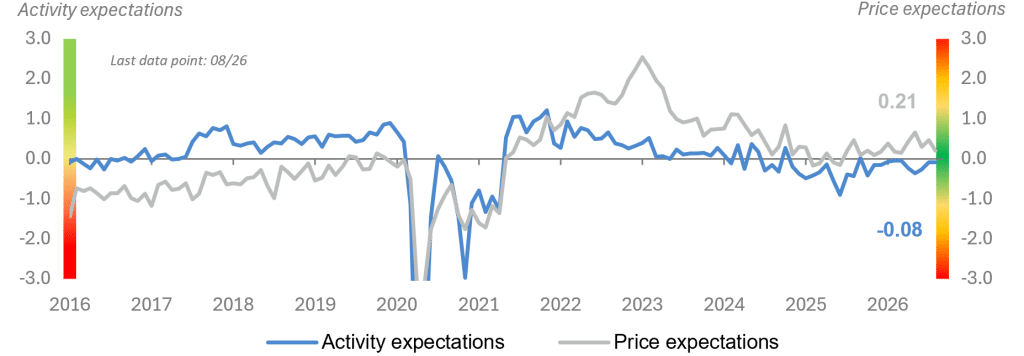
Sources: Accuracy, European Commission
France – Trade: outlook
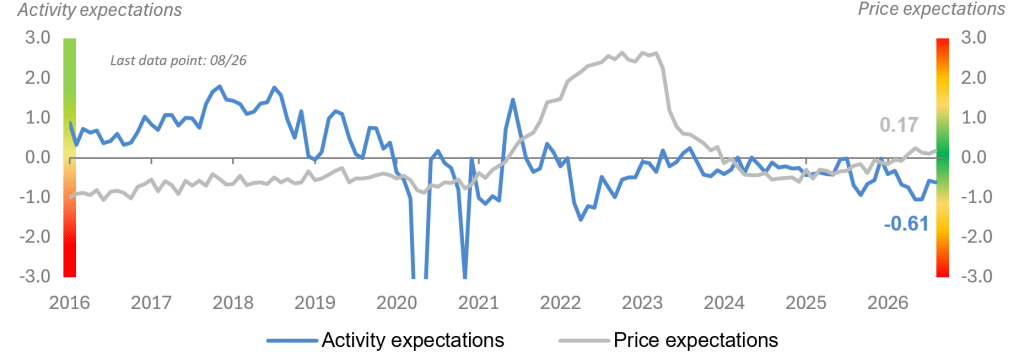
Sources: Accuracy, European Commission
3 – Germany: industry is surprisingly better placed than other sectors
Germany – Industry: outlook
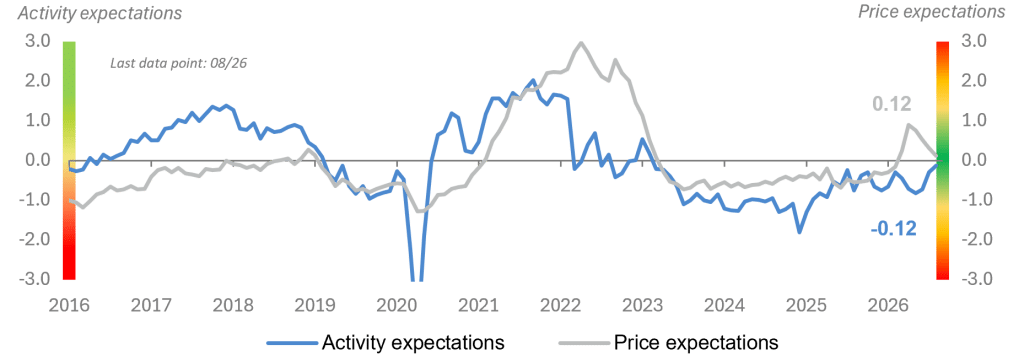
Sources: Accuracy, European Commission
Germany – Construction: outlook
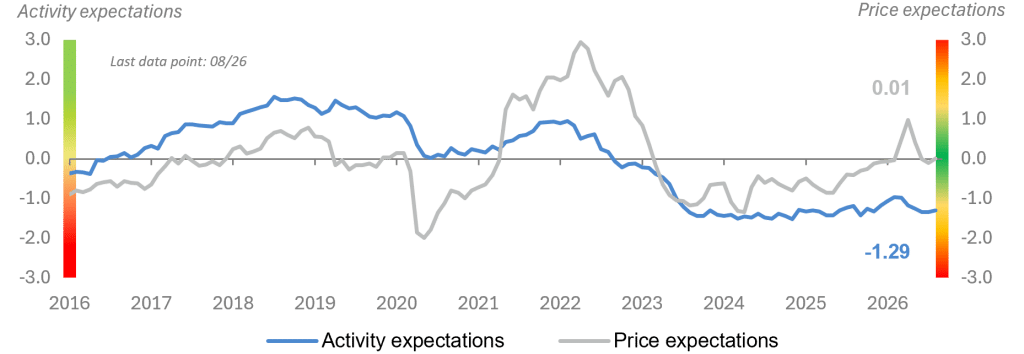
Sources: Accuracy, European Commission
Germany – Services: outlook
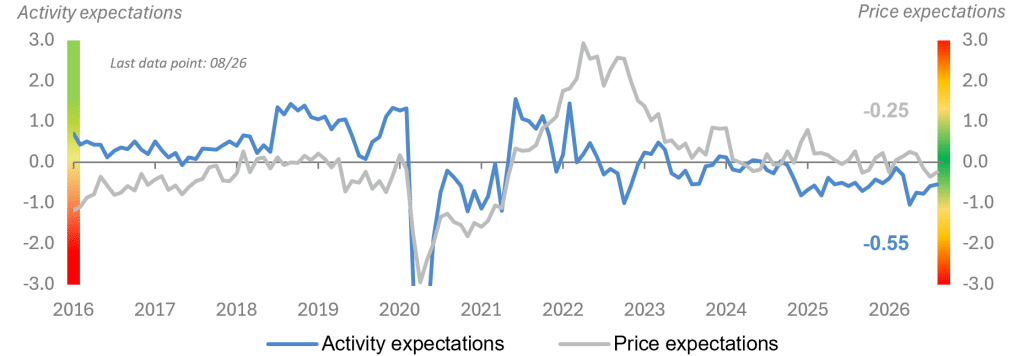
Sources: Accuracy, European Commission
Germany – Trade: outlook
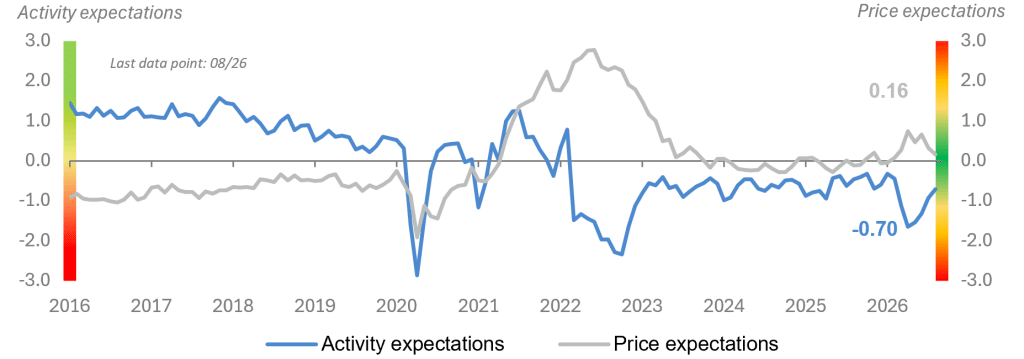
Sources: Accuracy, European Commission
US inflation
Normalisation is not in sight
United-States: year-on-year CPI inflation remains above the 2% target
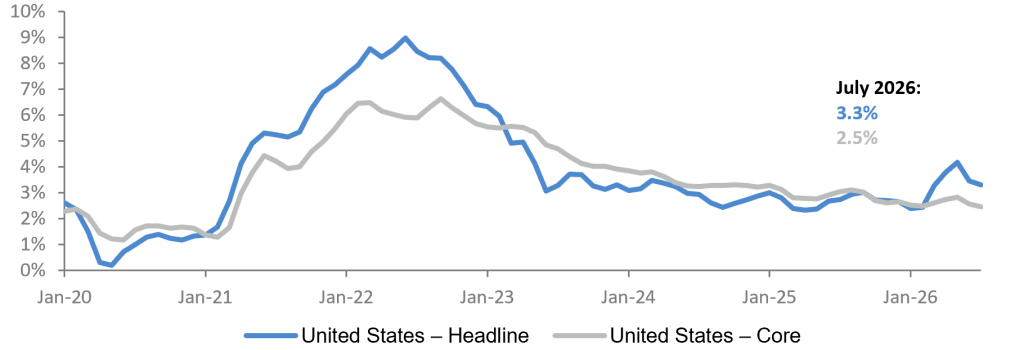
Sources: Accuracy, Macrobond
United-States: alternative price measures also indicate that inflation remains too high
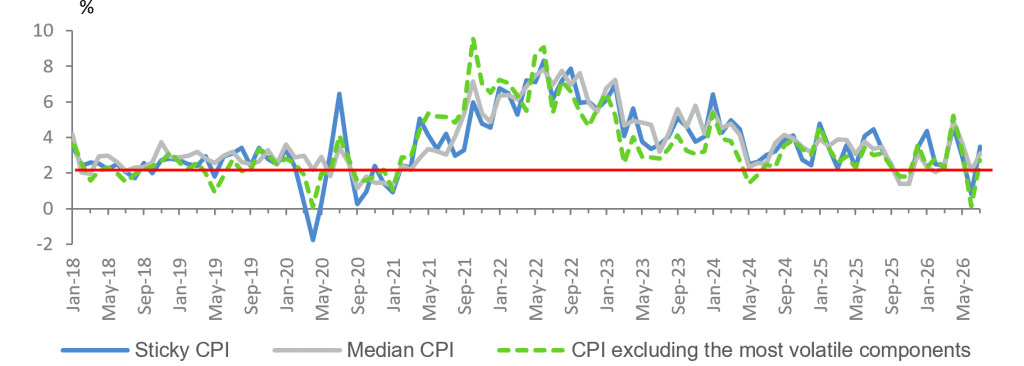
Sources: Accuracy, Atlanta Fed, Cleveland Fed, Macrobond
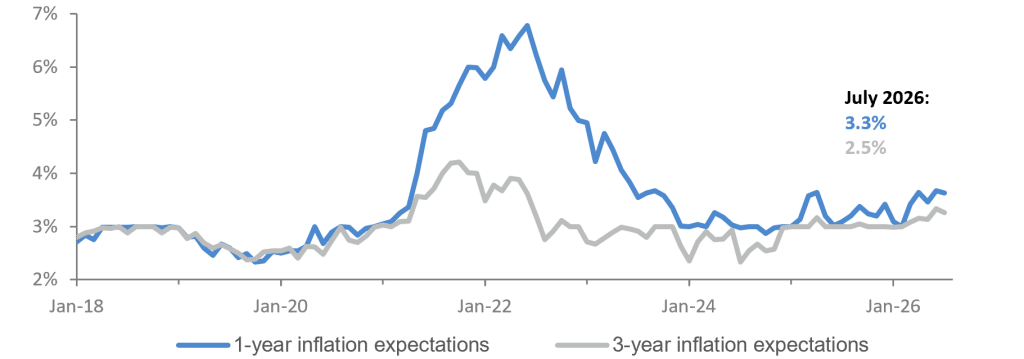
United-States: consumer inflation expectations are both too high and rising
Sources: Accuracy, Macrobond, NY’s Fed
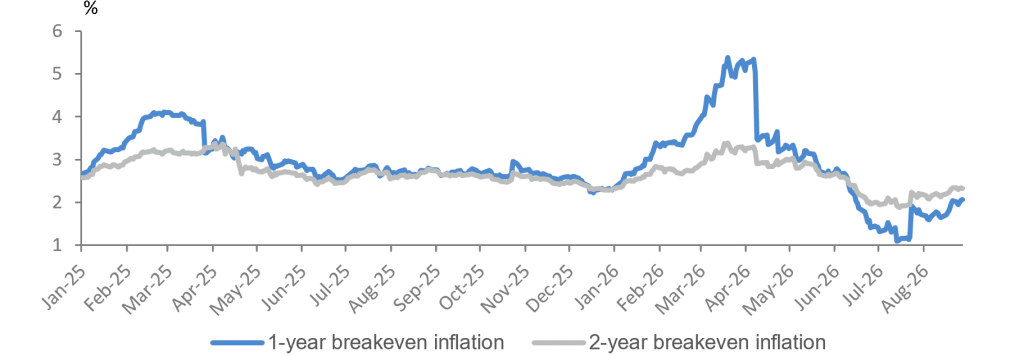
United-States: capital-market inflation expectations are following a broadly similar path
Sources: Accuracy, Bloomberg
Eurozone inflation
An uncomfortable acceleration driven by energy
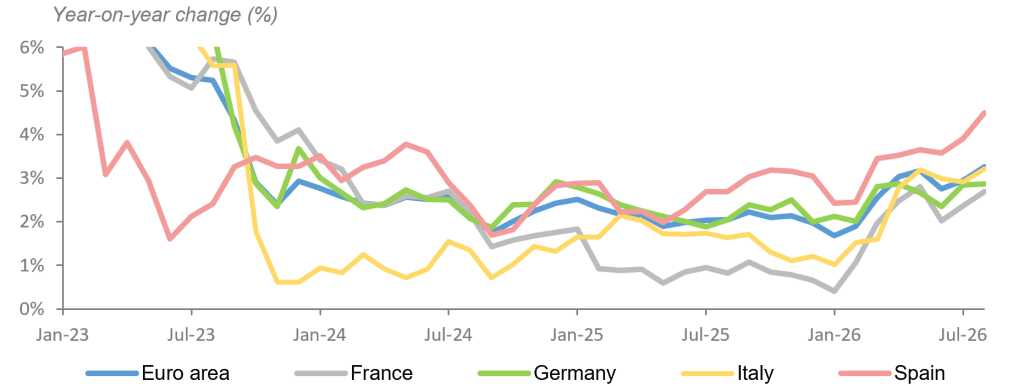
Eurozone: headline consumer price inflation
Sources: Accuracy, Macrobond
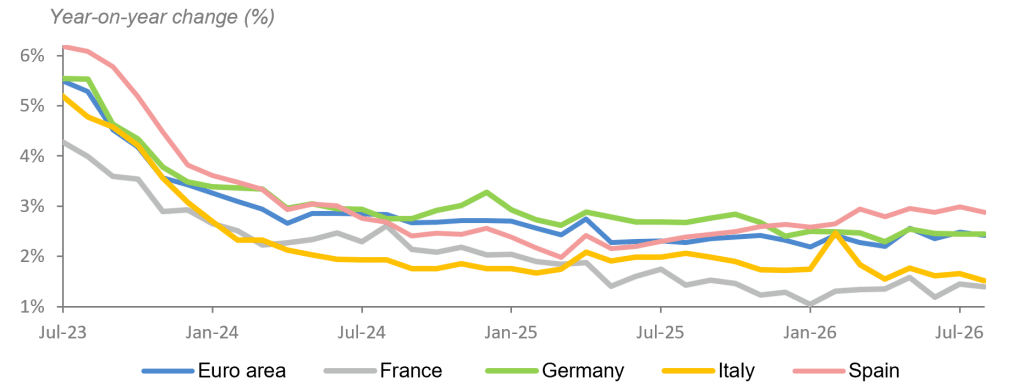
Eurozone: core consumer price inflation
Sources: Accuracy, Macrobond
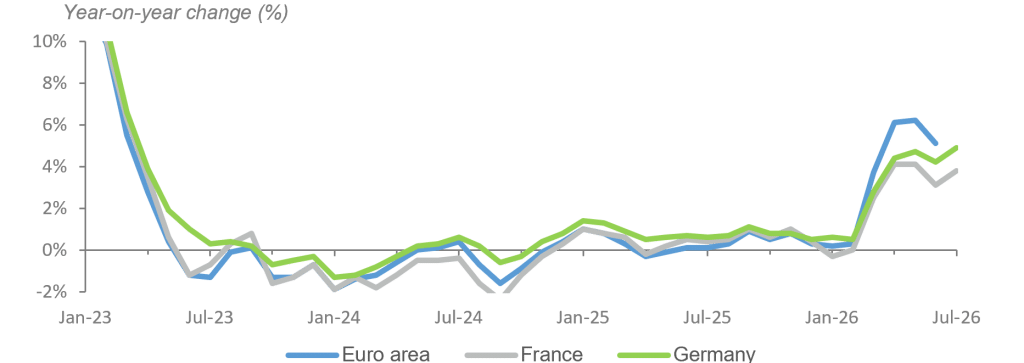
Eurozone: manufacturing producer prices are rising
Sources: Accuracy, Eurostat, Macrobond
- Eurozone inflation has picked up again in recent months, chiefly as a result of the renewed rise in energy prices linked to the conflict in the Middle East. The increase nevertheless appears to reflect a supply shock, caused by cost pressure from higher input prices, rather than a broad-based resurgence of inflationary pressures, with demand-side factors remaining relatively stable.
- The situation therefore remains different from 2022, when inflationary tensions were broader and fuelled simultaneously by strong post-Covid demand and severe supply constraints. The main risk now lies in a more persistent pass-through of the energy shock to underlying prices and inflation expectations.
Eurozone monetary policy
A temporary pause, with vigilance over energy prices
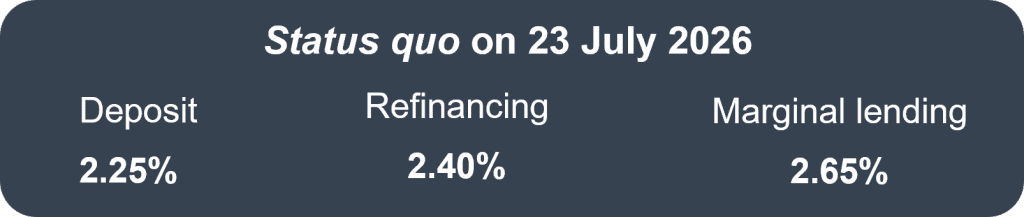
The ECB paused in July following the increase in June
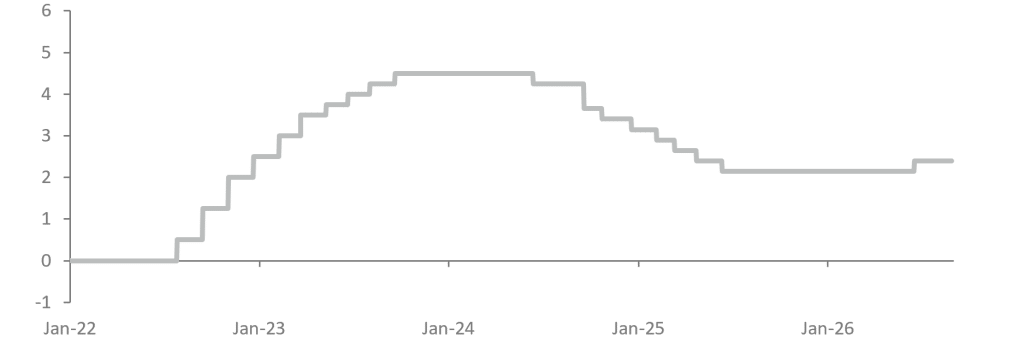
Sources: Accuracy, Macrobond
The Governing Council’s key messages:
- This is a cautious pause, not a signal of easing. The energy shock linked to the conflict in the Middle East remains uncertain. Its full impact on prices, margins and wages has not yet materialised.
- Disinflation is uncertain and, in any case, inflation is still above average. Inflation rebounded in August to 3.3% year on year, after 2.8% in June and 2.9% in July. Inflation excluding energy (the main culprit, at 14.3% year on year, its highest level since 2023) and food eased to 2.4%. It should be noted, however, that services prices remain dynamic, rising by 3.0% year on year.
- An asymmetric risk profile exists. According to the ECB, a return of inflation to the 2% target is not yet in sight. Price risks are tilted to the upside, while growth risks are tilted to the downside.
- The economy is resilient but faces a clear acceleration in prices. Activity improved slightly in the second quarter and unemployment remains close to its historical lows, at 6.2%. Short-term growth is nevertheless expected to remain modest.
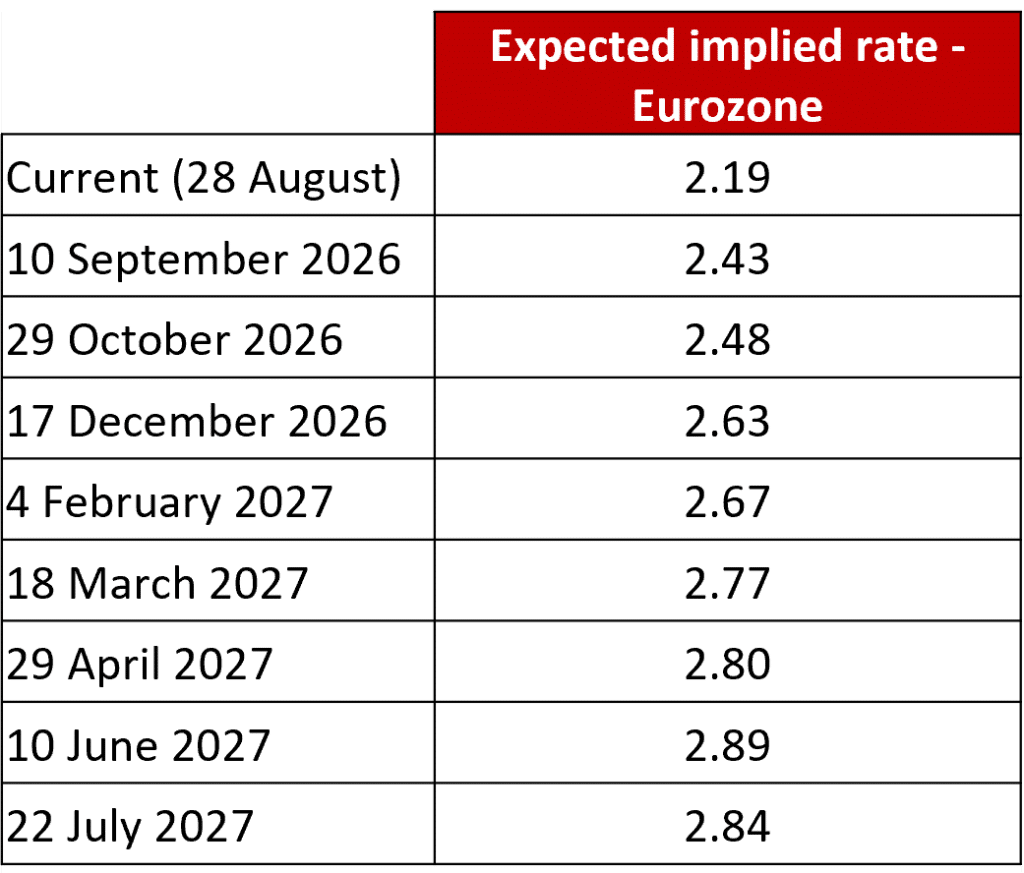
Against a backdrop of renewed pressure on oil and gas prices, the ECB is expected, on 10 September, to opt for a further tightening of monetary policy. After all, is prevention not better than cure?
US monetary policy
Status quo, internal divisions, and more: the Warsh consensus called into question
Kevin Warsh’s appointment had been greeted with goodwill from his colleagues, the markets and observers alike. The second FOMC meeting, held at the end of July under his chairmanship, resulted in the policy rate being left unchanged in the 3.50–3.75% range, despite very firm communication on inflation. Criticism was therefore heard. Behind this apparent status quo, the meeting revealed a more divided Fed and a chair facing his first credibility test.
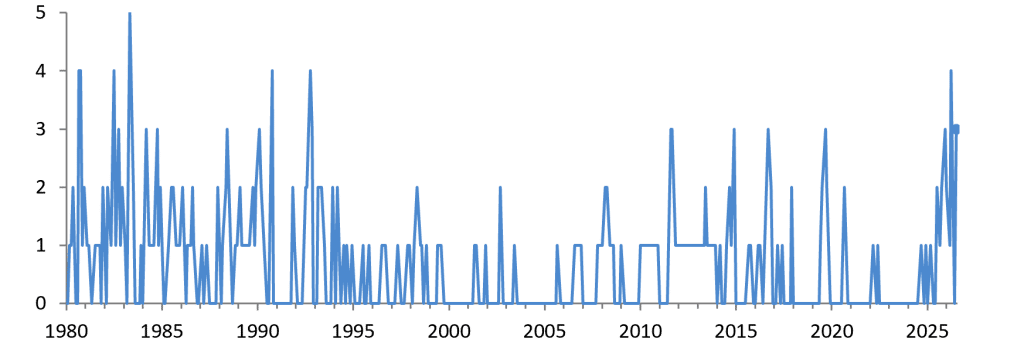
The vote ended 9–3, with regional presidents Lorie Logan (Dallas), Beth Hammack (Cleveland) and Neel Kashkari (Minneapolis) favouring an immediate rate rise. Such dissent is relatively exceptional: this was only the sixth occurrence in thirty years of at least three FOMC members opposing the majority decision.
History of dissenting votes at FOMC meetings
Sources: Accuracy, Bloomberg
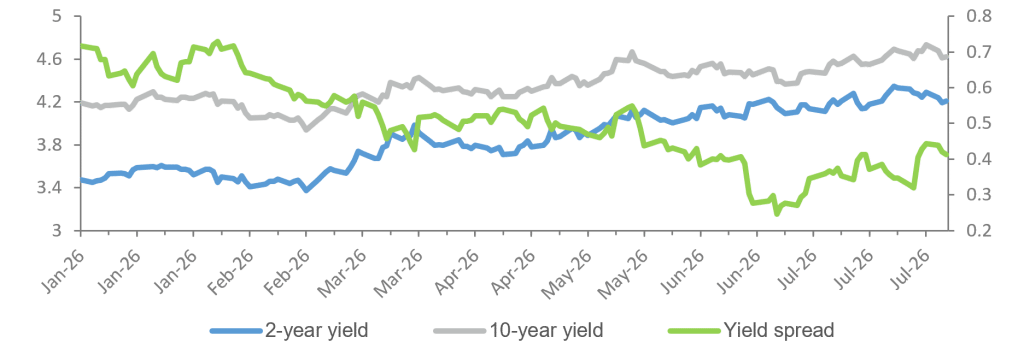
Markets focused above all on the gap between rhetoric and action. After several weeks of resolutely hawkish communication, the absence of a rise in the policy rate was seen as a climbdown. Investors therefore detected a degree of self-satisfaction in Warsh over the rise in long-term rates, but a reluctance to raise short-term rates, and are now watching the yield curve steepen.
US Treasury yields at 2 and 10 years, daily
Sources: Accuracy, Bloomberg
The main lesson from this meeting was, in fact, Kevin Warsh’s stated desire to reduce reliance on forward guidance – in other words, explicit communication about the future path of monetary policy.
In his view, markets have gradually become used to acting on expectations of central-bank decisions rather than analysing the economy directly. Investors must now “play the ball rather than the referee”: focus on inflation, activity and employment, rather than on the Fed’s future intentions.
2 – Forward guidance: Kevin Warsh’s risky bet
- Abolishing forward guidance does not abolish the need for anticipation
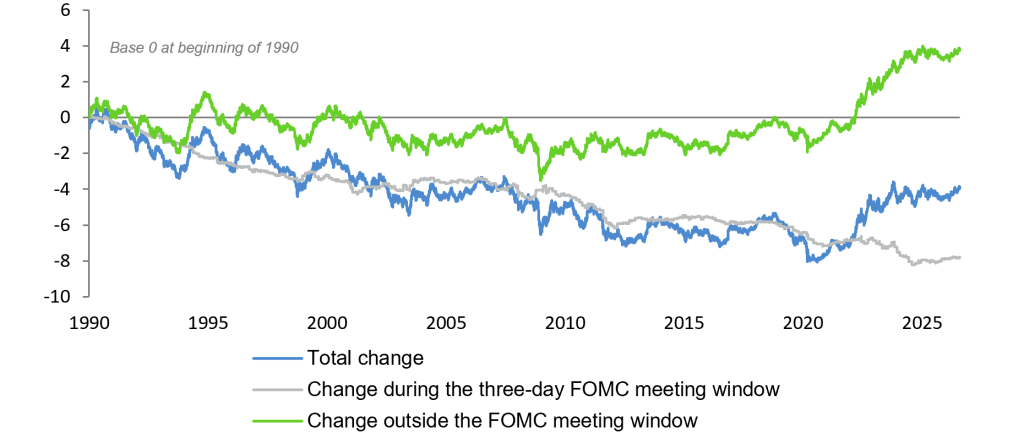
The Fed still controls short-term interest rates, and financial actors must necessarily form a view on its next decisions. By reducing the official information available, the central bank is pushing markets to reconstruct the monetary trajectory themselves from macroeconomic data and also from fragmented signals drawn from statements by policymakers.
United-States: when the 10-year Treasury yield moves independently of the Fed
Sources: Accuracy, FT, Bloomberg
- This is reflected in a marked steepening of the yield curve
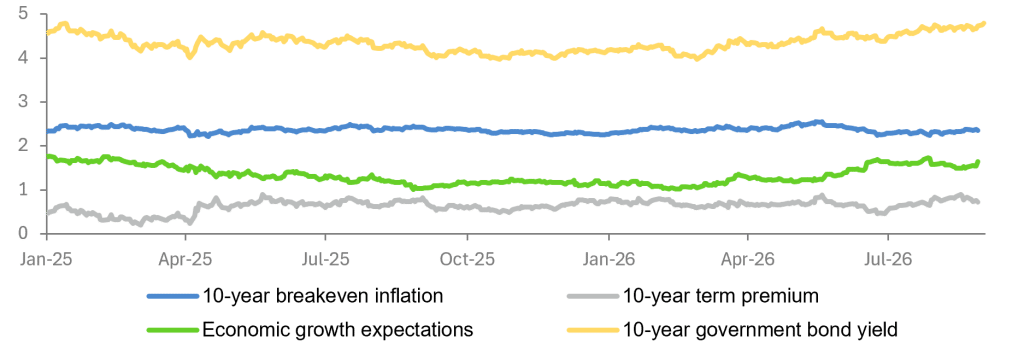
Following the July monetary-policy meeting, two-year yields fell, signalling lower expectations of immediate tightening, while the 30-year Treasury yield rose above 5.25%, its highest level since 2007. Investors are now demanding a higher risk premium in the face of the possibility that the Fed allows inflation to persist for longer, notably against a backdrop of Middle East tensions and risks linked to rising energy prices.
Decomposition of the 10-year US Treasury yield: recent uncertainty centres on the term premium
Sources: Accuracy, Macrobond
- The immediate consequence of this communication was therefore a deterioration in the quality of available information and greater volatility in asset prices
Reducing forward guidance could in reality narrow the Fed’s room for manoeuvre, because by allowing uncertainty over its future reaction function to take root, Warsh risks being forced to raise rates at forthcoming meetings in order to restore weakened credibility. Futures contracts now imply roughly a 68% probability of a 25-basis-point increase as early as September. Investors are now waiting for actions rather than signals.
3 – Facing AI, can the Fed repeat Alan Greenspan’s bet?
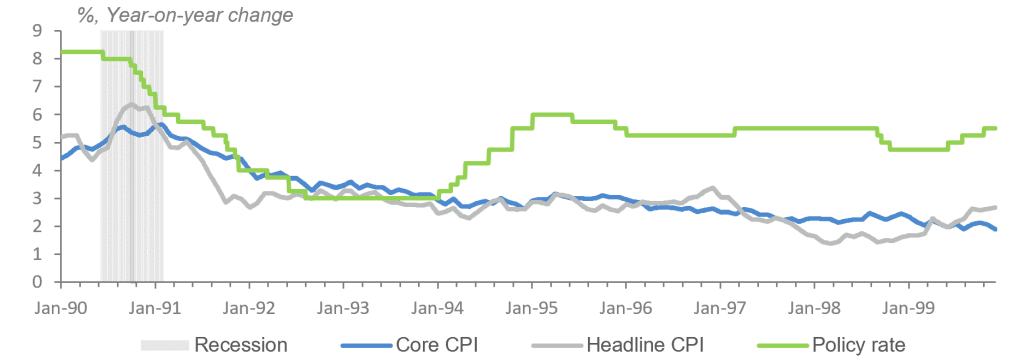
In the mid-1990s, US economic growth was robust, unemployment was falling sharply and inflation was contained. Although some members of the Federal Reserve’s FOMC argued for a pre-emptive tightening of monetary policy, Alan Greenspan, then chair of the central bank, opposed it. His intuition? The rapid diffusion of information technologies would increase the productive capacity of the US economy, allowing stronger growth and lower unemployment without generating inflationary pressure. That reading proved broadly correct.
United-States: rates held steady in 1996, then raised from 1997 as unemployment fell and inflation rose
Sources: Accuracy, FRED, Macrobond
Greenspan’s 1996 bet:
- Keeping policy rates at 5.25%.
- New information technologies increase productivity and therefore the economy’s growth potential.
- New information technologies discourage wage increases because workers fear automation.
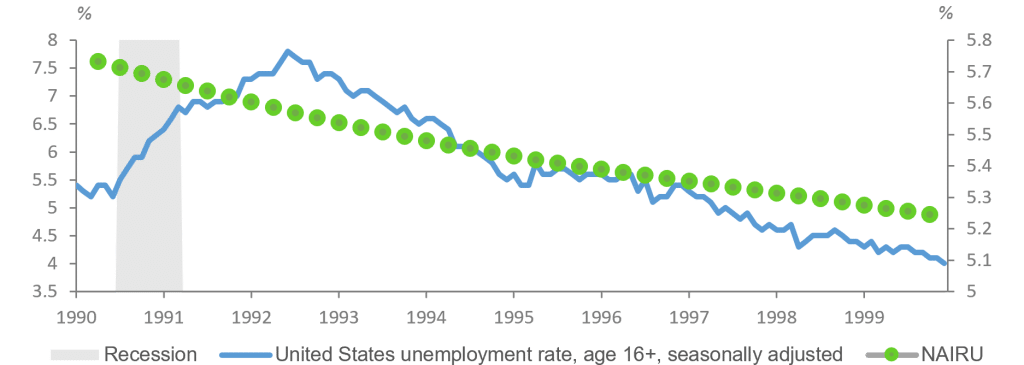
Today, the Fed is asking whether a potentially similar dynamic is emerging with artificial intelligence. At the microeconomic level, companies increasingly cite AI as a lever for efficiency, and surveys show these technologies spreading through the US economy. Their effects on productivity gains at the macroeconomic level, however, remain to be clarified.
United-States: labour market tensions from 1997
Sources: Accuracy, FRED, Macrobond
Nota bene: Although Greenspan persuaded the FOMC not to raise rates, the Fed did not loosen policy. From 1997 onwards, labour-market tensions encouraged the Fed to raise rates in order to contain inflation. The precedent therefore simply suggests that a favourable technological shock changes the overall balance between growth, employment and inflation.
*NAIRU: Non-Accelerating Inflation Rate of Unemployment. The unemployment rate below which inflation begins to accelerate, owing to labour shortages and rising wages and production costs.
4 – K. Warsh’s “Fed Force Five”
- Communication
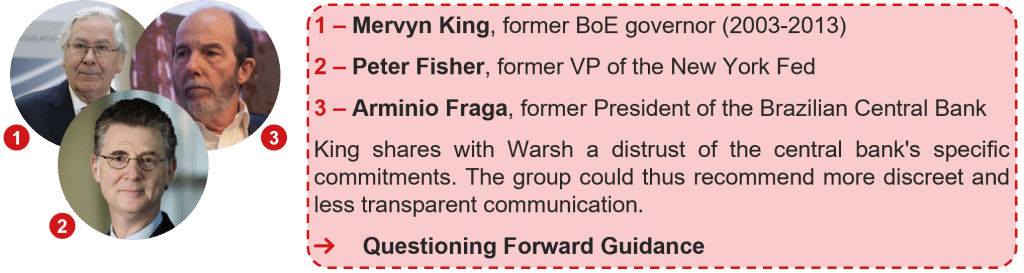
- Data
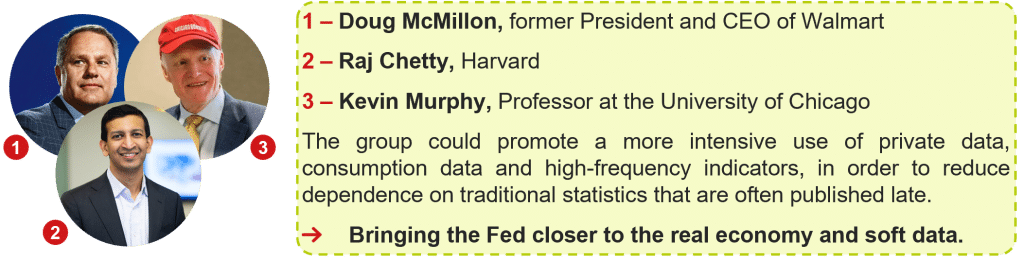
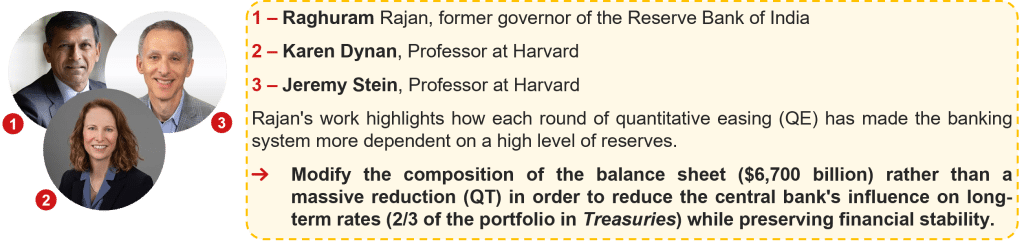
- The Fed’s balance sheet
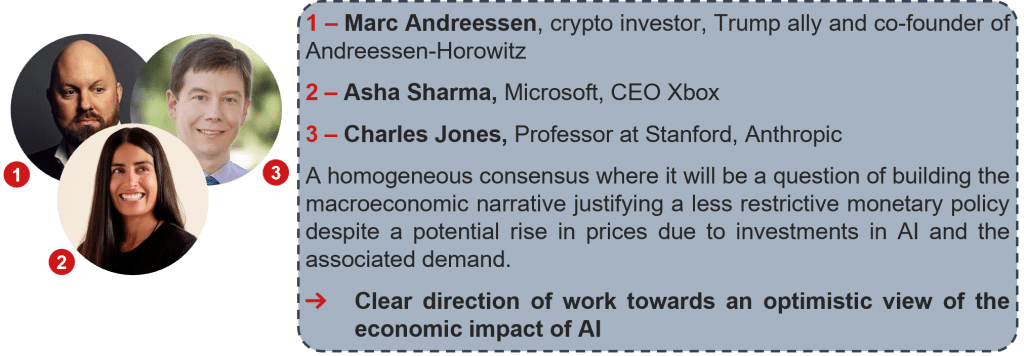
- AI
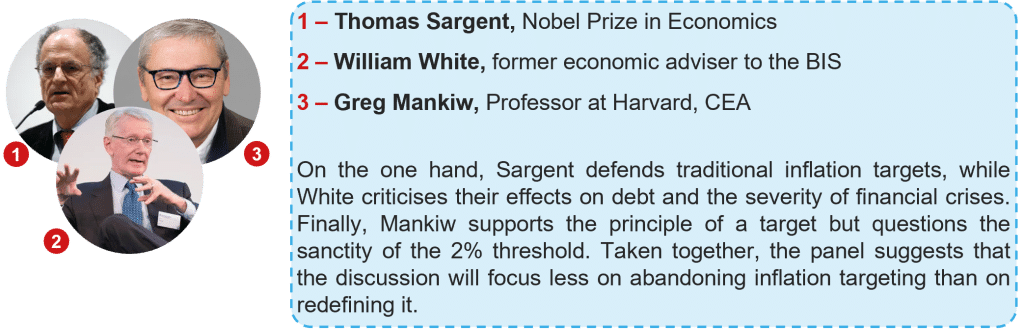
- Inflation
Financing the United States
1 – The cost of debt pushes the Treasury to intervene
1. Intervention on the yen
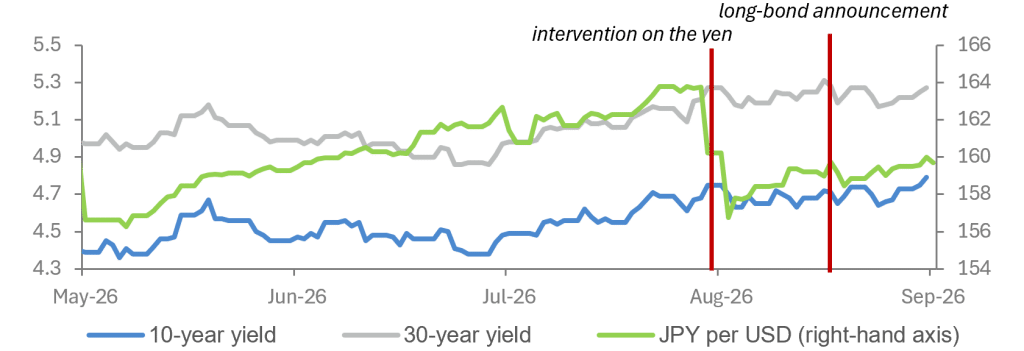
At the end of July, the yen had fallen to ¥163.24 to the dollar, its weakest level since 1986, against a backdrop of resurgent inflation and a monetary policy still regarded as accommodative. Japan is also the largest holder of US debt, with roughly $1,000bn of Treasuries. A sale of reserves to support the yen could have weighed on US bond prices and pushed long-term rates even higher. Scott Bessent, the US Treasury Secretary, therefore faced a double challenge: stabilising the exchange rate while protecting one of the foundations of the economy’s financing system.
The New York Fed therefore bought yen on behalf of the Treasury, the first such operation in 30 years, financed by a sale of euros so as not to weaken the dollar directly against other currencies. The operation acts as insurance against Japanese sales of Treasuries, but its effect on the exchange rate quickly faded. Since a stronger yen in practice implies a weaker dollar, the episode illustrates the difficulty of the mandate entrusted to Mr Bessent by Donald Trump: to contain long-term rates while preserving a dollar that is certainly firm enough, but above all competitive.
2. Long-bond buybacks
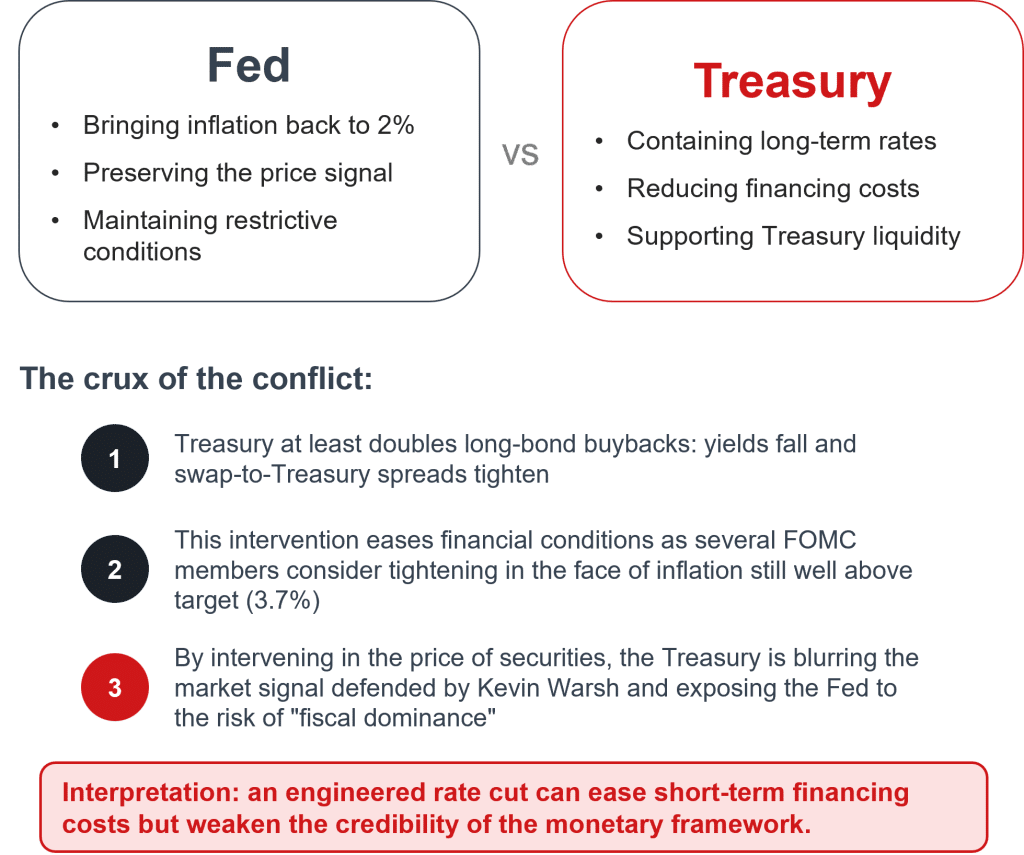
The rise in long-dated Treasury yields is not only the result of expectations of higher policy rates. A fiscal deficit of 5.8% of GDP and debt at 125% of GDP, massive issuance of private debt to finance AI investment (Meta, Microsoft and Amazon), and inflation at 3.7% are all increasing the premium demanded by investors. By mid-August, the ten-year yield had reached 4.75% and the 30-year 5.32%, close to their highest levels since 2025 and 2007 respectively. As the midterm elections approach, the Treasury is seeking to prevent tighter financial conditions from weighing on the federal budget, housing and investment.
It was therefore announced that the maximum size of buyback operations in US debt securities with maturities of ten to 30 years would be increased from $2bn to $4bn, over a three-month period from 9 September to 4 November 2026. The announcement pushed yields back to their early-July levels and narrowed the spread between debt securities and swaps, signalling investors’ clear willingness to hold on to their bonds in the face of a large buyer. The scope of the intervention remains limited, however, since it does not alter the structural forces driving yields higher.
Two Treasury interventions to protect US debt-servicing costs
Sources: Accuracy, Fed, BoJ
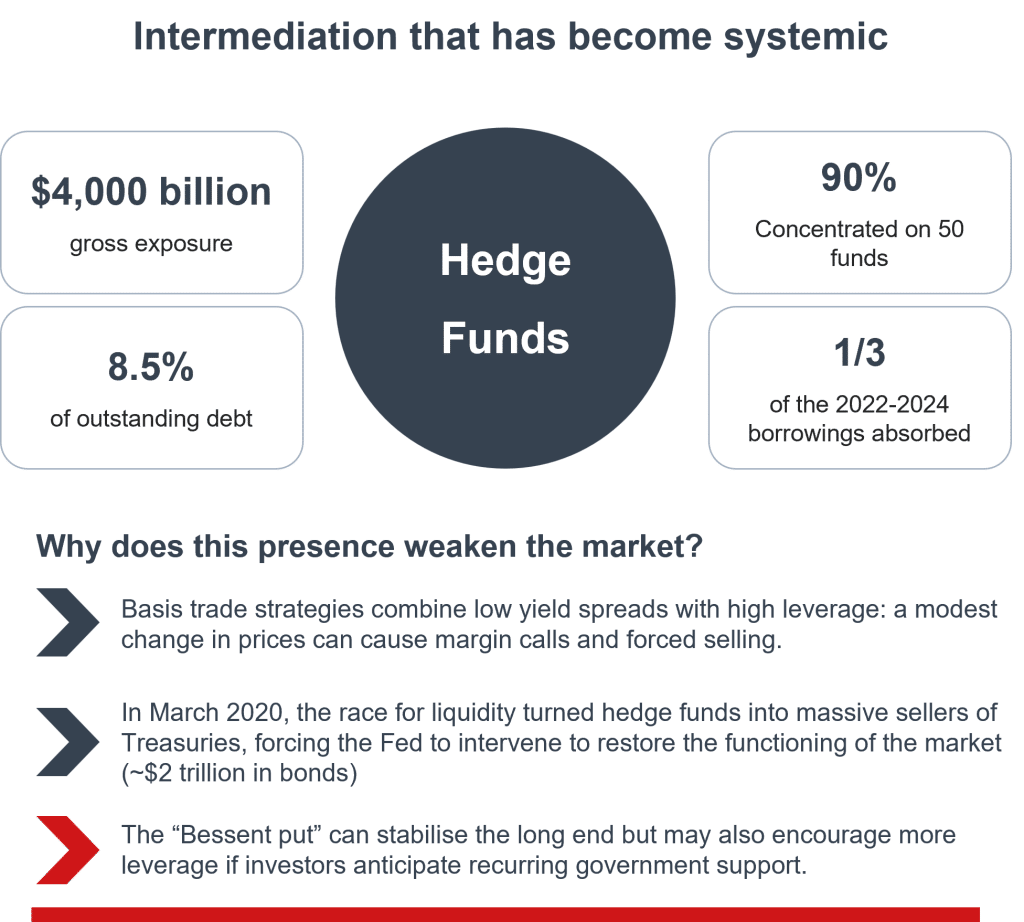
2 – The Fed–Treasury conflict blurs the price of risk, while hedge funds amplify market moves
3 – Reassuring markets on the Fed and reconciling America’s central bank with the Treasury
The symposium held, as it is every late summer, by the US central bank at Jackson Hole helped clarify matters on two fronts.
On how the Fed operates:
- Taking account of structural changes in the economy: could AI be a new factor of production? And with what consequences for growth, the labour market, inflation, returns on capital and more?
- Reviewing the principles and management of monetary policy
- In terms of principles, the first priority is not to misread the economic diagnosis. That means ensuring the right balance between demand and supply in the market for goods and services, looking closely at monetary dynamics, identifying as the dominant monetary-policy instrument the level of short-term interest rates that can secure both price stability and full employment, and putting in place communication that is both appropriate and effective.
- In terms of management, the range of indicators to be monitored needs to be reviewed; the distorting mirror game between the central bank and capital markets should be avoided; and the Fed must guard against communication that ultimately reduces degrees of freedom on both sides.
As for the relationship between the central bank and the Treasury, the objective could only be to temper upward pressure on the long end of the yield curve. Pending the launch of measures to restore the balance of the public accounts, the Fed needs to reaffirm its fierce determination to fight inflation.
Even so, it is difficult for Kevin Warsh to shake off a degree of strategic ambiguity: he has promised President Trump that he will succeed in lowering both inflation and interest rates, chiefly on the intermediate and long sections of the yield curve, while also reassuring capital markets that he is committed to providing them with a protective economic and financial environment. That also means pursuing a restrictive policy when necessary.
Snapshot: towards a new “great schism of the West”?
The transatlantic relationship, long built around an “accepted asymmetry”, is now being hit by a serious squall. Beyond recent political sideshows, the divergences have become structural, multiple and cumulative, feeding a dynamic of growing mistrust between the United States and Europe. Rather than reducing the shift to a binary choice between alliance and rupture, it may be better understood as a process of schism: the dominant centre is contested, competing norms emerge, and the distance widens gradually, held back only by the persistence of deep interdependencies. History helps us take the measure of this through several striking precedents. In today’s metastable setting, a number of medium-term paths remain possible, ranging from the preservation of a precarious balance to relative estrangement or realignment under American influence. The future of the transatlantic relationship therefore remains open: history and geography illuminate it, but its course is still to be decided.
The relationship between the United States and Europe (principally the European Union and the United Kingdom) is being hit by a serious squall. The US President, Donald Trump, has threatened to take his country out of NATO, to seize Greenland – a “constituent autonomous territory” of Denmark and an overseas territory associated with the EU – while accusing European leaders of organising the “civilisational erasure” of their continent. European countries are simply too dependent on their American ally in areas as critical as energy, payments, technology and defence for a response calibrated to the scale of the challenge. For now, they can only muddle through as best they can, while preparing for greater autonomy tomorrow. But how much autonomy, and over what horizon? The process of forging a compromise among Europeans has only just begun.
What is happening, and how might the relationship between these two regions of the world evolve? Beyond that twofold question, how should we understand the current dynamic in terms of history and geography?
Let us start from the following observation: while President Trump’s disparaging remarks may be interpreted as political sideshows, Europe’s reactions should be understood as evidence of a relationship destined to change. It is therefore necessary to return to its essence. Following Jean Monnet, regarded as one of the fathers of Europe, and Geir Lundestad, the Norwegian historian, it is reasonable to say that, in the aftermath of the Second World War, Europe’s elites “invited” American hegemony, out of interest, fear, weakness or conviction, and defined a consensual structuring framework. The balance struck along the Atlantic axis took the form of an “accepted asymmetry”: European security in exchange for American influence across a broad field, from politics to economics. Today, doubts about the security guarantee are helping to call that influence into question. The search for strategic autonomy has begun. With it comes a vicious circle of mistrust: beyond their President’s diatribes, Americans fear that Europe’s distancing could translate into rapprochement with China, and therefore a threat to their supremacy.
In reality, the transatlantic relationship is being weakened by structural, multiple and ultimately cumulative divergences, which lie behind the current process of growing mistrust. A binary framework – alliance versus rupture – is probably not fully adequate to describe the shift under way. The language of schism may be more appropriate. In its religious meaning, a schism is the act by which a group of believers belonging to a given confession separates and recognises a different spirituality. The current relationship between the two regions closely follows this logic of schism: a tangible initial unity; a contested dominant centre; competing norms of legitimacy, to which we shall return shortly; an opposition that is no longer cyclical but structural; and, as we shall see, a gradual distancing, slowed by the persistence of interdependencies over a more or less extended period.
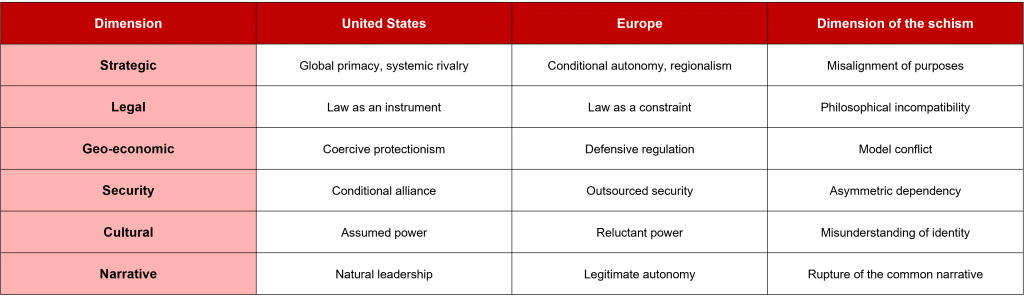
The conflict of norms can be presented as follows:
Conflits of norms leading to the “Western schism”
Sources: various sources synthesised by artificial intelligence
The diagnosis of a Western schism has been made. The divergence is multidimensional, encompassing a number of important values: views of the world, definitions of law, economic regulation and positioning on the international stage. Yet economic and financial ties, a diminished but still necessary security convergence, and a dense cultural and relational fabric all act as brakes on complete estrangement, let alone rupture.
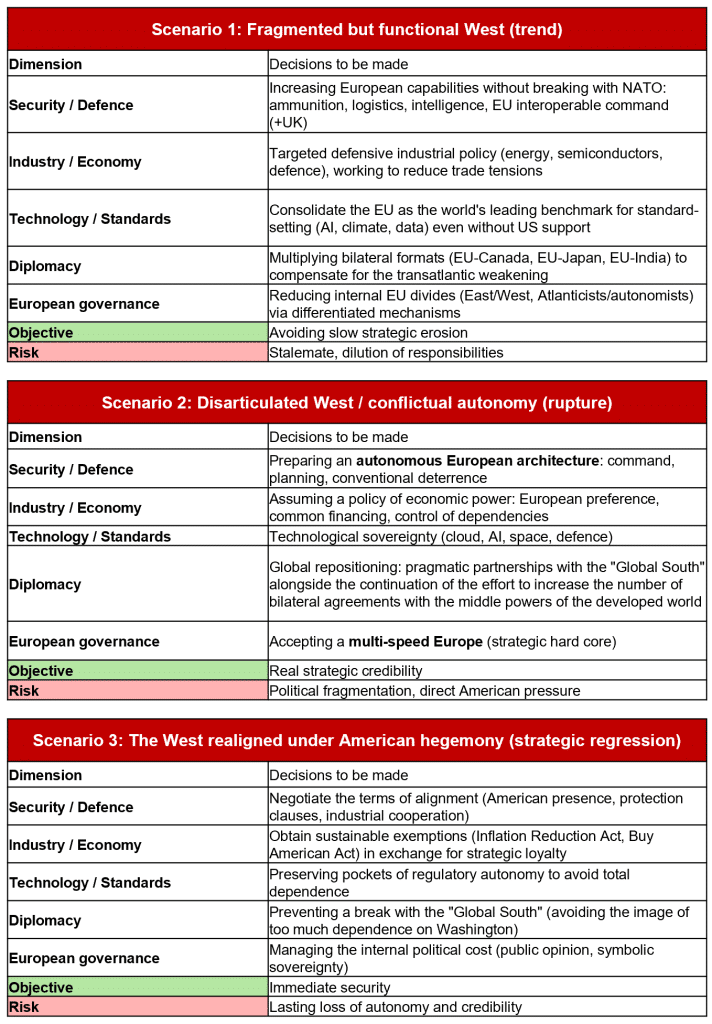
A snapshot of today’s situation captures this balance. It is probably more metastable than stable. It could evolve in an international environment shaped by two major forces: the systemic rivalry between the United States and China, and a somewhat lopsided European triptych (a first-rank economy, but a political actor hampered by the absence of unified command and insufficient military power). Seen from a European perspective, three scenarios for the evolution of the transatlantic relationship are possible over the next few years (five to ten years, perhaps?). In the central scenario, the current balance, precarious though it is, broadly holds. Each side seeks to contain centrifugal forces. The two alternative scenarios frame this central case: one points to distancing from the United States; the other, in the form of a pleasant surprise, suggests realignment, but under Washington’s leadership. Movement towards either path is largely a matter of political will on both sides. The American preference would be for realignment, while Europe would hesitate between the other two. Hence, ultimately, the impression that the central scenario is the most likely.
Three possible futures for the West after the schism: implications for Europe
Sources: various sources synthesised by artificial intelligence
How can we step back from this “Western schism” now taking shape, or already under way? By widening the lens, historically and geographically, and by trying to gauge the consequences that have followed from comparable episodes.
Throughout its long history, the West has repeatedly faced schisms. Without claiming to be exhaustive, four stand out:
- Rome versus Constantinople in the 11th century, and the separation of the Eastern and Western Christian churches;
- Rome versus Avignon at the turn of the 14th and 15th centuries, and the question of which of the two popes legitimately embodied universality;
- Catholicism versus Protestantism in the 16th century, with a theological dispute that carried anthropological implications (mediation towards God) and political ones, through the territorialisation of religion: cuius regio, eius religio;
- The French Revolution versus Europe’s monarchies at the end of the 18th century, with a conflict over the source of legitimacy.
A short history of past Western schisms

Sources: various sources synthesised by artificial intelligence
It is difficult not to see that today’s tensions between the United States and Europe echo these historical experiences. Washington asserts a claim to universality reminiscent of Rome in the 11th century, while Brussels presents itself as the heir to an older order founded on law. Similarly, as in the period of rivalry between Rome and Avignon, the United States and Europe largely share the same value base, but do not possess the same capacity to embody it in the eyes of the world. One conclusion seems to follow. Each of the three scenarios envisaged for the future of relations across the Atlantic is genuinely possible. The future is not yet written.
But beware: schism is not solely a Western experience. Let us leave the shores of history and move to those of geography. Other civilisations have experienced schismatic trajectories. Start with the Muslim world. The ummah (the community encompassing all believers who practise Islam) is the unifying element. From a political succession dispute to the institutionalisation of normative differences, Shiism took shape outside the dominant current of Sunnism. Moreover, that central branch is itself characterised by several poles competing with one another: Saudi Arabia, Egypt and Turkey. The plurality of centres is firmly established. Turn next to the Russian world. Whatever its history, and however it gradually came into being, Moscow is its civilisational centre, and its cultural and political borders are treated as intangible. Any process of distancing, let alone rupture, undertaken by Ukraine over the past two decades amounts, in this view, to an unacceptable schism. War is the means of reintegrating the country into the Russian space. Finally, consider the Chinese world. It is defined both by civilisational continuity (culture, history and Confucianism) and by an imperial, centralised conception of power. In this framework, Beijing “normalises” Hong Kong, tolerates Singapore and its roughly 25% non-Chinese population, instrumentalises the diaspora elsewhere in the world as far as it can, and does not tolerate Taiwan leaving its sphere of control. For now, the process leading to schism is blocked.
The point is clear: within cultural and economic networks that are at once dense and complicated, transformations do not naturally or always fit into a simple binary opposition between continuity and rupture. Schism (should we call it geopolitical schism?) emerges when three factors combine: the inescapable nature of the civilisational fact, a challenge to the system’s centre, and the absence of a mechanism for pluralisation. The West appears to have reached precisely that point today. Tomorrow, should attention turn to Europe?
Hervé Goulletquer, Senior Economic Adviser, Accuracy