

PPPs in the Middle East
The Gulf is renowned for its ambitious, large-scale infrastructure projects, historically funded largely by governments drawing on oil and gas revenues. That model is changing. Private capital is moving up the agenda across the region, with Saudi Arabia and the UAE in particular seeking a greater role for private investors in financing and delivering the next wave of infrastructure.
It’s estimated there’s over US$250bn of PPP projects in the pipeline across the GCC region (MEED, The GCC PPP Projects Market 2026). The value of deals closed each year across MEA has averaged around US$6bn since 2021, putting it in line with APAC (US$6bn), albeit still behind Latin America (US$10bn), North America (US$13bn) and Europe (US$13bn) (IJ Global, Infrastructure and Project Finance League Table Reports, 2021-2025). The scale of the ambition for privately financed projects is therefore clear, but so is the challenge of converting this ambition into financeable transactions.
The Gulf has proven that it can deliver successful PPPs. To date, these have been largely in power and water projects, where revenue models are well-established. The question now is whether new PPP projects in the region, outside these sectors, will be structured to attract capital at scale.
We know this will be a harder test. Roads, airports, healthcare and more complex social infrastructure bring less familiar revenue models, more interfaces and, in some cases, material demand risk.
What’s more, current geopolitical uncertainty adds another dimension. It has not halted infrastructure investment, but it is influencing the type of assets being prioritised, with a notable greater focus on resilient transport, logistics and energy infrastructure. Investors continue to see significant opportunities from a long-term perspective.
The Gulf already has strong institutions, capable sponsors and deep pools of capital. The success of the next phase of PPPs will depend on how well projects are prepared, structured and contracted.
How, then, can procuring entities attract capital for these projects, while ensuring value for money?
Bankability is the constraint
Three conditions underpin a functioning PPP market: a credible long-term pipeline, sufficient depth of capital and bankable projects.
For the first criterion, the Gulf is making good progress. Abu Dhabi’s latest pipeline, announced early this year, worth AED 55bn and covering 24 projects is five times the size of the portfolio announced in 2020, and Saudi Arabia’s project pipeline remains substantial despite the refocusing of several giga-projects – PIF’s 2026– 30 strategy refers to private-sector participation some 36 times.
The second criterion is also well in hand: the region has strong domestic banks, access to global credit, deep sovereign capital and limited foreign-exchange risk. While the current instability in the region may elevate risk for investors today, the programmes in question are long-term in nature.
It is the third criterion, bankability, that remains the constraint.
PPP bankability matrix: Gulf project sectors
Sectors with clearer, more predictable revenue models tend to be more bankable, while delivery complexity increases across transport, healthcare and social infrastructure
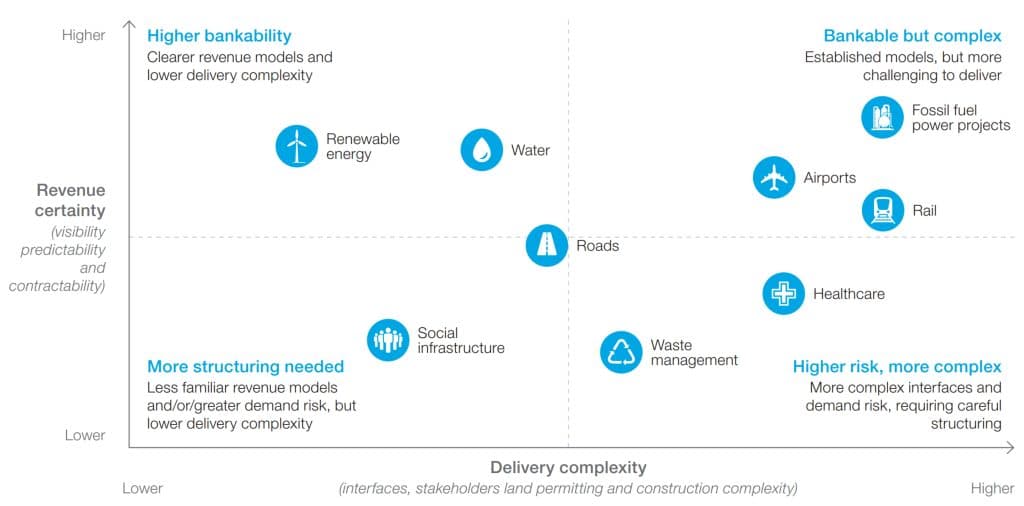
Capital has flowed into sectors with clear revenue models, credible public counterparties and established contractual frameworks. But can that success be repeated in sectors with more complex interfaces, less tried-and-tested frameworks and genuine demand risk, while still providing value-for-money?
For investors, the proposition remains straightforward: a defined commercial opportunity with an acceptable risk-adjusted return. Scale alone does not provide that. Deals need to be structured in ways that give investors confidence in returns while driving private-sector partners to deliver an asset that meets government needs efficiently. Lessons from other parts of the world show how this is done.
Proper project preparation is the foundation
Public sector procurement processes in the region are generally credible and increasingly aligned with international practice. Concerns that may arise are less about the process itself, and more about the stability and quality of the projects that enter it.
PPP finance requires discipline: uncertainties must be addressed before lenders are willing to commit capital. But far from being an obstacle to delivery, this discipline is, in fact, one of the primary benefits of the model.
In the Gulf, projects procured conventionally have been known to suffer from scope instability, compressed development programmes and untested assumptions. The pressure to move from concept to construction before design, interfaces and delivery responsibilities have been resolved is the main reason projects can derail and end up in dispute. With PPPs, to attract more private capital, this needs to be eliminated. The alternative outcome is limited competition, excessive bid qualifications, higher pricing and tighter financing conditions.
Pipeline stability matters too. False starts, reprioritisation and abandoned procurements are not unique to the Gulf, but they harm investment, nonetheless. While some recent U-turns have been for reasons beyond even the control of regional governments, investors need confidence in the long-term view to build their operations, capital networks and SPV partnerships.
Consistency matters more than expanding frameworks
The formal PPP architecture across the Gulf is now largely in place. The establishment of PPP laws, dedicated authorities or specialist units in Saudi Arabia, the UAE, Kuwait, Qatar, Oman and Bahrain shows real progress over the last six or seven years.
But market confidence will be shaped by how consistently commercial and legal terms are applied across successive procurements; how contracts are administered after award; and how payment, change, dispute and termination mechanisms operate in practice.
For long-term capital, isolated success is not enough. Investors price the behaviour of the portfolio as well as the terms of the individual project.
The next credibility gain will therefore come not from additional institutional reform, but from a sustained record of predictable execution.
Risk transfer has a price
Here in the region, onerous risk transfer from procurers to bidders remains all too common. This does little to reduce the overall risk on a project and, instead, actually harms the project’s appeal and increases its price.
This is exacerbated in a financed project where, in the Gulf as much as anywhere else, lenders impose such discipline vigorously. Where a risk cannot be controlled by the private partner, it returns through pricing, qualifications, demands for guarantees or reduced bidder appetite.
The theory is well-established: risk is optimised when it sits with the party best able to manage it. Good risk allocation supports competition and financeability – land acquisition, permitting, unknown ground conditions and utility interfaces are obvious examples. Retaining or underwriting those risks can materially improve the proposition without weakening private-sector accountability.
The focus should be on handing private partners the risks they can influence: delivery, financing, lifecycle cost, availability and performance. Procurers need to understand the risk-price trade-off when allocating risk, and where the breakeven point lies.
Revenue risk is the dividing line
Revenue risk remains the clearest dividing line between projects that attract capital and those that struggle. Strategic importance and technical quality are no substitutes for cash flows that can be forecast, contracted and financed.
The core requirements are familiar: identifiable assets and services, measurable outputs, sufficient operating independence and long-term cash flows capable of supporting debt. But the harder question is how much demand or revenue risk the private sector can price efficiently. If that risk is transferred beyond the market’s capacity, value for money deteriorates quickly, particularly in Gulf markets where governments already have access to relatively low-cost capital.
Nevertheless, public funding can still crowd in private investment. Anchor infrastructure, enabling works and flagship assets can reduce both capital requirements and uncertainty across adjacent developments. This can lead to new perspectives: instead of considering whether revenue can be transferred, the question becomes whether the project benefits from doing so.
Success depends on execution
The Gulf has strong foundations in place, particularly in pipeline scale and depth of capital, but faces greater challenges on project preparation and risk allocation
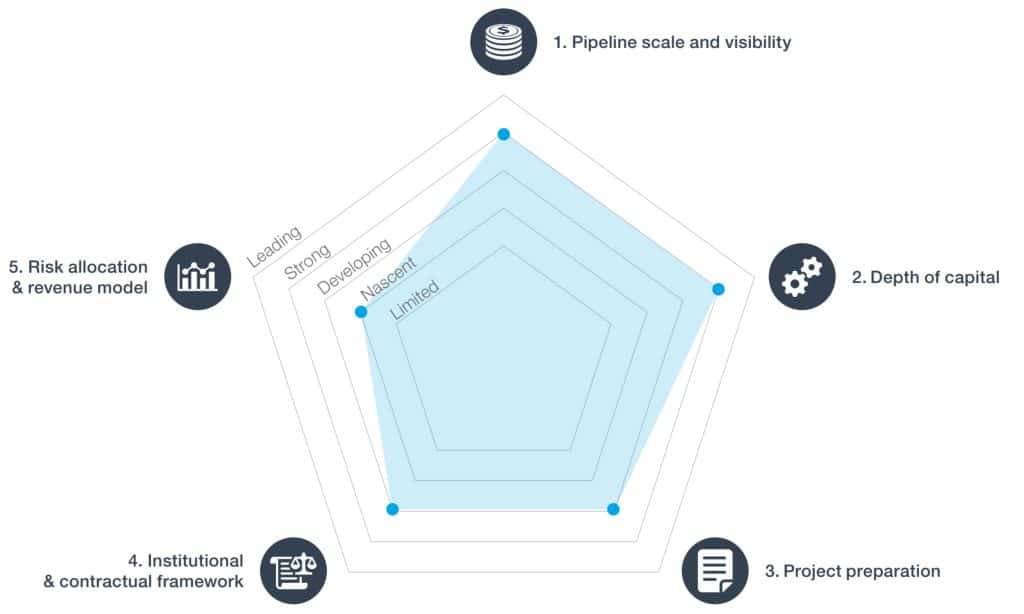

PPPs in the Gulf have come a long way. The task now is to build on that progress.
Most of the necessary foundations are already present: ambitious pipelines, capable institutions, strong banking systems, sovereign capital and established experience in power, water and selected social infrastructure.
The success of the next phase of PPPs will be determined by how projects are executed by procuring entities. That means:
- Stable pipelines with minimal U-turns;
- Rigorous preparation before procurement;
- Consistent contracts and contract administration;
- Disciplined risk allocation;
- Revenue models aligned with what private capital can carry.
Recent portfolio resets may help put these priorities into practice, but only if they direct capital and institutional attention towards projects with clearer commercial fundamentals.
Over the next five years, the test will be less about creating new frameworks than applying existing ones consistently. Consistent execution will broaden the investor base, deepen financing options and create a repeatable PPP market beyond the sectors that have already succeeded. By preparing bankable projects and allocating risk to those best able to manage it, governments and procuring entities can turn ambitious pipelines into financeable transactions while protecting value for money. That is how the countries of the Gulf can expand on the foundations they have built to advance private sector participation and deliver more of the infrastructure needed to unlock their ambitions.