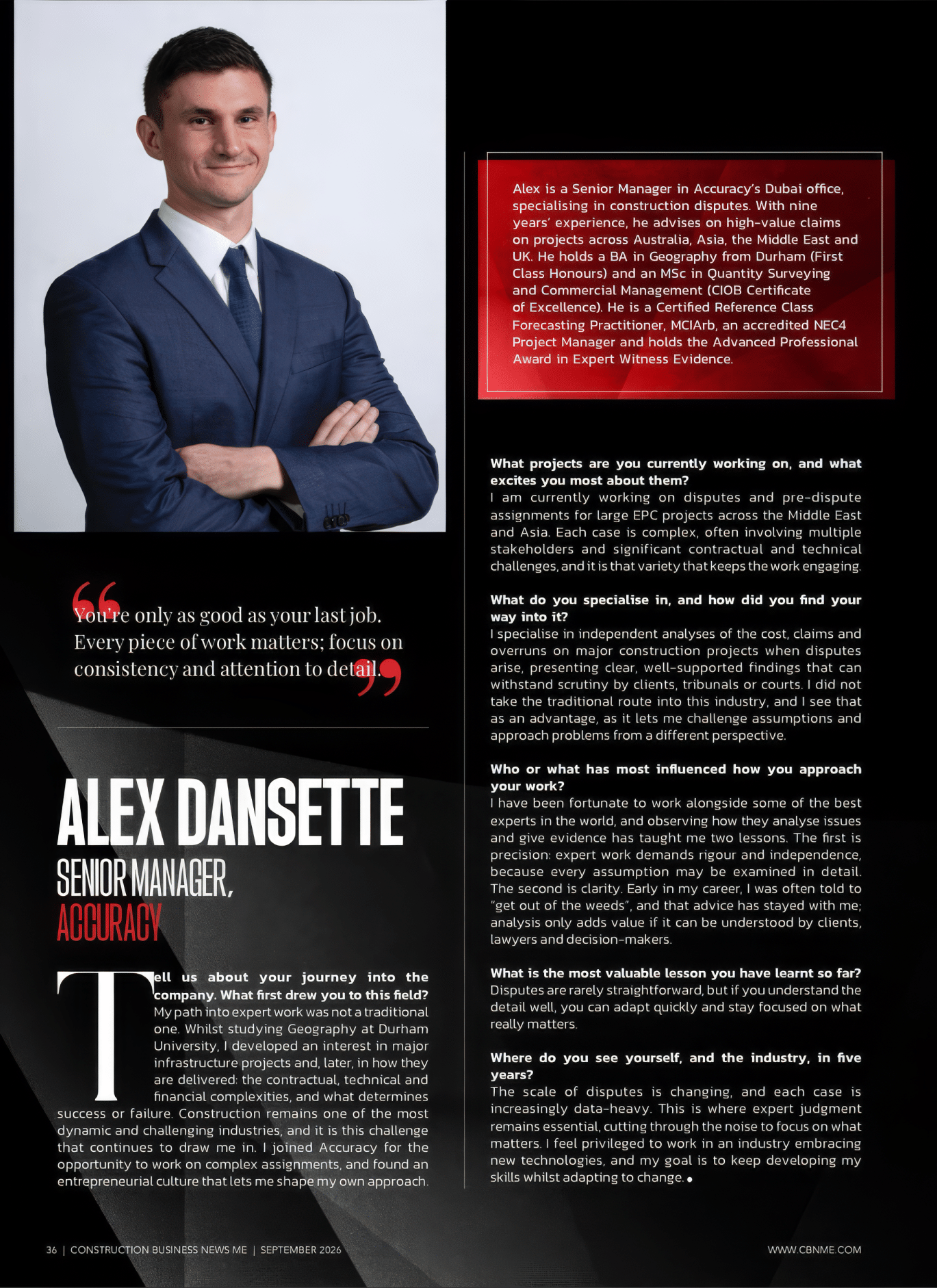
Alex Dansette is a Senior Manager in Accuracy’s Dubai office, specialising in construction disputes. With nine years’ experience, he advises on high-value claims on projects across Australia, Asia, the Middle East and UK. He holds a BA in Geography from Durham (First Class Honours) and an MSc in Quantity Surveying and Commercial Management (CIOB Certificate of Excellence). He is a Certified Reference Class Forecasting Practitioner, MCIArb, an accredited NEC4 Project Manager and holds the Advanced Professional Award in Expert Witness Evidence.
Tell us about your journey into the company. What first drew you to this field?
My path into expert work was not a traditional one. Whilst studying Geography at Durham University, I developed an interest in major infrastructure projects and, later, in how they are delivered: the contractual, technical and financial complexities, and what determines success or failure. Construction remains one of the most dynamic and challenging industries, and it is this challenge that continues to draw me in. I joined Accuracy for the opportunity to work on complex assignments, and found an entrepreneurial culture that lets me shape my own approach.
What projects are you currently working on, and what excites you most about them?
I am currently working on disputes and pre-dispute assignments for large EPC projects across the Middle East and Asia. Each case is complex, often involving multiple stakeholders and significant contractual and technical challenges, and it is that variety that keeps the work engaging.
What do you specialise in, and how did you find your way into it?
I specialise in independent analyses of the cost, claims and overruns on major construction projects when disputes arise, presenting clear, well-supported findings that can withstand scrutiny by clients, tribunals or courts. I did not take the traditional route into this industry, and I see that as an advantage, as it lets me challenge assumptions and approach problems from a different perspective.
Who or what has most influenced how you approach your work?
I have been fortunate to work alongside some of the best experts in the world, and observing how they analyse issues and give evidence has taught me two lessons. The first is precision: expert work demands rigour and independence, because every assumption may be examined in detail. The second is clarity. Early in my career, I was often told to “get out of the weeds”, and that advice has stayed with me; analysis only adds value if it can be understood by clients, lawyers and decision-makers.
What is the most valuable lesson you have learnt so far?
Disputes are rarely straightforward, but if you understand the detail well, you can adapt quickly and stay focused on what really matters.
Where do you see yourself, and the industry, in five years?
The scale of disputes is changing, and each case is increasingly data-heavy. This is where expert judgment remains essential, cutting through the noise to focus on what matters. I feel privileged to work in an industry embracing new technologies, and my goal is to keep developing my skills whilst adapting to change.
You’re only as good as your last job. Every piece of work matters; focus on consistency and attention to detail.
Alex Dansette