
As carve-outs become a defining feature of today’s M&A landscape, both buyers and sellers are grappling with their unique challenges and opportunities. Driven by strategic refocusing, market pressures, and the pursuit of higher standalone value, carve-outs demand a sharp operational lens, rigorous due diligence, and disciplined execution. This article is a part of a series from Accuracy that explores the rise of carve-outs, key market trends, common pitfalls, and practical steps dealmakers can take to ensure a smooth separation and unlock long-term value.
Carve-Outs: the high-wire act of modern M&A
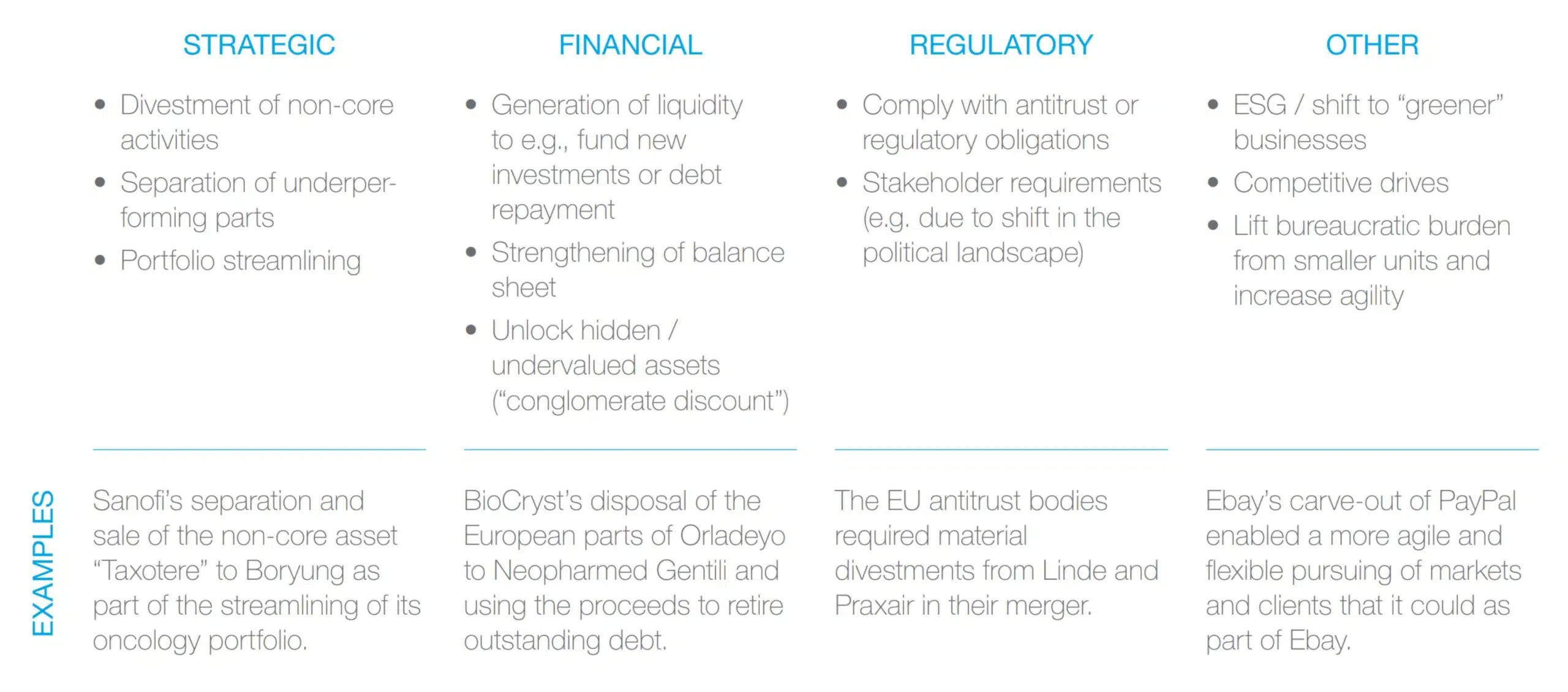
In today’s M&A landscape, carve-outs are becoming increasingly common. The motivations for carve-outs are as diverse as the transaction itself, ranging from strategic portfolio considerations to financial objectives to regulatory or antitrust obligations: Take, for example, a business that may be (i) looking to refocus on “core” operations and therefore disposes “non-core” assets or divisions, (ii) facing liquidity pressure to shore up its balance sheet and meet looming debt obligations (particularly relevant in the hawkish interest environment post-Covid), (iii) targeting improved profitability when a particular division may have a dilutive effect overall, or (iv) addressing regulatory requirements (such as an enforced disposal under competition regulations). Others, by contrast, may appeal for opportunistic reasons, for instance a carve- out may unlock value through higher external market valuation for a standalone business (vs implicit valuation within the existing business) or a set of identified potential buyers may be looking to expand and/or consolidate their market.

Unlike a traditional buy-out transaction, carve-outs come with an array of additional uncertainties and risks for a prospective buyer, from both a financial viewpoint (can we trust the numbers?) and an operational one (will the disentanglement from the existing group be more complex than expected? What about the added burden of post- acquisition integration in the event of a trade buyer?). Sellers must also contend with extended deal timelines, increased distraction for management during due diligence and potential pre-sale reorganisations, as well as the potential for continued support to the carved-out business post-completion through Transition Service Agreements (TSAs).
Despite these challenges, deals are getting done. Success, however, requires greater pre-deal scrutiny — not only through rigorous financial, legal, and tax due diligence, but also through careful evaluation of Day 1 readiness, validation of the standalone business plan, and assessment of growth prospects. This article series explores the most common challenges in carve-out transactions and outlines practical steps and best practices that buyers and sellers can take to navigate them effectively and achieve the best possible outcomes.
Key drivers for Carve-Outs
Carve-out financials present a significant challenge, as financial reporting that aligns with the transaction perimeter often does not exist. Developing both historical and forward-looking financials is a critical task that should not be underestimated.
Charlene Burridge, Partner at Accuracy
A Carve-Out isn’t a Carve-Out
But what actually is a carve-out?
A carve-out entails the separation of a business unit, division, product or set of assets from a parent company, often creating a standalone business capable of operating independently. The carved-out business might operate in an adjacent (“non-core”) market to its parent, cover a defined geographic zone, or sit within a specific section of the value chain (think logistics, manufacturing, production), for example. It will often share key management positions with the rest of the business, use common back-office functions (e.g. Finance, IT, HR, Marketing), and even might occupy the same premises (both industrial and office sites). Setting the perimeter of a carve-out is therefore not always as straightforward as it appears, as there may well be various undocumented interdependencies that blur the lines between business divisions. These factors ensure that no two carve-outs are alike, and every transaction is inevitably a bespoke process.
What are the main differences in a carve-out sale process compared to a “standard” buy-out?
At the outset, the potential lack of visibility over the intended transaction perimeter presents a challenge to a seller’s management. The more organised the group already is, with a more coherent divestment rationale, the more likely that such initial difficulties can be overcome in a timely manner. The key challenge is that the standalone asset to be ultimately sold does not exist in the exact form today. Depending on the buyer universe – most notably whether it consists of buyers being able to integrate the asset and provide certain functions – large transformations and build-backs to create a standalone business might be necessary. The role of an experienced advisor, engaged in the early stages of a process, can be fundamental in guiding management, both setting a clear path and timeline for a potential sale, as well as avoiding pitfalls that could erode deal value.
During the interactions between sellers and buyers, buyers will often have a longer and more thorough question list compared to a more typical buy-out process, reflecting the greater number of facets to a deal that may go wrong. As a general rule, the more complex the existing integration between the carve-out target and its parent, the longer the due diligence process will last, which will necessarily consume more of management’s time. And even after a deal signs and completes, Transition Service Agreements (TSAs) are often critical for ongoing support from the previous owner to the carved-out business; careful negotiation of these (coverage, costs, and duration of this support) can be a sticking point.
Carve-Out transactions becoming more common
Carve-outs have increasingly emerged as a strategic lever in M&A, propelled by macroeconomic shifts, shareholder pressure and evolving corporate priorities. Understanding these market dynamics is critical for both sellers and buyers navigating this complex space.
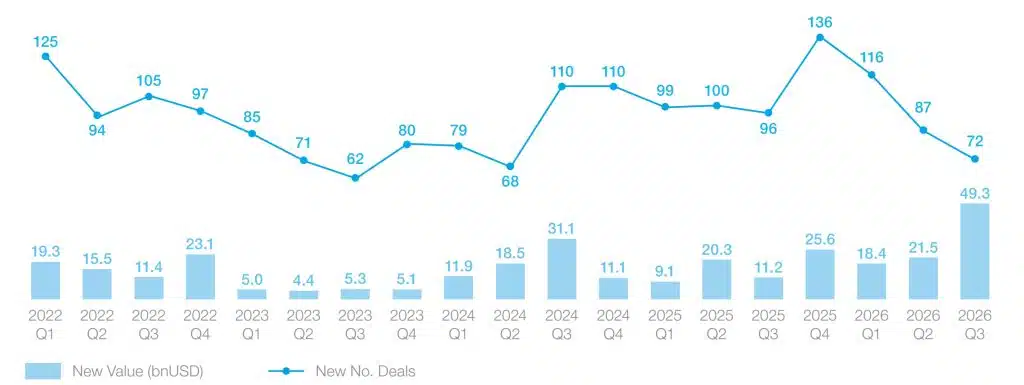
The economic turbulence and market slowdown during the Covid pandemic prompted companies (both large and small) to reassess their structure. In many cases, it even resulted in strategic decisions to realign their focus and update their business plans. This led to an acceleration in divestitures and carve-outs. Between 2020-24, carve-outs and divestures grew (as a share of all buyouts) from 5.7% in Q4 2021 to 12.6% in Q1 2024¹, as companies sought to shed non-core assets and sharpen focus on profitability and resilience. In the US, carve-outs accounted for 15.5% of middle-market buyouts in Q1 2024 – double the 7.6% recorded in 2022, primarily led by industrial conglomerates and multinational corporations.²
The activity dipped by c.10% in Q1 2025 before recovering again by the fourth quarter. Intent points to a deeper pipeline, with 71% of private equity firms saying they would pursue carve-outs and 57% of corporates open to or actively exploring divestitures.³
Private equity firms have increasingly targeted carve-outs as they offer under-optimised businesses at attractive valuations. Through operational improvements, they aim to drive margin expansion and strategic repositioning. Pre-pandemic, strong cash reserves, and sector convergence – such as tech integration in mobility, fintech, and telecom/media – even fuelled less conventional deals and divestures.
Prepacked vs. unpacked deals
Unpacked deal: In an unpacked carve-out, the separation and preparation of the target business are largely left to the buyer after acquisition. The seller provides limited pre-sale structuring or separation planning, meaning the buyer must handle much of the operational disentanglement, systems setup, and standalone readiness post-completion. While this approach can accelerate deal timing for the seller, it increases execution risk and
post-acquisition complexity for the buyer.
Pre-packed deal: In a pre-packed carve-out, the seller undertakes significant preparatory work before the sale to ensure the business can operate independently from Day 1. This may include establishing standalone financials, transferring key contracts, setting up separate IT and HR functions, and negotiating transition service agreements. A pre-packed approach reduces uncertainty, shortens integration timelines, and generally makes the business more attractive to buyers — though it requires more upfront investment and management effort from the seller.

Global PE/VC-backed carve-outs, 2022-2026Q3
Source: S&P Global – CapIQ
Certain sectors are more suited for carve-outs than others thanks to their operational separability, easier disentanglements and separate asset ownerships, in particular: (i) technology firms are divesting legacy hardware or on-premises (licensed) software divisions and opting for cloud-based / subscription-based business models to focus on specific market dynamics and innovation priorities; (ii) healthcare and pharmaceutical firms are also seeing a rise in carve-outs of generics, OTC divisions or diagnostics units (e.g. Novartis’ spin-off of its generics and biosimilars division); and (iii) energy and industrial firms are increasingly shaping their divestitures based on ESG mandates and decarbonisation strategies.
Carve-Out execution – Strategic goldmine or operational minefield
While the fundamental elements and rules of a M&A transaction hold true in a carve-out setting, carve-outs introduce additional layers of complexity, requiring a sharper lens, deeper insights, and an appreciation for the operational reality post-separation. It is particularly important in carve-out situations for sellers to engage experienced advisors with sector expertise; thorough vendor due diligence (VDD) forces management to lift the covers and get to grips with the health of the business (for better or for worse). Confronting this, and dealing with any significant issues identified, ensures a far smoother ride once buyer’s advisors have access to information and indeed, often shortens the period of iterative interrogation. It comes as no surprise that sellers often express relief that they did conduct VDD before a carve-out, whilst buyers often bemoan the lack of VDD, which can manifest itself through price chips and more difficult negotiations further down the line.
Most carve-out targets lack standalone financial statements due to a carve-out perimeter that is not aligned with existing financial reporting segments, costs for shared services, differing legal structure, and existing operational integration. “Carve-out financials” prepared by a seller must therefore consider the allocation of costs and revenues to/from the parent company that appropriately reflects the financial reality of the standalone business. This is highly subjective, and the only certainty of carve-out financials is that they will not be perfect. Flexibility and pragmatism from both seller and buyer are needed to arrive at an acceptable consensus to strike a deal.
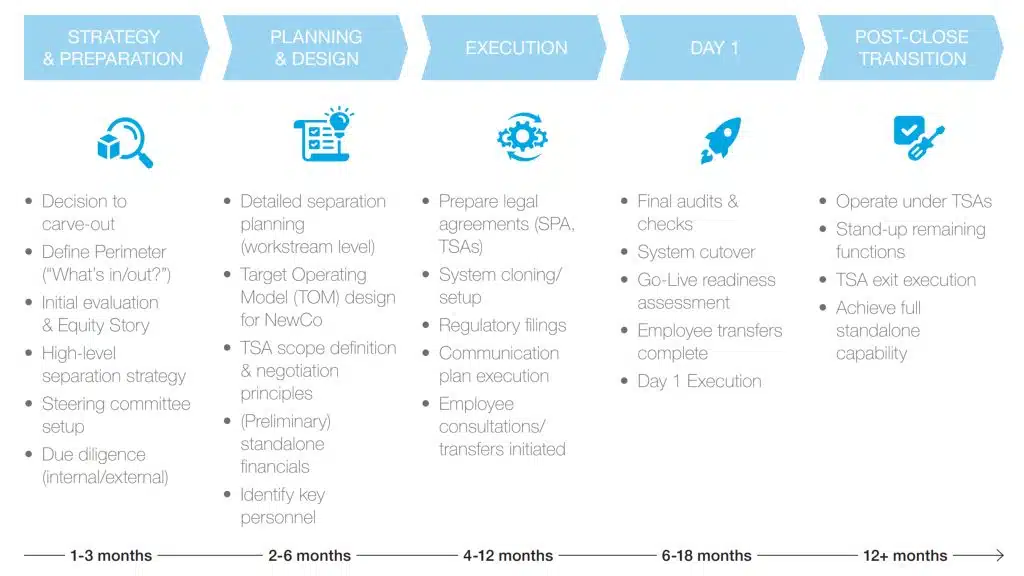
A typical carve-out can take anywhere from 18-36 months
Source: Accuracy
The separation of a carve-out business from its parent is often multifaceted, with complex operational dependencies. This typically spans various back-office functions, in particular Finance, IT and HR. Designing and costing the standalone functions require deep expertise; IT alone can be particularly challenging considering the transfer (or replacement) of systems, licences, and infrastructure. Intellectual property is often a thorny issue, particularly in the instance of non- transferrable rights and licences where third-party consent may be required (be aware of ominous Change of Control clauses). Similarly, the timely legal novation of critical operating contracts (and permits, in some cases) must be executed to ensure Day 1 readiness. Again, a meticulous planning is critical to deal success.
Transition Service Agreements (TSAs) are often employed during carve-outs and offer the buyer comfort with regard to continuity of critical functions from Day 1, whilst the carved-out business builds and implements its own capabilities. However, these are not free, and a balance must be struck to ensure the TSA delivers the appropriate level of support for a sufficient duration without being financially onerous. Law firms have specialist teams to negotiate TSAs, while the diligence process likely to guide a buyer as to where they will be more/less needed.
Executing a separation demands substantial operational expertise combined with a strong focus on change management. After all, it is often akin to performing surgery on a living organism.
Roland Drapatz, Partner at Accuracy
For a trade buyer, the work does not end once the deal completes. It is likely that an integration alongside a synergy plan has been prepared for the combined business as part of the investment thesis; the implementation of these synergies once the keys have been handed over remains fraught with complexity. It requires meticulous planning and monitoring, strong management, and often unforeseen legal obstacles. In parallel, the integration of the newly acquired business can uncover cultural frictions that require sensitive handling. Entrenched ways of working (systems, policies, hierarchies) cannot be undone overnight, and it is imperative to maintain a collegiate approach to facilitate integration and unlock the value originally identified.
Talent retention—both at the senior management level and across key operational roles—is a critical consideration in carve-out transactions. Within the parent group, strategic direction and oversight may have been driven centrally, with the carved-out business managed by a less experienced general manager or even a multi-divisional director in a part-time capacity—someone who may not transition with the divested entity. Post-acquisition, the composition, and capability of the management team will be pivotal to the success of the standalone business. Equally important is the retention of functional and technical talent who carry institutional knowledge and operational continuity. These factors raise important considerations around retention and incentivisation packages for existing leadership and staff, as well as the potential need for external recruitment and the associated costs.
Join us in exploring Carve-Outs further
The increasing appetite for carve-outs is clear to see; buyers and sellers have demonstrated the ability to unlock greater value, through carve-outs particularly in recent years, and this trend looks set to continue. In a crowded investor landscape, with ever more investment funds looking to deploy record levels of dry powder and searching for their niche in the market, carve-outs are a compelling investment choice.
The deal handbook for executing a carve-out is certainly less mature than the established buy-out market, but nevertheless there is a growing familiarity with the added complexities and potential pitfalls that we have discussed, namely: robustness of standalone financials, separation planning and post-deal integration. A dual mindset of both meticulous attention to detail as well as a healthy dose of pragmatism is invaluable to seeing a carve-out through to fruition.
Seeking help in the early stages, on both the sell side and buy side, can be instrumental in identifying and remedying potential deal-breakers. Fortunately, there is a growing population of advisors with direct experience in carve-out transactions on hand to supplement your own internal capabilities.
As market momentum for carve-outs continues, dealmakers who master the nuances of carve-out diligence will be best positioned to extract maximum value – and, importantly, avoid post-deal surprises.
> Or consult our french version here.
Charlene Burridge – Partner, Accuracy
Roland Drapatz – Partner, Accuracy
Charles Wheeler – Director, Accuracy
Abhay Gopalani – Manager, Accuracy
Ayush Rai – Manager, Accuracy
Exploring Carve-Outs in M&A