
Tourism and optimism tend to go hand in hand, and the summer season lends itself naturally to both – at least in the Northern Hemisphere! But how is the sector coping with the geoeconomic and geopolitical upheavals reshaping today’s world? And, while adaptation is clearly necessary, can it be achieved easily?
Before addressing these questions, it is worth establishing the framework: what exactly is tourism, and how significant is it? According to the United Nations, tourism encompasses any trip away from one’s usual place of residence lasting at least one night and no more than one year, regardless of purpose: business, leisure, health, and so forth. What distinguishes tourism from leisure activities is its timeframe. Leisure takes place within daily life, over the course of a day or an evening. The origins of the word itself reveal an anthropological dimension that remains relevant today. Tourism derives from the old French word tour and entered English usage in the early nineteenth century. The term evokes a circular journey – travel is not intended to last forever; it ultimately brings the traveller back to the point of departure.
To take this reflection a step further, consider one of the modern myths of travel: the American road trip. Contrary to appearances, it is not primarily associated with crossing borders but with discovering one’s own country. It highlights a fundamental characteristic of tourism: it can be either domestic or international. In both cases, the journey reflects a desire to break with routine and broaden one’s horizons. That aspiration runs through the entire culture of travel, from the novels of Jules Verne to Jack Kerouac’s On the Road. More than simply an economic activity, tourism fulfils an ancient promise: the call of elsewhere. It is precisely this promise that explains tourism’s remarkable expansion over recent decades.
To grasp the scale of tourism’s development, it is useful to begin with a framework that categorises its various forms. There are five in total: three ‘primary’ categories – domestic tourism, inbound tourism (from abroad into a given country) and outbound tourism (from a given country to destinations abroad) – and two combined categories – internal tourism (domestic plus inbound) and national tourism (domestic plus outbound). Total tourism can be defined as the sum of internal, inbound and outbound tourism.
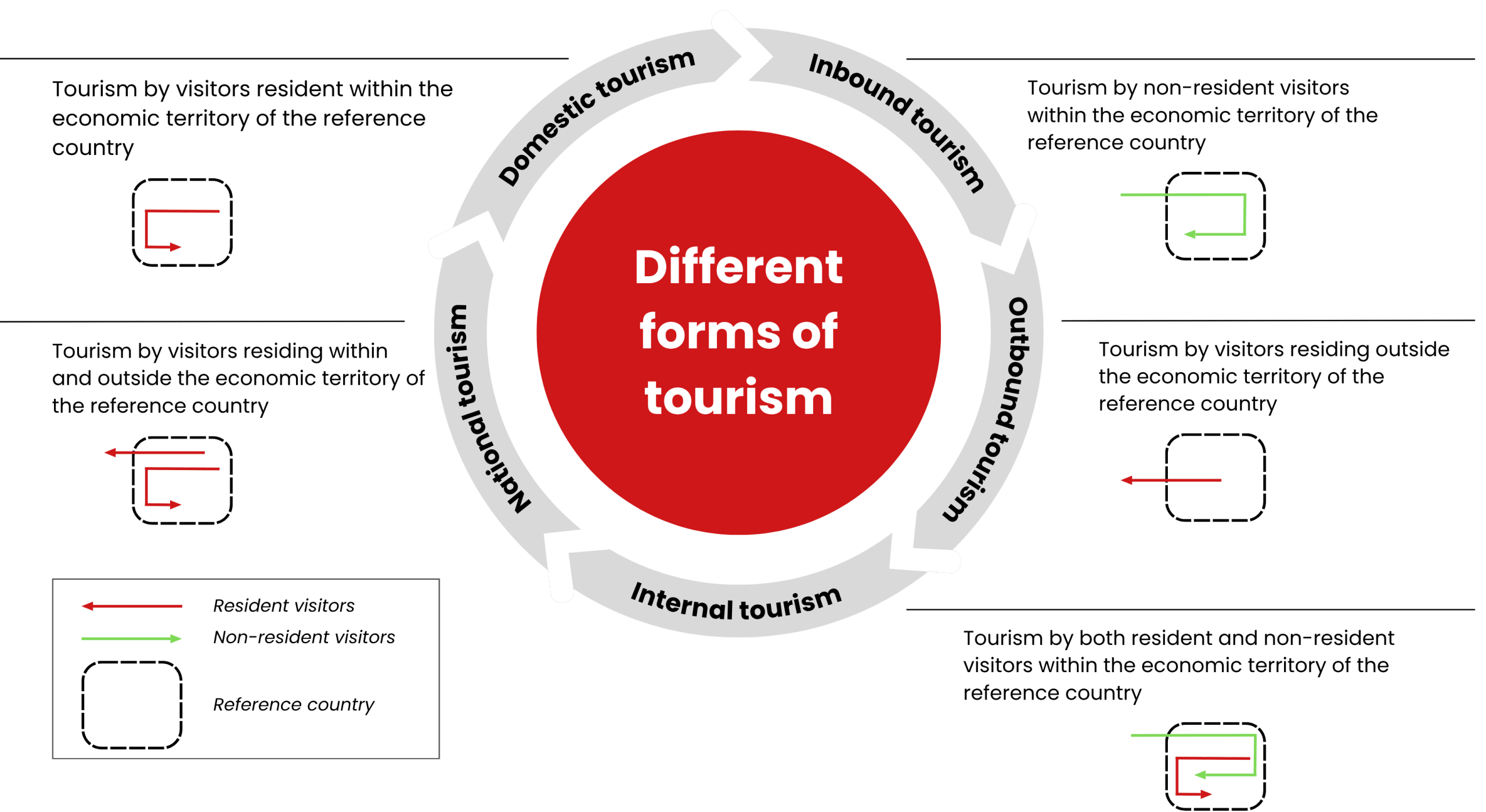
Let us turn to the numbers, focusing first on four countries that play a major role in the sector: relative to population size, total tourism activity represents around 5.7 times the population in Spain, 4.6 times in France, and roughly 2.5 times in both Thailand and the United States. Tourism is predominantly domestic in the American and Asian cases, while inbound tourism carries much greater weight in the two European economies. Outbound tourism, meanwhile, appears closely linked to residents’ purchasing power.
The different components of tourism: respective weight in a representative sample of four countries

Sources: UN Tourism, World Bank.
Moving beyond taxonomy and country examples, it is worth stepping back to consider the global landscape. A useful starting point is the distinction between international and domestic tourism: residents of a given country travel either abroad or within their own borders. International tourism is relatively straightforward to measure, thanks to United Nations data. Its expansion over the past fifty years has been nothing short of spectacular. Global receipts from international tourism have increased elevenfold, compared with world GDP growth of 440% over the same period – a multiplication factor of 5.4.
Visitor numbers have risen sevenfold, while the global population has merely doubled. As we have already seen, however, this boom has been far from uniform. Some countries are considerably more exposed to tourism than others.
Assessing domestic tourism and its evolution over time is considerably more difficult.
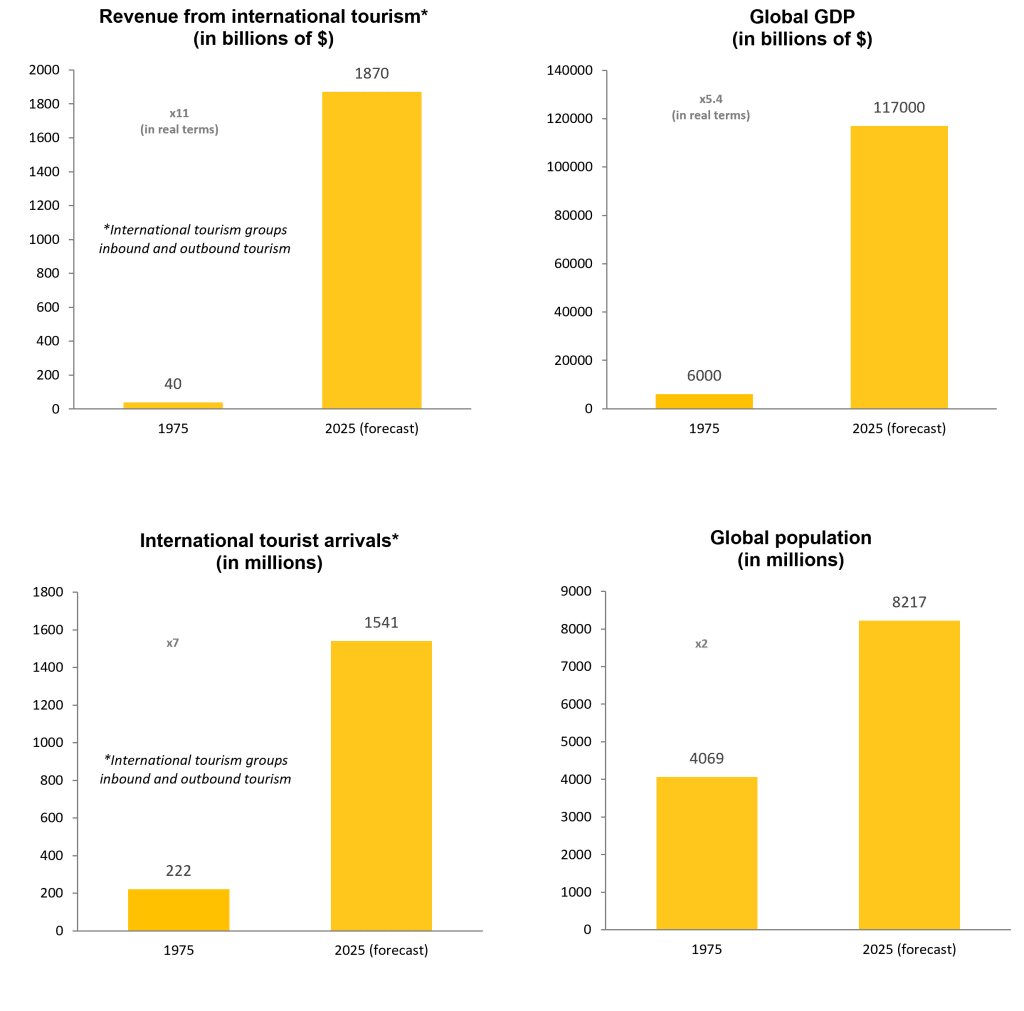
Sources: Accuracy, UN Tourism
¹Worldwide statistics are often incomplete. One figure is nevertheless well established: in 2018 there were around 9 billion domestic tourist trips, compared with 1.5 billion international tourists. While international tourism expanded sevenfold between 1975 and today, domestic tourism likely grew by a factor of only 3 to 3.5. Both trends share common drivers: population growth, rising GDP per capita and urbanisation. Yet international tourism has benefited from additional forces, including falling air travel costs, more open borders during a prolonged period of relative global stability, the emergence of the internet and online booking platforms, and the expansion of the middle class across emerging economies.
With the scene now set, attention turns to centre stage: how are global disruptions affecting tourism? A useful geoeconomic and geopolitical framework can be built around four dimensions.
First, tourism is a significant contributor to economic activity. Globally, it accounts for around 3% of GDP directly and roughly three times that level once indirect effects are included, although national differences are substantial. In Thailand, tourism represented nearly 7.5% of GDP at the end of the 2010s before collapsing to just 0.8% in 2021 in the wake of Covid-19. Its recovery has proved far from straightforward. In Spain, the sector typically contributes between 6% and 7% of GDP. In France, the figure exceeds 3.5%, while in the United States it stands at around 3%. Beyond growth, tourism supports employment, investment and consumption, often significantly in regions best suited to the industry. For countries that have embraced international tourism, it also provides a welcome boost to external accounts, as tourism revenues are recorded as exports of services.
Second, tourism is a source of international influence. When visitors enjoy a positive experience, the resulting goodwill strengthens a country’s soft power, the intangible assets that underpin international influence, including language, culture, values and, ultimately, diplomacy.
Third, when combining these economic and cultural dimensions, tourism becomes a strategic tool that governments can deploy in the pursuit of international competitiveness.
Fourth, tourism comes with significant vulnerabilities. The sector is acutely sensitive to crises, whether pandemics such as Covid-19, geopolitical tensions as currently seen in the Middle East or developments in financial markets. Exchange rates, in particular, are a critical determinant of tourism performance.
Against this backdrop, how should we characterise the geoeconomic model of our four representative countries?
The United States is the world’s largest tourism market, with direct tourism GDP estimated at nearly $900 billion in 2025.¹ Around 90% of activity is domestic. The sector is both dominant and stable, while the tourism balance is broadly in equilibrium. This strength is reinforced by the country’s considerable soft power, reflected in foreign visitors’ enthusiasm for its national parks, theme parks such as Disney, and iconic destinations including New York, Las Vegas and Los Angeles. In fact, tourism primarily serves as a showcase for America’s economic strength through domestic tourism and its international appeal through inbound tourism. France attracts more foreign visitors than any other country in the world. Yet the sector’s relative weight in the economy is not so high as to create systemic risk should tourism activity weaken. Nevertheless, tourism plays a vital role in France’s cultural reach and is a major contributor to its external balance. The tourism surplus accounts for roughly one-third of the surplus generated by the services sector as a whole and therefore helps offset, at least in part, the country’s trade deficit in goods. Tourism is a cornerstone of French soft power, through the country’s heritage, culture and lifestyle offerings. Even so, it remains dependent on the international economic and geopolitical environment. In Spain, tourism is an economic giant. Its contribution to GDP can exceed 15% once indirect effects are included, while tourism earnings play a decisive role in generating the country’s current-account surplus. However, the country’s specialisation in mass tourism leaves it highly exposed to economic downturns and geopolitical tensions. Thailand faces a similar challenge. Its external accounts are particularly vulnerable when tourism underperforms, making it more difficult to compensate for weaknesses elsewhere in the economy.
As these examples illustrate, tourism sits at the intersection of three key dimensions: economic weight, soft power and external balance. Spain and Thailand represent classic ‘tourism-exporter’ models. For such systems to function effectively, the world must remain open and the global economy operate under broadly normal conditions. France is less dependent, but tourism remains crucial both to the country’s attractiveness and to the health of its current account. The United States, by contrast, benefits from such powerful economic, cultural and political leadership that it enjoys the luxury of a relatively comfortable form of tourism neutrality. The same cannot be said of the other countries in our sample. Tourism will almost certainly remain a powerful engine of growth and influence. The question is no longer whether it will continue to expand, but how it will adapt to an increasingly fragmented world.
Hervé Goulletquer – Senior Economic Adviser, Accuracy
Accuracy Talks Straight #16 – Economic point of view