
Why do projects so often go wrong? There are many studies and opinions on this. Our own research shows a diverse range of root causes, all of which fall into two categories:
- The project started on an unrealistic basis – with optimistic or poor-quality estimates of execution cost and time, or, indeed, of expected benefits.
- The project suffered a loss of control during delivery – where inefficiencies, errors or ill-informed decisions led to delays and cost overruns.
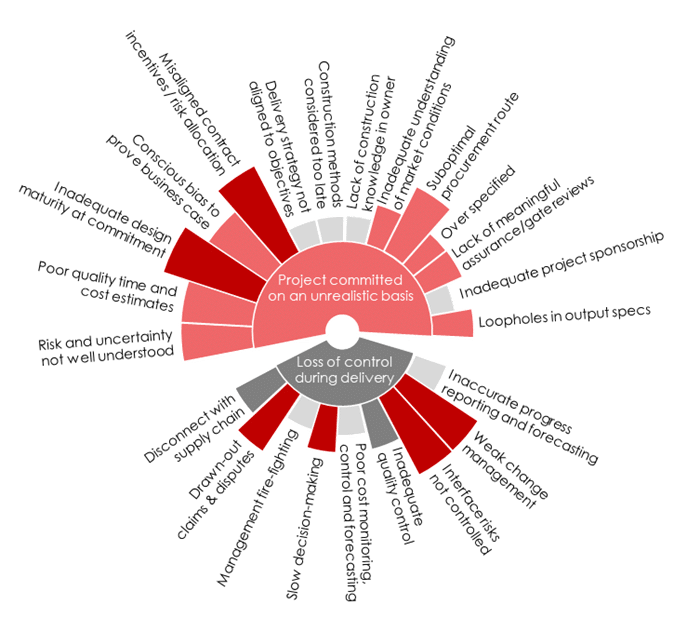
Causes of project failure
The evidence is clear: setting a project off on a sound basis is the most effective way to achieve a successful outcome. But this offers little comfort to those leading projects that have already veered off track. Thankfully, regardless of how the project ended up in trouble, there are five key levers that project leaders can employ to turn projects around. Each comes with its drawbacks and risks – there are no “silver bullets” – but these need to be weighed up against the wider benefits of bringing the project back on track.
Accelerate / resequence the works
- This typically involves deploying a combination of measures in an attempt to speed up works and reduce the overall project timescale. Such measures may include opening more workfronts or moving to seven-day working – if permitted by local rules and regulations. Logistical challenges, management capacity and the impact on the workforce must be carefully considered, however.
- This lever is often the first a project team will activate, but that is a mistake. Acceleration inevitably increases the risk profile of a project, and the impact this has on project cost is almost always hugely underestimated.
Descope / defer scope
- This option is much harder to choose, but it can be a very effective way to secure a project’s timescales or budget. Look again at the project’s business case. Which parts of the project can be done later, or even dropped altogether, with minimal impact on the asset’s use/performance?
- Normally, this method will require negotiations with the project owner, operator and/or end user, requiring stakeholders to collaborate on solving the problem with a “win/win” mindset.
- Owners should be aware that the project might ultimately cost more overall due to the need for temporary works, remobilisation, extended preliminaries, inefficiencies of working once the site is operational, etc. Of course, such considerations must be weighed against the strategic and economic benefits of deferring scope and opening parts of the project on time.
Improve cash flow through the supply chain
- Cash acts as the project’s lifeblood circulating through the supply chain, keeping materials, equipment and labour flowing to the site. The rate and predictability with which cash flows through the supply chain can have tremendous impact on delivery timescales.
- Moving cash to suppliers more quickly and more frequently helps put the project “first in the queue” when dealing with them. It keeps teams and equipment on site, minimises lead times for materials and avoids suppliers holding back on progress to manage their own cash flow.
- Unfortunately, all too often, the opposite action is taken: payments are withheld in an attempt to coerce suppliers to work harder or faster. It almost never works.
Renegotiate commercial agreements
- Often, when one party finds itself on the raw end of a deal, it slows down or even halts its contribution to a project, whether as a result of management indecision, risk aversion or de-prioritisation of the project.
- When this happens, the other parties need to think “win/win” – get to the negotiating table to explore how to alleviate the casualty’s pain, for the overall benefit of the project. For example, a developer might offer a contractor an increase in budget in return for faster delivery.
- This requires a mature, collaborative and strategic mindset from all parties involved. Resolving outstanding claims and variations quickly to put the focus back on delivery is a vital step. Otherwise project leaders can become distracted by demands for updates on such matters, which can also block investment in acceleration measures.
Improve quality and get things right first time
- This is a particular challenge where projects involve innovative designs or methodologies, something that is becoming more commonplace as owners strive for better sustainability performance, striking designs and minimal impact on the local environment.
- Project teams should focus on two things:
- Stop making the same mistakes – undertake a methodical root-cause analysis to understand what is causing the problems, and identify and implement effective solutions.
- Plan high-stakes activities rigorously – carry out detailed planning and rehearsals for complex and critical site operations, especially those that involve some novelty, to ensure everyone understands their part and that all risks have been identified and mitigated.
Of course, which lever to apply depends on the root of the problem. And each comes with a trade-off, whether on project cost, timescales, quality or benefits.
In all cases, to turn a project’s performance around, leaders must reinforce management and controls. In our experience, there are four key practical steps that project leaders can take to help put a project back on track:
- Establish a tiger team, gathering the best people from across the business to bring drive, expertise and fresh perspectives. This should include customers or suppliers too, where appropriate.
- Set a 100-day turnaround plan, with measurable activities every day and clear objectives or milestones every week, to bring clarity, focus and pace.
- Co-locate the client, contractor and supply chain management teams in order to boost collaboration and dramatically accelerate decision-making and problem-solving.
- Increase the management tempo, with daily meetings to drive progress and eliminate obstacles by making sure decision-makers are well-informed quickly.
Above all, timely action is critical. All too often, project teams squander valuable time in denial about the situation, hopeful that project performance will recover with just a few small tweaks here and there. However, more often than not, projects veer further off course if they are not quickly reined in. Taking well-informed, bold and decisive action as early as possible provides the best chance of success.
By Mathew Hazenberg, Director, Accuracy