As the first month of Trump’s second presidency comes to a close, let’s take a look at how the rest of the world perceived his return to power.
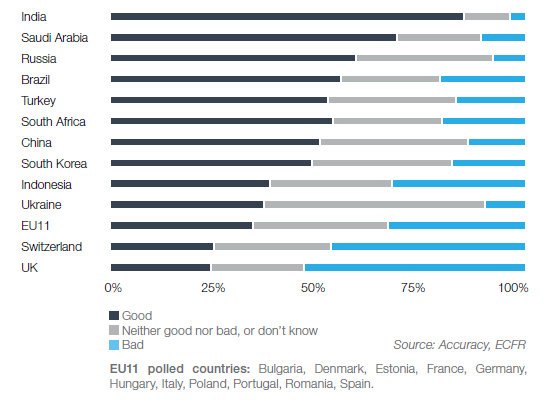
A poll undertaken in November 2024 by the European Council on Foreign Relations (ECFR), a think tank, resulted in a number of fascinating findings. When asked whether Trump’s return would be good or bad for Americans, the majority of respondents answered in the affirmative, particularly so in India and Saudi Arabia. Somewhat surprisingly, the most negative responses came from long-standing allies of the US, such as the UK and EU member states. This striking result suggests a schism in the West, one that Trump’s time in office since his election, with policies like a proposed takeover of Greenland, has done little to rectify.
Do you think the election of Donald Trump as US president is a good or a bad thing for US citizens? (%)
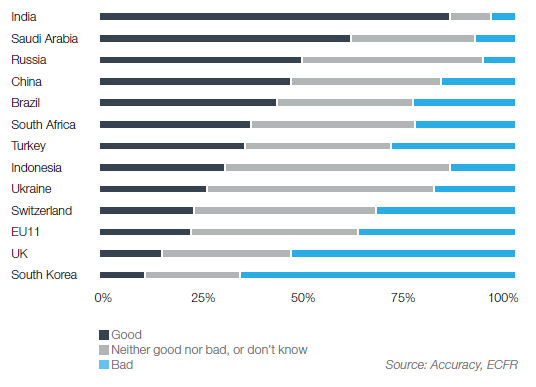
These findings were mirrored closely by the respondents’ answers to the question of whether Trump’s return would be beneficial to their own countries. Again, India and Saudi Arabia appeared the most optimistic. However, after Trump’s recent comments on Gaza, it would not be unreasonable to question whether the Saudis remain so positive. The most significant difference between the two questions can be attributed to South Korea: only 11% of Koreans polled thought that Trump’s return would help their country. Indeed, their reliance on the US for defence purposes, combined with Trump’s campaign slogan of ‘no new wars’, may well be behind this gloomy mentality.
Do you think the election of Donald Trump as US president is a good or a bad thing for your country? (%)
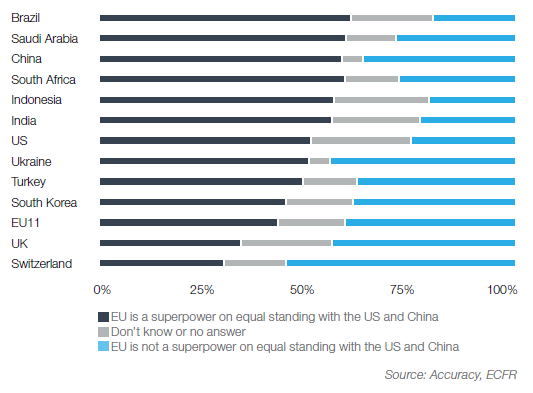
The poll also chose to question participants on their view of the European Union and its place in a changing world. When asked whether the EU was a global superpower on equal footing with the US and China, the vast majority of respondents replied that it was. Interestingly, BRICS countries (with the exception of Russia) held this position most emphatically. By contrast, EU member states themselves, as well as neighbours in the form of the UK and Switzerland, held the poorest views of the Union.
Which position best reflects your view on the EU’s global standing? (%)
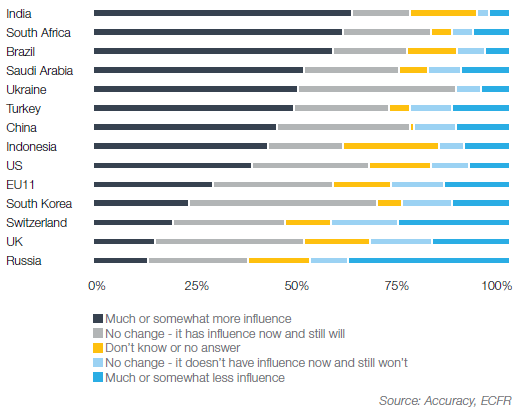
Furthermore, when questioned over the EU’s standing in the future, the majority of responses affirmed that its influence was likely to grow or at least remain at the same level. Once again, the BRICs countries seemed to consider the strength of EU influence most favourably, and the Europeans appeared the most disinclined to believe it. One glaring exception was Russia. Indeed, respondents from the country believed that the EU’s influence is set to wane. This most likely reflects tensions linked to the EU’s anti-Russian stance following the onset of war in Ukraine. Perhaps Russia’s survival in the face of extreme adverse policies imposed by the West have led Russians to question the extent of European influence in the world today.
How do you think the EU’s global influence will change over the next decade? (%)