

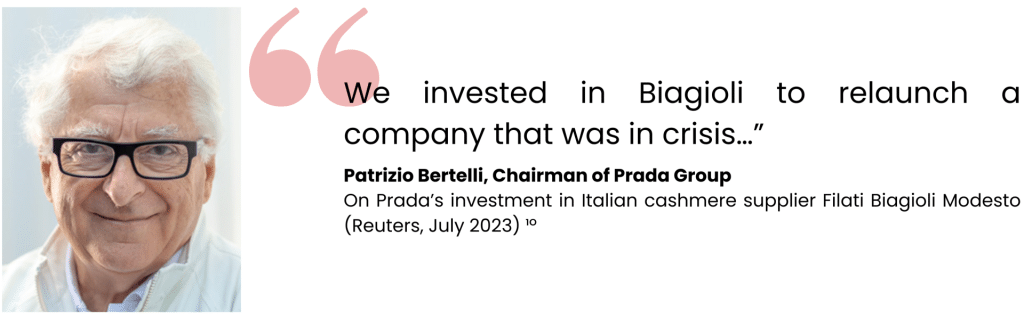
Leading luxury houses are acquiring specialist suppliers at an accelerating pace, taking stakes in tanneries, silk mills, eyewear manufacturers, and fine jewellery producers across Italy and France. According to public data, 2025 alone saw Chanel, Kering, and Prada each invest in multiple manufacturing partners spanning silk, leather, footwear, metal accessories, eyewear components, and fine jewellery. This concentration of upstream deal activity comes without recent precedent. The rationales converge on a single logic: securing direct control over capabilities that the market appears increasingly unable to preserve.
Yet the strategic case for integration, however compelling, is no guarantee of success. This article examines what economic theory predicts about vertical integration and when it creates or destroys value; how the current wave of luxury upstream acquisitions maps to that framework; and what the competitive and regulatory implications are as consolidation accelerates.
Why are luxury groups moving upstream?
The artisanal supply base on which European luxury depends has deteriorated rapidly in recent years. In Italy’s Tuscan leather cluster, for example, over 300 companies closed in the first half of 2024 alone, with a sharp acceleration of shutdowns in the Florence–Pisa area affecting well over 1,600 workers. ¹ More generally, in the first three quarters of 2024, more than 2,000 clothing, textile, and leather goods factories closed across Italy. ²
Three structural forces underlie this fragility. First, regulatory pressure: the EU’s Ecodesign for Sustainable Products Regulation (ESPR) ³ and its forthcoming Digital Product Passport (DPP) requirements mandate supply-chain traceability that micro-enterprises are structurally ill-equipped to deliver. The average European tannery employs just 21 people, and water resource management alone already absorbs over 60% of Italian tanneries total environmental expenditure. ⁴ Second, a generational succession crisis: France’s métiers d’art sector has lost at least 25,000 salaried positions since 2009, ⁵ and 41% of enterprises now have at least one person over 55 holding essential know-how with no succession plan. ⁶ Third, a widening talent gap: the Altagamma Foundation estimates that the Italian luxury sector requires 276,000 additional workers by 2028, with fashion and accessories already the hardest category to fill; 47.5% of these positions went unfilled in 2023. ⁷
Against this backdrop, a surge of liquidity following the 2021–23 luxury boom created both the means and the urgency to act. LVMH reported a record €86.2 billion in revenue in 2023 ⁸; Chanel reported $19.7 billion, its highest ever, following three consecutive years of double-digit growth. ⁹ Capital was available precisely when the supply base was most vulnerable.
Make or buy: what does economic theory tell us?
Economic theory offers a framework for evaluating when vertical integration creates value and when it does not. The central question is not whether a luxury group desires control, but whether ownership is the most efficient mechanism to secure it.
Transaction cost economics ¹¹ identifies three conditions under which ownership dominates arm’s-length contracting:
- Asset specificity: when an input requires relationship-specific investment that cannot be redeployed, the risk of hold-up by one party exploiting the other’s sunk investment makes market contracting fragile.
- Contractual incompleteness: when the aspects of quality or know-how transfer cannot be fully specified in a contract, price signals fail to align incentives.
- Uncertainty: when regulatory change, demand volatility, or environmental disruption makes long-term supply agreements unreliable, hierarchical control offers resilience that contracts cannot. In the context examined in this article, this uncertainty primarily takes the specific form of input foreclosure risk, whereby scarce upstream suppliers may be pre-empted or locked up by vertically integrated rivals.
Property rights theory ¹² adds a complementary lens: when contracts are incomplete, the party that makes the most critical non-contractible investments should hold residual ownership rights. If a luxury group funds a tannery’s ESG upgrades, installs traceability infrastructure, and trains the workforce, arm’s-length contracting leaves it exposed, and the supplier retains the right to exit or sell to a competitor. Ownership addresses this directly.
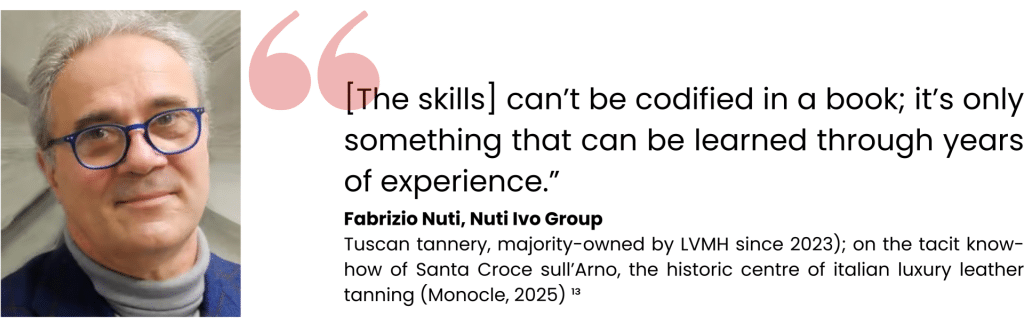
All three conditions apply with unusual intensity to luxury artisanal supply chains. When craft know-how is geographically concentrated in a single valley, held by an ageing family of four, or embodied in tacit technique rather than codifiable process, for example, it becomes an input of extreme asset specificity. Few contracts can fully specify what a skilled currier does, or how a master silk weaver reads the material. And the regulatory, demographic, and geopolitical pressures described above make long-term supply security solely through the market increasingly unreliable.
However, theory is equally clear about when integration fails. Ownership is sub-optimal when inputs are sufficiently standardised that multiple suppliers compete on quality and price; when the target’s value depends on entrepreneurial autonomy that corporate absorption destroys; or when integration complexity exceeds the governance benefit.
In these circumstances, three alternative governance structures may outperform vertical integration, though each carries distinct trade-offs:
- Co-investment and long-term offtake agreements share ESG upgrade costs and secure capacity without ownership transfer, but they leave the investing party exposed if the supplier fails or is acquired by a rival.
- Joint ventures and shared specialist hubs (common in aerospace and semiconductors) pool R&D and production while maintaining supplier plurality, but they require complex governance and create intellectual property sharing risks.
- Buyer-led supplier development programmes elevate standards across the ecosystem but generate free-rider problems: capability improvements made in an independent supplier benefit all buyers who source from it.
Therefore, the choice between ownership and these alternatives is less a matter of preference than a function of asset specificity, contractibility, and the relative cost of governance failure under each model.
How do luxury houses’ acquisitions fit in this economic framework?
The deal rationales articulated by luxury groups align closely with the economic conditions that justify integration. Three recent transactions illustrate the pattern:
- LVMH Métiers d’Art’s increase of its stake in Riba Guixà, a century-old Catalan tannery, to 80% in May 2024 was framed around sustainable and innovative manufacturing. ¹⁴
- Prada, in June 2025 acquiring a 10% stake in Rino Mastrotto, one of Italy’s premier leather tanneries, cited the need to strengthen control “over a highly strategic phase of the production process”. ¹⁵
- Kering, completing its third upstream eyewear acquisition in three months with the purchase of sun lens manufacturer Lenti, described the move as “a milestone” in building internal industrial capabilities. ¹⁶
Each rationale maps to a distinct element of the economic framework. LVMH’s ESG framing reflects the compliance cost burden: owning the supplier can be among the most reliable mechanisms to ensure environmental standards are met and to internalise the return on modernisation investment. Prada’s language around production control reflects contractual incompleteness: “highly strategic phases” are precisely those whose quality dimensions resist specification in an arm’s- length contract. Kering’s capability language reflects asset specificity: lens-polishing or stone-setting expertise, once the practitioners retire or the workshop closes, is rarely recoverable through the market.
Nevertheless, not all upstream acquisitions satisfy this theoretical test equally. There is an important distinction between capability-securing transactions, where the target holds truly non-replicable know-how and ownership is the only credible mechanism to prevent its permanent loss, and capacity-securing transactions, where the target provides specialised but ultimately substitutable manufacturing capacity. The former meets the conditions for ownership identified by theory; the latter may not. Poorly calibrated integration risks internalising fragility by absorbing an under-resourced supplier’s ESG exposure, key-person dependency, and scalability constraints, for example, without strategic benefit. An entry cost to ownership is worth weighing explicitly against the strategic benefit of control.
What does this mean for future developments in the luxury industry?
As upstream consolidation accelerates, its implications extend beyond individual corporate strategy into the competitive architecture of luxury supply markets and the adequacy of the regulatory frameworks intended to govern them.
EU competition law was not designed with artisanal supply chains in mind. When a dominant luxury group acquires the only supplier of a genuinely non-replicable craft capability, the transaction will typically fall below the EU and national notification thresholds and therefore escape ex-ante merger control. ¹⁷ However, the Towercast ruling in March 2023 ¹⁸ confirms that national competition authorities may review non-notifiable mergers ex-post where the acquirer holds a dominant position. Several EU member states are also considering or have already introduced call-in powers to review potentially problematic mergers even below standard thresholds. From a substantive standpoint, the Commission’s draft Merger Guidelines, released for public consultation on 30 April 2026, explicitly address this capability foreclosure gap by incorporating non-price parameters, such as craftmanship, innovation and sustainability into the ex-ante merger control framework. ¹⁹
The challenge remains structural: competitive harm from supplier extinction is cumulative and slow-moving, which is precisely the kind that falls between the cracks of merger control. Merger control is in fact calibrated to detect acute market distortions rather than the gradual erosion of an artisanal ecosystem. It has historically focused on price and output rather than non-price parameters like sustainability, lead times, and the preservation of rare know-how. When a specialised supplier closes, irreplaceable know-how exits the market permanently, and the damage falls hardest on smaller brands that cannot afford to integrate upstream themselves. A more appropriate regulatory response may not be reflexive prohibition, which risks accelerating the very closures it seeks to prevent, but a more nuanced assessment that weighs a ‘theory of benefit’ (preserving fragile capabilities and enhancing resilience) against the risk of anticompetitive effects, in particular foreclosure. As the Commission’s latest draft guidelines suggest, while integration can stabilize an ecosystem, it may also harm competition if rivals lose access to essential inputs, like high-quality hides or stone-setting capacity.
For luxury groups, the practical implication points in a fairly clear direction: proactive governance of acquired capabilities (transparent capacity-allocation policies, non-discriminatory access terms for independent brands, published sustainability standards) can be both strategically sound and competitively defensive. The OECD Supply Chain Resilience Review (2025) finds that the most effective supply chains are those where shared interests among firms and stakeholders are embedded in governance, not left to goodwill. ²º
The optimal path for each group ultimately depends on a rigorous, asset-by-asset assessment:
- Is the capability truly non-replicable?
- Does the target’s fragility stem from structural market failure (such as ESG costs, succession risk, demand volatility) or from operational weakness that integration cannot fix?
- Are intermediate governance structures available that would secure the capability with less ecosystem disruption?
These questions sit at the analytical core of a decision that is likely to shape the competitive landscape of luxury manufacturing for decades.
In an era where supply chain transparency, ESG performance, and artisanal authenticity are increasingly material to brand value, luxury’s long-term competitive advantage may depend as much on the health of its upstream ecosystem as on the creativity of its design studios. Ownership is sometimes the right answer. Stewardship, whether through ownership, partnership, or investment, is the broader commitment worth making.
Pascale Déchamps – Partner, Accuracy
Jimmy Lam – Senior Manager, Accuracy
Vertical integration in luxury: control, risk and the ecosystem crossroads