
Sino-European industrial partnerships are materialising at a time when industrial power relations are being profoundly reshaped. Far from being confined to the logic of economic cooperation, they increasingly serve as instruments for structuring technological, normative and decision-making power.
This evolution reflects a transformation in the foundations of industrial sovereignty. Today, such sovereignty lies in control of the ecosystem architectures on which innovation, investment and market access depend: interfaces, standards, platforms and learning flows.
In this context, partnerships function as trajectory-setting mechanisms. They allow for a gradual build-up of capabilities in complex systems through joint learning, ecosystem integration and privileged access to architectural processes. These dynamics facilitate the acquisition of critical skills linked to value-chain orchestration and the definition of technological benchmarks.
Standardisation plays a central role. By fixing interfaces, protocols and compliance criteria, it steers industrial development and locks technological choices into long- lasting frameworks. When coupled with technological platforms, standards become embedded in shared software environments, interfaces and development tools used by all players, thereby structuring the ecosystem and making dependencies difficult to reverse.
These mechanisms generate cumulative effects.
Dependencies emerge gradually, through a succession of decisions that are rational locally, with no visible transfer of control. As long as jobs and investment are preserved, the strategic risk remains largely invisible. Once architectures are stabilised, however, reversibility becomes severely constrained.
Europe is therefore exposed to the risk of losing its industrial orchestration capability. It may retain production capacity while progressively losing control over the technological and normative frameworks that determine its evolution. This growing disconnect between production and decision-making lies at the heart of contemporary industrial sovereignty.
The challenge, then, is Europe’s ability to articulate a doctrine for strategic partnerships. This requires treating alliances as sovereignty commitments; governing learning and architectural flows; rebuilding normative capacity linked to reference platforms; and embedding access to the European market within a logic of strategic reciprocity.
Europe still possesses substantial assets: technological capital, industrial depth, regulatory capacity and market power. Whether it can mobilise them depends on its ability to govern its alliances and control the industrial trajectories they help to shape.
From industrial partnership to instrument of power
Sino-European alliances are often presented as pragmatic responses to the constraints of electrification, rising technological costs and the fragmentation of global markets. Shared investment, reciprocal market access and accelerated innovation: the dominant narrative remains one of rational cooperation between firms facing a major technological rupture.
Yet this assessment is incomplete – and arguably misleading. Behind the consensual language of partnership lies a deeper reconfiguration of industrial power relations. Alliances, cross-shareholdings and joint ventures are no longer merely tools for economic optimisation; they have become structuring vectors of power, capable of durably shifting technological, normative and decision-making centres of gravity.
China’s strategy is distinctive because of the systemic coherence of its arrangements. Each partnership is designed as a building block within a wider architecture: accelerated learning, integration into European ecosystems, normative diffusion and the gradual construction of industrial dependencies. Considered individually, such agreements appear balanced; aggregated over time, they quietly redraw industrial hierarchies.
For Europe, the stakes extend well beyond short-term economic performance. They concern control over technological trajectories, governance of industrial platforms and the ability to remain a rule-setter rather than a rule-taker. This article therefore examines Sino- European partnerships not as contingent arrangements, but as instruments of power recomposition, and sketches the foundations of an industrial sovereignty doctrine adapted to this new landscape.

From transactional to strategic partnerships
1. Partnerships as instruments of power
As value chains grow more complex, architectures become more digital and standards increasingly determine market access, industrial partnerships have become a key vector in reshaping sovereignty¹.
This is particularly evident in the automotive sector, which sits at the intersection of electrification, embedded software, data and platforms. The automotive industry has thus become a strategic arena, concentrating issues of economic security, technological control and normative positioning within a fragmented international system.
The relevant question, therefore, is no longer whether Europe should cooperate with China, but under what conditions does such cooperation preserve, or undermine, Europe’s ability to control its industrial trajectories.
2. From commercial competition to systemic rivalry
China’s approach to the European automotive sector has transformed: where previously it followed a logic of export-led expansion or opportunistic investment, now it forms part of a long-term industrial policy aimed at securing architectural positions, exerting normative influence and controlling platforms. Partnerships play a central role, providing access to ecosystems, organisational learning and progressive integration into critical value chains.
This dynamic aligns squarely with what the European Commission labels “economic security”². In addition to competitiveness, the issue has grown to include the capacity of advanced economies to retain control over strategic technological assets amid mounting geo-economic rivalry.
The asymmetry is structural. Chinese firms act within an integrated, state-backed strategy, combining industrial policy, normative diplomacy and financial support. By contrast, European firms still tend to approach these alliances through largely commercial and operational lenses.
3. Industry sovereignty as a trajectory problem
The core risk does not lie in sudden asset loss, but in the gradual displacement of architectural power. Industrial sovereignty is therefore less about owning production facilities than about defining technological benchmarks, structuring ecosystems and steering innovation trajectories.
This marks a profound shift. Where classical strategies focused on industrial relocation and asset ownership, today’s logic prioritises ecosystem orchestration and technological alignment around dominant reference frameworks.
Alliances thus become trajectory-setting devices. They may underpin lasting strategic autonomy or quietly organise functional dependency without any visible transfer of control. This ambivalence sits at the heart of Europe’s dilemma. OECD³ and Bruegel⁴ research converges on a crucial insight: such dependencies rarely arise from explicit strategic choices. Instead, they result from the cumulative effect of locally rational decisions taken without consolidated assessment of their systemic consequences.

Accelerated learning and capability transfers
1. From technical learning to dependency trajectories
Industrial learning is often portrayed as a neutral process: skill-sharing, best-practice diffusion, organisational maturation. This view is misleading. In complex-system industries, learning is the first step in a strategic dependency trajectory.
What is at stake in Sino-European partnerships goes well beyond skills transfer. It concerns the ability to integrate heterogeneous systems, define architectural benchmarks and orchestrate complex value chains – precisely where modern industrial sovereignty resides.
Learning thus becomes a mechanism of gradual capture. Each joint project, shared platform or co-designed validation process brings the ecosystem closer to a tipping point, where formal autonomy remains but functional dependence is already embedded.
2. Architectural power as the core sovereignty
In today’s automotive industry, strategic value lies in architectures, where previously it arose from components⁵ : Control over interfaces, protocols, validation frameworks and software environments confers structuring power over the ecosystem, shaping innovation, directing investment and locking in technological paths.
China’s strategy is to access this architectural core through joint learning⁶. By participating in European integration processes, Chinese firms internalise organisational routines and governance frameworks for managing complex systems. These capabilities are then redeployed within their own platforms, generating asymmetric convergence⁷.
The lesson from platform and dynamic-capabilities research is clear: lasting competitive advantage stems not from isolated innovation, but from the ability to structure entire ecosystems.
3. Invisible accumulation and political irreversability
The most insidious aspect of these mechanisms is their political invisibility. Each partnership appears manageable; each transfer marginal. Yet their aggregation produces powerful cumulative effects. Instead of being formally decided, dependencies emerge through the addition of choices that are rational in isolation but destabilising in combination.
This dynamic creates a major political issue. As long as employment is preserved and investment remains visible, strategic alarm bells do not ring. However, once dominant architectures are entrenched and critical competencies have shifted, reversibility becomes prohibitively costly. Dependency is then a fait accompli.
Recent analyses from the OECD⁸ and MIT⁹ on complex value chains have demonstrated that these pathway effects constitute one of the main mechanisms for loss of technological sovereignty in advanced industries.
Industrial sovereignty, in short, is lost through the gradual displacement of architectural power, not through takeovers or offshoring.
Understanding this mechanism is crucial. For it is at this stage – whilst the situation is still reversible – that Europe’s ability to remain in control of its industrial trajectory is largely determined.
Standards as instruments of lock-in and industrial power
By fixing interfaces, protocols and compliance criteria, standards guide industrial development and channel investment towards compatible technologies, often long before regulatory decisions are taken. In doing so, they embed technological choices in durable frameworks and act as early lock-in mechanisms.
Electrification and vehicle digitalisation have triggered a new wave of standard-setting. Vehicle-infrastructure connectivity, battery and charging standards, software frameworks and data governance now define the architectures of tomorrow.
China entered this arena early, aligning industrial policy, normative diplomacy and technological strategy. Indeed, China Standards 2035 explicitly seeks to embed Chinese- origin standards at the core of global architectures¹⁰. In the automotive sector, this strategy is being systematically rolled out across three key areas: vehicle connectivity, infrastructure and battery standards ¹¹,¹².
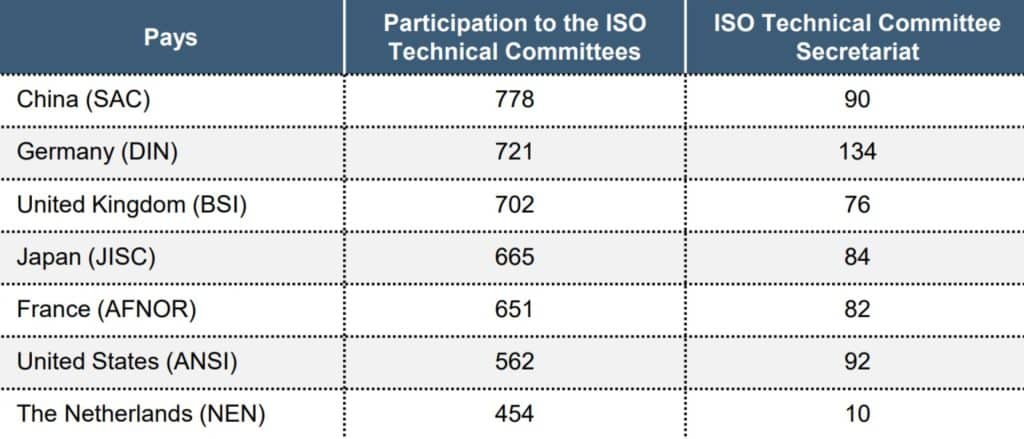
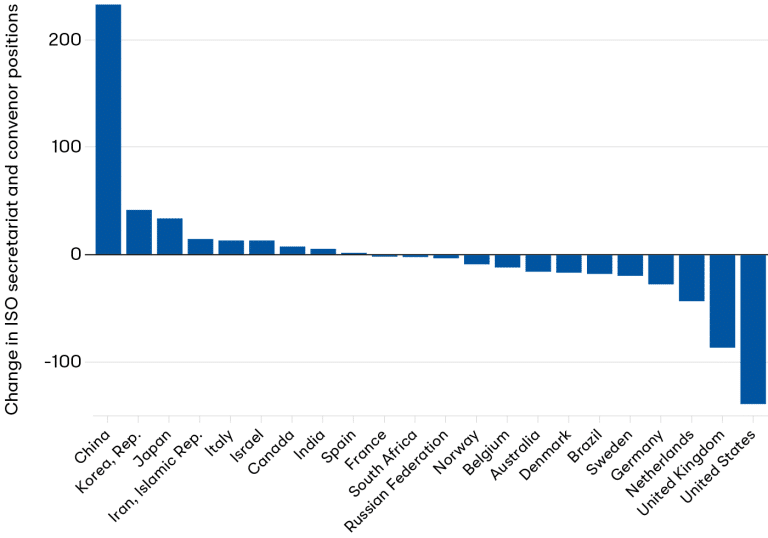
Active participation in international standard-setting bodies (ISO¹³ , IEC and WP.29¹⁴) allows Chinese actors to shape technical benchmarks at the point of definition.
Figure 1: Number of members and secretarial roles in ISO Technical Committees by country as at 31 March 2025¹⁵
Source : Compilation of authors based on data from ISO technical committees. See: ISO, ISO Technical Committees Metadata, May 2025
By relying on partnerships and joint ventures with Europe rather than imposing proprietary standards outright, China is implementing a strategy of gradual convergence, aligning interfaces and protocols with solutions compatible with Chinese platforms. Once architectures stabilise, switching costs become prohibitive¹⁶.
This mechanism has been seen before in other strategic sectors, in particular semi conductors¹⁷ and digital infrastructure¹⁸. The lesson is consistent: dependency rarely results from shocks but from cascades of rational, incremental decisions taken without systemic foresight.
Figure 2: Number of members and secretarial roles in ISO Technical Committees by country as at 31 March 2025¹⁹
Source : United States Studies Centre, Standards Development Organisations in an Era of Strategic Competition, December 2024
For Europe, the choice is stark. Either it remains a rule-setter in technological frameworks, or it becomes a standards-taker, integrating platforms and trajectories it no longer controls.
Standardisation has thus become one of the decisive battlegrounds of 21st-century industrial sovereignty.
The risk for Europe is the gradual loss of its ability to set its own agenda. By relying on platforms and software environments designed elsewhere, Europe reduces its ability to shape its own path of innovation. Sovereignty no longer lies in individual components, but in control over the frameworks within which innovation takes place.
For the European automotive industry, the challenge is therefore less about avoiding any and all cooperation than about preventing the irreversible establishment of organised dependencies.
Systemic risks of organised dependecy
1. Erosion of industrial orchestration capacity
The first – and still largely underestimated – risk is the erosion of Europe’s capacity for industrial orchestration. Unlike the learning dynamics discussed earlier, this phenomenon operates at a macroeconomic and political level. Its deceptiveness is central to its danger. Investment remains visible, employment is maintained and the transition appears manageable. Yet strategic value steadily migrates towards intangible assets that escape public scrutiny: software, data, intellectual property, technical standards, brands and, above all, platform governance. It is these layers that now concentrate the power to shape long-term industrial choices and national competitiveness²º.
In advanced economies, industrial value is shifting toward intangible assets: software, data, design, branding, and organizational capital. Between 2023 and 2024, global investment in intangible assets rose by around 3%, compared with barely 1% growth in tangible investment.
Since 2008, investment in intangibles has expanded 3.7 times faster than investment in physical capital, now accounting for roughly 13.6% of global GDP, against 11% for tangible assets.
China illustrates this trajectory with particular clarity. In 2024, it ranked first globally in invention patents granted in the “core digital economy”, with more than 500,000 patents approved, a 23.1% year-on-year increase that far exceeds the global average growth. More striking still, China now holds close to 60% of global AI-related patents, demonstrating its commitment to developing the strategic foundations of the digital economy²¹,²². These figures reflect the scale of Chinese R&D, as well as deliberate concentration on the intangible layers that increasingly structure industrial power.
As Europe integrates architectures, platforms and technological benchmarks designed elsewhere, it may preserve production capacity while progressively relinquishing control over its innovation pathways. Instead of deindustrialisation, the risk is one of relegation: Europe becomes a high-performing system integrator, one that is competitive yet structurally dependent and unable to define its own reference architectures.
2. Cross-dependencies and latent geopolitical vulnerabilities
Over time, these industrial dependencies generate latent geopolitical vulnerabilities.
Control over software environments, update cycles, critical interfaces and strategic data flows provides channels of indirect influence that remain largely absent from traditional economic-security analysis.
In an era of intensified technological rivalry, the line between cooperation and systemic exposure becomes dangerously thin. Recent experience with critical supply chains and digital dependencies has shown how assets once regarded as purely industrial can rapidly become instruments of political leverage²³.
The cumulative nature of these dependencies is what makes them particularly problematic. Taken individually, each partnership appears manageable; each platform integration or data-sharing arrangement seems controlled. In aggregate, however, the accretion of dependencies – across platforms, standards, data and maintenance – creates a threshold effect. Beyond a certain point, reversibility vanishes.

Towards a european doctrine of strategic partnerships
1. Reframing alliances as instruments of sovereignty
The first requirement is conceptual. Any structuring industrial alliance must now be understood as a sovereignty commitment. In a context of intensified technological rivalry, partnerships can no longer be assessed solely in terms of short-term economic gains or operational synergies. They should instead be analysed as trajectory devices: what forms of dependency do they create? Which critical assets do they expose? What strategic capabilities do they mobilise or relinquish over a ten- to fifteen-year horizon?
This reframing implies a change of method. Each strategically significant partnership should be subject to a consolidated ex-ante assessment, extending well beyond financial flows to integrate learning and capability transfers, access to architectural layers and platforms, data governance arrangements, and normative and standard-setting implications. Far from restricting cooperation, the objective is to embed it within a controlled trajectory of industrial sovereignty.
This approach is increasingly reflected in European thinking on strategic autonomy. The European Parliament has explicitly underlined that technological partnerships can act as vectors of structural dependency and therefore require systematic risk assessment in light of long-term autonomy²⁴. Research on digital sovereignty converges on a similar conclusion: industrial alliances today are not merely cooperative arrangements, but political instruments shaping interdependence and projecting power²⁵.
2. Actively governing learning and architectural flows
Protection must shift from the purely defensive to the strategic. Sovereignty today is secured by orchestration, rather than by prohibition. This implies mapping critical competencies, identifying sensitive architectural layers and actively governing access to structuring platforms. In this context, every industrial partnership must therefore be treated as a potential mechanism for dependency creation or, indeed, limitation.
Partnership governance should explicitly address dynamic intellectual-property clauses, data localisation, control of software environments, oversight of organisational learning and access to critical layers of system integration. Such mechanisms already exist in embryonic form within Europe’s emerging economic-security and investment control toolbox²⁶. They must now be extended to industrial cooperation, which remain largely outside the scope of explicit European strategic doctrine.

3. Rebuilding normative power and platform-centred capacity
Reasserting influence in standard-setting requires sustained investment in normative arenas, close coordination between industry and public authorities, and a systematic European presence in international technical committees. Past experience offers clear warnings. In semiconductors, Europe’s delayed positioning on critical architectures allowed dominant standards to emerge elsewhere, leaving it dependent on value chains it only partially controls. In digital technologies, the absence of sovereign operating systems and cloud platforms has entrenched structural reliance on non-European architectures.
The lesson is clear: normative power cannot exist without platform power. Standards gain traction when they are anchored in robust technological solutions that structure ecosystems, guide innovation paths and accelerate market adoption.
The governance of partnerships must incorporate clauses on intellectual property, data localisation and control over software environments, as well as oversight of organisational transfers and access to critical layers. Instead of in capital, sovereignty lies in control over knowledge flows, interfaces and standards. This interplay between standards and platforms provides a strategic lever for steering technological trajectories and strengthening European competitiveness.
4. Instituting a doctrine of strategic reciprocity
Europe’s market openness must be recast as a lever of strategic negotiation. Reciprocity has long been understood in terms of trade balances, where it was possible to adjust tariffs or investment volumes. When faced with a hostile power, acting reciprocally amounted to choosing isolation. This framework now appears limited and inadequate in an environment shaped by technological dependencies and industrial structures.
In an economy structured by such dependencies and architectural control, reciprocity means conditioning access to the European market on verifiable commitments: balanced technology transfers, compliance with European normative frameworks and reciprocal access to strategic infrastructures. In a fragmented international environment, unconditional openness becomes a structural vulnerability. This analysis aligns with the conclusions of the Draghi Report, which stresses the need for a coherent European approach to safeguarding competitiveness and strategic autonomy²⁷. Europe already possesses under-used instruments: the Foreign Subsidies Regulation, investment-screening mechanisms, and emerging anti-coercion tools. The challenge lies in coordinating their use and articulating them within a coherent strategic doctrine.
A European doctrine of strategic reciprocity requires effective coordination between actors who are currently fragmented. The European Commission (DG TRADE, DG COMP, DG GROW) manages trade and competition tools; member states oversee industrial policy and investment control; regulators and sectoral agencies hold granular technological knowledge; firms alone grasp the operational realities of partnerships.
Yet these different levels still operate largely in silos. Each perceives only part of the risk, preventing the emergence of a shared, forward-looking assessment of dependency trajectories.
Instituting strategic reciprocity thus requires shared evaluation mechanisms capable of integrating these perspectives and projecting medium- and long-term effects. At this stage, coordination ceases to be abstract and becomes an operational condition of sovereignty.
Europe still possesses major assets: technological capital, industrial depth, regulatory influence and market power. If it equips itself with an explicit doctrine for strategic partnerships, it can not only contain emerging dependencies but recover its capacity to act as a rule-setter in the automotive industry of the twenty-first century.

From passive partnership to governed sovereignty
Sino-European partnerships are neither neutral nor purely economic. They are devices for structuring industrial power, capable of durably reshaping technological and normative hierarchies.
Europe’s choice is not between openness and closure, but between passivity and control. An open economy without doctrine becomes an integration space for others’ strategies.
Industrial sovereignty, once measured by asset ownership, is now measured by the capacity to define the architectures that organise assets. It is not lost in visible crises, but along silent trajectories.
If Europe fails to govern its alliances, it risks preserving its production capacity while relinquishing control over how such capacity is used. Europe would effectively continue to produce but no longer decide.
Frédéric Recordon – Partner, Accuracy
Alliances, standards and dependencies – The strategic trap of Sino-European partnerships